

You can find my two-part introduction to the Gospel of John at these two links, and my index/outline for it here; for the previous installment on John 2:1-12, go here.
The Gospel of John: The Sacred Heart (John 2:13-22)
We have passed through the new creation narrative of the early chapters, and the author has also evoked the forging of God’s covenant with the Israelites at Sinai. This brings the Tabernacle to mind, and with it, the Temple, and this is the image that carries us to an event from the beginning of Holy Week. This in turn conjures the final week of Yeshua’s life: the rest of the book will take place in light of Yeshua’s trials before the authorities of both religion (Chanan1 and Qayafah1) and the state (Pilatus1 and Herod). Thus all his acts become exhibits in evidence, and all his preaching becomes testimony. This is one of three major themes of Johannine thought that colors this passage.
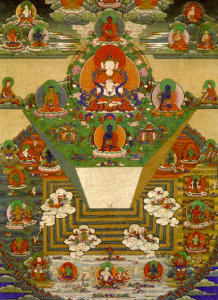
Bhutanese thangka, depicting Mount Meru
and Tibetan Buddhist universe (ca. 19th c.).
The second calls for slightly more explanation. (A post of mine on the architecture of the Temple, “Angels of the Veil,” may be useful background.) Many religions and cultures preserve a holy site as the center of the world: its spiritual center and, sometimes, its literal center. This center has many names and forms: the Greeks held it to be Delphi, which they called the world’s ὀμφαλός (omfalos), its “navel”; it may be associated with a tree, like the Norse ᚣᚷᚷᛞᚱᚪᛋᛁᛚ (Yggdrasil); it is often a mountain, like मेरु (Mount Meru) in the Dharmic religions.2 In Judaism, the Temple was considered a terrestrial copy of God’s heavenly palace, passed on to Moses and Solomon by angels. The Temple was the heart of the Jewish world. What was done in the earthly ectype of the heavenly throne room was implicitly cosmic. Hence, though this event is one of the few which appear in all canonical Gospels, the weight it receives in John is exceptional. In cleansing the Temple, Yeshua is implicitly fulfilling the prophecy of Malachi: “he shall purify the sons of Levi, that they may offer unto the Lord an offering in righteousness.”
But this passage does still more than that, which is our third theme. It equates the Temple itself with another reality, in a manner familiar to many esoteric traditions. The Tanakh declares man to be made by God “after Our image, in Our likeness”; in our text, the incarnated Logos (without preamble) refers to his own body as the Temple. Apart from the mere shocking fact of the Logos‘ embodiment in the prologue, this is the first time that his body is given central emphasis; it will not be the last.
I translated this passage a couple of months ago, for the feast of the dedication of the Lateran basilica (which is the episcopal seat of the pope). I made a few choices resulting in differences of wording this time, and my commentary has a different focus; if you’re interested in reading my previous translation and commentary as well, you can find that here.
John 2:13-22, RSV-CE
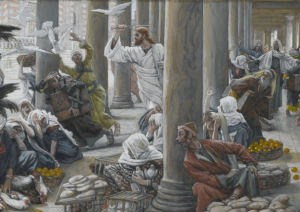
Les Vendeurs Chassés du Temple [The Merchants
Chased From the Temple] (ca. 1890),
by James Tissot.
The Passovera of the Jews was at hand, and Jesus went up to Jerusalem.a, b In the temple he found those who were selling oxen and sheep and pigeons,c and the money-changersd at their business. And making a whip of cords, he drove them all, with the sheep and oxen, out of the temple; and he poured out the coins of the money-changers and overturned their tables. And he told those who sold the pigeons, “Take these things away; you shall not make my Father’s housee a house of trade.” His disciples remembered that it was written, “Zeal for thy house will consume me.”f The Jews then said to him, “What sign have you to show us for doing this?”g Jesus answered them, “Destroy this temple,h and in three days I will raise it up.” The Jews then said, “It has taken forty-six yearsi to build this temple, and will you raise it up in three days?” But he spoke of the temple of his body. When therefore he was raised from the dead, his disciples remembered that he had said this; and they believed the scripture and the word which Jesus had spoken.
John 2:13-22, my translation
And it was near the Jews’ Paskha,a and Yeshua went up into Yrushalem.a, b And he found in the Temple people selling cattle and sheep and pigeonsc and the coin-changersd sitting—and making a whip of cords, he threw all out of the Temple, the sheep and cattle, and he poured out the coins of the moneychangers and overturned their tables, and to those selling pigeons he said: “Take these things out of here, do not make the house of my Fathere a house of commerce.” His students remembered that it is written: “Passion for your house will eat me up.”f
So the Jews responded and said to him, “What sign do you exhibit to us, that you do these things?”g
Yeshua told them in response: “Break up this shrineh and in three days I will raise it.”
Then the Jews said, “Forty-six yearsi this shrine has been being built, and you will raise it in three days?”
Yet this man spoke of the shrine of his body. So, when he was raised from the dead, his students remembered that he said this, and had faith in the Writ and in the word which Yeshua said.
Textual Notes
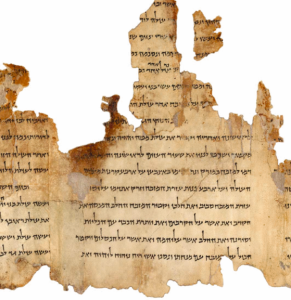
a. Passover … Jerusalem/Paskha … Yrushalem | τὸ πάσχα … Ἱεροσόλυμα [to pascha … Hierosolüma]: Paskha and Yrushalem are my approximations of the Aramaic פַּסְחָא [Pas’châ’] and יְרוּשְׁלֶם [Y’rúsh’lem]. In the text itself, I’ve used kh to transliterate ח instead of my usual ch, hoping to discourage the erroneous pronunciation pasha. Saying it with the sound of ch as in the German Bach or Scots loch is ideal (pass-cha), but next-best is paska.
b. went up to Jerusalem/went up into Yrushalem | ἀνέβη εἰς Ἱεροσόλυμα [anebē eis Hierosolüma]: There were three festivals associated with pilgrimage to the holy city:
- חַג הַפֶּסַח [Chagh3 ha-Pesach], “pilgrimage of the omission,” or Passover, near the beginning of spring, coinciding with the barley harvest;
- שָׁבוּעוֹת [Shâvû3outh], “weeks” (literally “sabbaths”), or Pentecost, around the spring-summer transition and aligning with the wheat harvest; and
- around the autumn equinox, חַג הַסֻּכּוֹת [Chagh ha-Súkouth], “pilgrimage of pavilions,” or the Feast of Tabernacles, coinciding with the harvests of several kinds of fruit (especially figs, grapes, dates, and pomegranates, four of the sacred seven species).
All Israelite males who were able to were required to make a pilgrimage to Jerusalem for these festivals, and to offer sacrifice when they did so. In John, Jesus is represented as visiting the Temple frequently—not only for the pilgrimage festivals, but on lesser observances like Chanukkah as well.
c. oxen and sheep and pigeons/cattle and sheep and pigeons | βόας καὶ πρόβατα καὶ περιστερὰς [boas kai probata kai peristeras]: These were most of the standard animals for sacrifice; goats were also accepted (perhaps “sheep” is meant here as shorthand for both). Jews visited the holy city not only from all over Palestine, but from all over the Mediterranean and far beyond it—there were established Jewish communities as far away as Ethiopia and southern India at this time. Even those who weren’t able to make a pilgrimage to Jerusalem three times every year for these festivals would save up to visit once, or every so often. They’d be likeliest to go either for Passover, as the most important, or for Pentecost, which would probably give travelers the best weather both to and from.
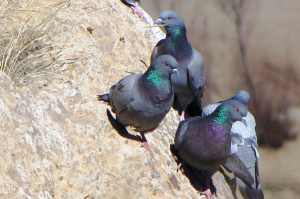
Rock doves, a.k.a. pigeons, in Iran. Photo
by Ramin Shirsavar, used via a CC BY-SA
3.0 license (source).
Traveling with an animal is difficult even today; back then, if it wasn’t a beast of burden, forget it—why make all of your travel more complicated and expensive just for an animal that might die or get stolen on the way, or might prove on examination in Jerusalem to be ritually disqualified? Far better to buy an animal once you arrive. Templar officials obviously recognized this: the bazaar which offered these animals for sale, and which Jesus chases out in our text, was stocked with pre-certified sacrificial animals so pilgrims there didn’t have to worry about being swindled.
Now, a lot of people believe the cleansing of the Temple was done because the officials were swindling people, via the currency exchange. The following is only a hunch on my part—though I suppose we could dignify it with the name “interpretation”; but I’ve never thought that Jesus’ “den of thieves” line had anything to do with cheating people of their money. Offering these pre-certified animals was obviously an extremely helpful thing to do, and I haven’t read any sources suggesting the Temple had any reputation for financial dishonesty. (Personally, I feel that the assumption has an antisemitic ring, but I’m not sure whether I’m being quite fair, since the allusion to Jeremiah can be read literally.) But it didn’t need to be about cheating. There were two other reasons, one practical and one ritual, that this bazaar should simply have been somewhere else.
The ritual point is that there are certain things which are innocent in themselves, but that it still isn’t okay to do when the place you’re doing it is the house of the Lord your God. I suspect that any type of commerce may make that list, for the same reason I find it revolting to see any nation’s flag, including my own, in a Catholic sanctuary.4 The ways the world operates—its systems of both hard and soft power politics—have no place in a space dedicated to the sacred; they are not the economy of grace. “Do not make the house of my Father a house of commerce.”
The practical one (which I first noticed thanks to a paper I was assigned in high school about Mark 11, so thank you, Mr. Feeney!) is that there’s only one place in the Temple this could have been: its spacious outer precinct, known as the Court of the Gentiles. The reason this is a practical problem is that for any inquirers into Judaism, whether they were on their way to full conversion, or were “God-fearers” paying their respects, or were curious about joining those first two groups, the Court of the Gentiles was the only part of the Temple they could come into to pray. Bearing in mind how important etiquette and propriety are in the Near East, it was a shocking act of discourtesy to expect them to do it in a stable—much as it would be shockingly callous to receive a man at the end of a tiring journey, accompanied by his new wife who is very much in labor, and tell them they’re welcome to sleep in the family barn.
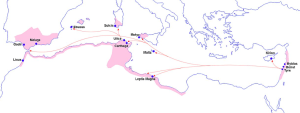
Phoenicia and its colonies in the 3rd-1st
centuries BC. Map by E. Matisoo-Smith et al.,
used via a CC BY-SA 4.0 license (source).
d. the money-changers/the coin-changers | τοὺς κερματιστὰς [tous kermatistas]: The principal currency of the Levant, the shekel (שֶׁקֶל [sheqel]) was originally a unit of weight. It probably became the name of a coin by being “a shekel of silver” (silver being the usual basis of coinage in antiquity5); this unit was used from Edom to Phoenicia and its colonies—in fact, the Carthaginians may have been coining shekels even before the folks back home in Tyre had begun to do so.6 By the first century, the Tyrian shekel was the preferred coinage of the Levant, over the Roman dēnārius or the Greek δραχμή [drachmē];7 this was thanks to the exceptionally, and consistently, pure silver used by the Tyrian mint, a standard which proved steady over centuries. By contrast, the silver content of Roman-minted money tended to fluctuate over decades or even years, usually in the direction of debasement.
The reason this was important was that the Temple was supported by a poll tax (i.e., a tax levied that was equal in absolute amount from every person, not a given percentage of an individual’s income): the amount required was half a shekel per adult male, which at the time equalled about two dēnāriī—two days’ pay for an “unskilled” laborer. This, at least in principle, gave every Israelite an equal “stake” in the Levitical priesthood.
e. my Father’s house/the house of my Father | τὸν οἶκον τοῦ πατρός μου [ton oikon tou patros mou]: We might suppose that this expression would draw notice, and shock, at the time; so it would, but not necessarily for the reason we suppose. The part of this that sticks out like a sore thumb is “my Father.” The idea of God as “our Father” was by no means wholly alien to Judaism, but this implicit claim to some singular kind of sonship is very conspicuous.
However, his speaking of the Temple as the divine “house”—which in some circles might be given a very “Christianity without religion” interpretation—is a standard way of speaking in contemporary Judaism. The normal term for the Temple in Hebrew was בֵּית־הַמִּקְדָּשׁ [Bêyth ha-Miq’dâsh], “the Holy House.” This aligns with the Tabernacle which preceded it: when that was created, the Israelites were a nomadic people who lived in tents; that Tent was exchanged for a House after they had become primarily sedentary.
f. Zeal for thy house will consume me/Passion for your house will eat me up | Ὁ ζῆλος τοῦ οἴκου σου καταφάγεταί με [Ho zēlos tou oikou sou katafagetai me]: This quotation comes from Psalm 69, one of a number of psalms closely associated by Christians with the Passion (Psalm 22 being supreme among these).
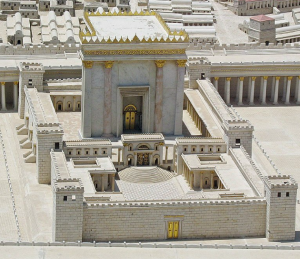
The Second Temple, as depicted in the Holyland
Model of Jerusalem. Photo by Ariely, used via
a CC BY-SA 3.0 license (source).
For thy sake I have borne reproach;
…shame hath covered my face.
I am become a stranger unto my brethren,
…and an alien unto my mother’s children.
For the zeal of thine house hath eaten me up;
…and the reproaches of them that reproached thee are fallen upon me.
When I wept, and chastened my soul with fasting,
…that was to my reproach.
I made sackcloth also my garment;
…and I became a proverb to them. ...
But as for me, my prayer is unto thee, O Lord, in an acceptable time:
…O God, in the multitude of thy mercy hear me, in the truth of thy salvation.
—Psalm 69:7-11, 13
g. What sign have you to show us for doing this?/What sign do you exhibit to us, that you do these things? | Τί σημεῖον δεικνύεις ἡμῖν, ὅτι ταῦτα ποιεῖς; [Ti sēmeion deiknüeis hēmin, hoti tauta poieis?]: The conscious meaning of this question is What sign are you going to show us to justify your conduct? However, all the authors of the New Testament seem to have been fond of wordplay—a taste no doubt encouraged by any training in or practice of midrash8—and would no doubt have picked up on the double entendre, which is What does this sign (the cleansing of the Temple), which you have now done in our presence, mean?
This form of this challenge is unique to the Fourth Gospel. There is a parallel from the Synoptics, in the form “By what authority do you do these things? And who gave you this authority?”, but this goes in a rather different direction; that is, in the short term (see Matt. 21, Mark 11, and Luke 20). We know from Matthew (ch. 26) and Mark (ch. 14) that his reply, equating the Temple with his own body, was the basis of Christ’s condemnation by a special session of the Sanhedrin, and the same thing is suggested, though not stated positively, by the author of Acts (ch. 6). Interestingly, it doesn’t come up again in John. This is one of several choices in John that—well, that suggests, without stating positively, that the Fourth Gospel was literally the fourth, or at any rate was written as a deliberate supplement to one or more gospels that existed already.
However, as long as we’re equating Temple with the body of Jesus, it’s also interesting, and frankly rather funny, that a similar phrase pops up in chapter 6 of John:
Τί σημεῖον δεικνύεις ἡμῖν, ὅτι ταῦτα ποιεῖς;
is paralleled by
Τί οὖν ποιεῖς σὺ σημεῖον, ἵνα ἴδωμεν καὶ πιστεύσωμέν σοι;
(Red, green, and light blue show identical words; dark blue and purple show words with near-identical grammatical function, while orange and brown indicate verbs that describe the same events—”showing” and “seeing”—from opposite points of view.)

The latter means “Then what sign do you do, in order that we may see it and have faith in you?”—the punchline being that this is immediately after he feeds the five thousand, and at least some of those at the synagogue in Capernaum who are now questioning him are people who were there for that miracle, and are now dropping un-subtle hints that they’d like him to do it again. (Come to think of it, we’re told that he made an especially fine vintage of wine, but all we hear about the bread is that it was filling. It’d make sense if it also happened to be really good bread!)
h. temple/shrine | τὸν ναὸν [ton naon]: Three terms are used in this passage for the Temple:
- ἱερόν [hieron], meaning “holy [place], sanctuary, temple,” which is the word the author uses in the narrative—this is what’s called a substantive adjective, where an adjective functions as a noun;
- οἶκος [oikos], the ordinary word for “house,” which is the term initially used by Yeshua; and
- ναός [naos], meaning “temple, shrine,” but related in origin to the verb ναίω [naiō], which meant “to inhabit, dwell in,” so that ναός probably meant “dwelling, home” at first and was later narrowed in application.
It bugs me when English translations do nothing to suggest—and therefore, in practice, conceal—changes in vocabulary within a passage. Granted, they’re not necessarily significant; but sometimes they are, and if the reader doesn’t know they’re there, it can give a false impression of the text’s meaning. And this one is so easy to convey in English! I don’t understand this behavior!
i. forty-six years | Τεσσεράκοντα καὶ ἓξ ἔτεσιν [tesserakonta kai hex etesin]: It is not known what exactly this refers to. Obviously the structure itself was hundreds of years old; it began in 539 BC, and was ready to be consecrated in 516, a period of only twenty-three years (though additional construction and decoration probably continued, possibly down to the end of the sixth century BC). Herod’s renovations began in 19 BC, but that date plus forty-six years would take us to 27 AD. That is at least two years too early according to Luke’s account, which is willing to use round numbers (“about thirty”) for Christ’s age, but dates the opening of St. John the Baptist’s ministry pretty precisely to “the fifteenth year of the reign of Tiberius Cæsar,” whose accession was in 14 AD; and it is only after the Baptist had been ministering for a while that Jesus inaugurated his own mission. On top of which, remember, this event has been transposed to near the beginning of this Gospel, but occurred near the close of said mission, which means that even if the Baptist and Jesus started their ministries in the same year, the cleansing of the Temple can hardly have taken place before the year 31 at the earliest—assuming there are no minor errors in anybody’s account of the dates. I personally think the likeliest explanation is that construction had halted for at least a few months from time to time, adding up to a few years’ pause in total, but I don’t have concrete evidence of this; it’s pure conjecture.
Some commentators have therefore looked for some symbolic significance in the number forty-six. To my knowledge, most have found none. The closest thing I can come up with to symbolism here is that if you include its Sundays, the season of Lent is forty-six days long. (Lest I be misunderstood: this “closest” is not very close at all; Lent did not exist at the time, and once it did develop, I know of no evidence that the forty-six in this passage had anything to do with the fast being fixed at forty days with Sundays counted out.)
A khachkar, or cross stone, from Gyumri,
Armenia. Photo by Crispin Semmens, used
via a CC BY 2.0 license (source).
A Theological Postscript:
On Myth
A phrase like “the body of Jesus is the Temple” might sound mythical. I want to make the following very clear: yes, that is exactly the way I think we’re supposed to understand this. However, that way of putting it invites certain misunderstandings. I’d like to clear those up, or (with luck) forestall them.
First, it is crucial to understand that myth does not mean “falsehood.” It is properly the name of a genre of literature, like mystery or science fiction. It is not a synonym for “lie” or “fiction,” and really shouldn’t be used that way.9 I wouldn’t usually insist on this level of pedantry, let alone prescriptivism—I don’t make a fuss when people use the term “joke” as though that word inherently indicated a falsehood, for example—but with respect to the term myth, I think it’s worth being a prescriptivist pedant, for three reasons:
- there isn’t really anything else to call this literary genre, whereas
- we already have “lie,” “fiction,” and literally dozens of synonyms for those words—we don’t need “myth” for this purpose; and
- luckily, with the term myth, either we’re early enough in the erosion of its meaning, or enough people have fought that erosion hard enough, that recovering and preserving its proper meaning is still (or again) an achievable goal.
Okay; what kind of genre is myth, then? What is it doing? And why am I going on about it? Chesterton described it extremely well, perhaps because if there was one thing he knew about back to front, it was stories.
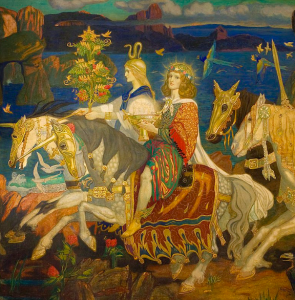
Part of Riders of the Sidhe10 (1911), by John Duncan.
It seems strangely forgotten nowadays that a myth is a work of imagination and therefore a work of art. It needs a poet to make it. … The student [of myth] cannot make a scientific statement about the savage, because the savage is not making a scientific statement about the world. He is saying something quite different; what might be called the gossip of the gods. We may say, if we like, that it is believed before there is time to examine it. It would be truer to say it is accepted before there is time to believe it. …
Now we do not comprehend this process in ourselves, far less in our most remote fellow-creatures. And the danger of these things being classified is that they may seem to be comprehended. … But we do not know what these things mean, simply because we do not know what we ourselves mean when we are moved by them. Suppose somebody in a story says “Pluck this flower and a princess will die in a castle beyond the sea,” we do not know why something stirs in the subconsciousness, or why what is impossible seems almost inevitable. Suppose we read “And in the hour when the King extinguished the candle his ships were wrecked far away on the coast of Hebrides.” We do not know why the imagination has accepted that image before the reason can reject it …
—G. K. Chesterton, The Everlasting Man, Part I, ch. V, “Man and Mythologies” (pp. 101-105 of Ignatius’ 2008 paperback reprint)
This idea—that mythology is a reaching out, by means of the imagination, to attempt contact with spiritual realities which we may not understand, but do perceive—is, in my opinion, correct. (There are other things mixed into mythology as well, ranging from jokes to life advice to vague recollections of historical events from many thousands of years ago; yet I believe the main core of mythology as a genre is spiritual perception expressed in terms of imagination.) The Inklings took up this idea, and C. S. Lewis in particular described the Incarnation as myth made fact. This phrase reminds me, strangely, of a curious detail about the Incarnation in the Athanasian Creed: “One, not by conversion of the Godhead into flesh, but by taking of the manhood into God.” But more importantly, myth-made-fact must be understood with the full force of both nouns.
The heart of Christianity is a myth which is also a fact. The old myth of the dying god, without ceasing to be myth, comes down from the heaven of legend and imagination to the earth of history. It happens—at a particular date, in a particular place, followed by definable historical consequences. We pass from a Balder or an Osiris, dying nobody knows when or where, to a historical person crucified (it is all in order) under Pontius Pilate. By becoming fact it does not cease to be myth: that is the miracle. … [I]t carries with it into the world of fact all the properties of a myth. God is more than a god, not less; Christ is more than Balder, not less. We must not be ashamed of the mythical radiance resting on our theology.
—C. S. Lewis, God In the Dock, “Myth Became Fact”11, 12
Along similar lines, in the second volume of the Cosmic Trilogy, the hero reflects that
the triple distinction of truth from myth and both from fact was purely terrestrial—was part and parcel of that unhappy distinction between soul and body which resulted from the fall. Even on earth the sacraments existed as a permanent reminder that the division was neither wholesome nor final. The Incarnation had been the beginning of its disappearance.
—C. S. Lewis, Perelandra11
Alright. Still: why am I making such a big deal about myth, even if it is myth-made-fact?
In saying this logion (“Break up this shrine and in three days I will raise it”), Jesus establishes a mythic equivalence between himself and the Temple. Going by the principles of midrash—which we touched on in textual note g and footnote 7—we can then exchange these terms in any other passage where either one of them occurs, or where a synonym or even a homonym for either one occurs. And this is substantiated in Scripture. Think of the פָּרֹכֶת [Pârokheth], the immense Veil of the Temple, embroidered with images of the cherubim. It hid the Ark of the Covenant, separating the Holy of Holies from the second-most sacred chamber, the Sanctuary (with the Menorah and the Table of Showbread). It makes perfect mythopoeic13 sense that the Parokhet spontaneously ripped in half at Christ’s death. Of course it did. It had to. His soul and body had just been torn apart; and the Temple was his body; indeed, Hebrews says that we “have boldness to enter into the holiest by a new and living way through the veil, that is to say, his flesh” (10:19-20, emphasis mine). The Veil had to be torn, not for any physical reason, but due to a metaphysical reason operating upon that physical object.
This kind of logic is at work throughout John—indeed, throughout the New Testament. I nearly forgot about the painfully obvious example of what St. Gabriel told the Mother of God (although technically, what he says makes her the Temple and her child the deity within it). “The Spirit of God shall come upon thee, and the power of the Most High shall overshadow thee”; this language had already been used, about the Tabernacle and the Temple before her. This is the logic of myth-made-fact; if you will, it is the logic of magic.
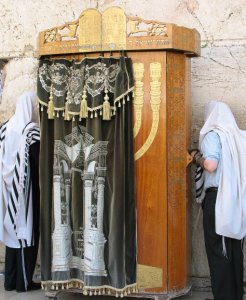
A mobile Torah ark at the Western Wall in 2007
—note the extensively embroidered dark grey
parokheth on the front. Photo by James Emery,
used via a CC BY 2.0 license (source).
On the whole, comparing miracles to magic is less illuminating than it sounds at first; “magic” usually means one of three things: illusionism, a.k.a. stage magic; an element in fantasy fiction; or practices linked, with varying degrees of silliness and evil, to the occult. Miracles aren’t like that at all. Especially in the Synoptics (Mark above all), there’s a very businesslike quality to miracles. Yet “magic” can suggest a fourth thing, especially in certain contexts and phrases, like Lewis’s brilliant phrase “Deep Magic from the dawn of time,” and miracles do resemble this fourth thing—which, most unfortunately, I can’t think of anything to call except “magic”! Most forms of esotericism (such as Rosicrucianism14) involve the doctrine that “Man is the microcosm,” i.e. that the human body is in some sense a map or index of creation in general. That may sound unbiblical to some readers, and in a way it is, but only because the Bible goes further than this. The Tanakh begins by declaring humanity the image of the Creator, and the Gospel of John opens by declaring one particular man the incarnation of the Creator.
In the Prelude, Wordsworth wrote:
…………the human form
…To me became an index of delight,
…Of grace and honour, power and worthiness.
The most important word there is index. An index is a list of various subjects, with reference to those places where, in the text, they are treated at greater length. But, at least, the words naming the subjects are the same; and a really good index will give some idea of the particular kind of treatment offered on the separate pages. The structure of the body is an index to the structure of a greater whole. Spirit becomes flesh, without losing spirit. Perhaps the best verbal example is in the common use of the word ‘heart’. Even in our common speech the word is ambiguous. As our meaning—physical life or compassionate life—so the word heart. Compassion is the union of man with his fellows, as is the blood. The permitted devotion to the Sacred Heart is to the source of both. The physical heart is, in this sense, an ‘index’ to both. …
The visionary forms of the occult schools are but dreams of the Divine Body. Christians, however, may be permitted to press the significance more closely. The body was holily created, is holily redeemed, and is to be holily raised from the dead. It is, in fact, for all our difficulties with it, less fallen than the soul … The Sacred Body is the plan upon which physical human creation was built, for it is the centre of physical human creation. The great dreams of the human form as including the whole universe are in this less than the truth. As His, so ours. We carry about with us an operative synthesis of the Virtues; and it may be held that when we fall in love (for example), we fall in love precisely with the operative synthesis.
…Grace was in all her steps, heaven in her eye;
…In every gesture dignity and love,
is much more a definite statement of fact than we had supposed; footsteps are astonishing movements of grace.
—Charles Williams, The Image of the City, “The Index of the Body” (pp. 80-86 in the Apocryphile Press edition of 2007)15
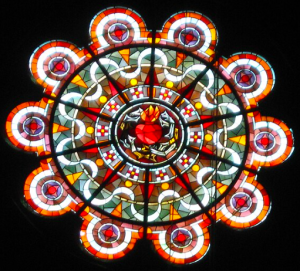
Stained glass depiction of the Sacred Heart of
Jesus from Sacré-Cœur Basilica in Paris.
Photo by Mylonas, used via a CC BY-SA 3.0
license (source).
Footnotes
1The names Chanan, Qayafah, and Pilatus equate with Annas, Caiaphas, and Pilate.
2To forestall any risk of misunderstanding: I do not know Norse, Sanskrit, or Devanāgarī, and only an extremely generous evaluation would mark me as “knowing” runes! I know just enough about runes to point out that I’m using the wrong set here; I ought really to have written the name of Yggdrasil in the Younger Futhark, so: ᚢᚴᚴᛐᚱᛆᛌᛁᛚ. Which I guess means I’ve given both! In any case, the reason I included original names and scripts here was simply and entirely “they’re pretty.”
3The word חַג [chagh], used in modern Hebrew to mean little more than “holiday,” is cognate to the Arabic حَجّ [haj], the term used for the pilgrimage to the Cube in Mecca made by practicing Muslims.
4I don’t even much like seeing the Vatican’s own flag in a sanctuary, frankly. The nation-state-equivalence the Church possesses in the form of the Vatican city-state—in addition to being tangled up with what I’ll gently call some negative energy in Catholic history—is a little beside the point in a liturgical context, after all.
5This may seem strange, since silver, which tarnishes, doesn’t retain its value as well as gold. However, the world’s gold reserves (both accessible and absolute) were then, and are now, far smaller than those of silver: the earth is though to contain over two million tonnes of silver, whereas the planet’s total gold reserves are measured in the hundreds of thousands of tonnes. (Sorry, it is specifically a metric tonne, not an imperial ton. Look, I did math last week to get “rundlets” right [and had to find out about yet a third kind of tun]; I’m not mathing two posts in a row.)
6Carthāgō (the Latin name of Carthage) is thought to be the Romans’ attempt at wrapping their lips around a name that was or resembled Qart Ch’dashta, i.e. “New Town,” the “old town” being Tyre. Also, for any of you who have an affection for the Homestar Runner franchise: this means that the name of the local deity of Tyre, Melqart, like that of Hector’s son Astyanax, just about means “the King of Town.”
7This usually appears in English in the lightly Latinized form drachma. (This form, with an –a instead of an –ē, did exist in Greek, but mainly in rural dialects; the standard form in Koiné was the form with –ē.)
8Midrash is the name of a type and period of rabbinic commentary—both in the sense of the comments they made, and in the sense of the method they used to arrive at their comments; it was largely, though not only, used for halakhic purposes. Hillel the Elder, an eminent Pharisee (ca. 70 BC– ca. 10 AD), whose beyt or interpretive school seems to have been losing ground to the more rigorist Beyt Shammai around the time Jesus was active, laid down seven rules of Scriptural midrash:
…A. applying the principle of a text to a new case a fortiori—Jesus uses this constantly;
…B. analogizing two texts based on synonyms or homonyms;
…C. extending a principle explicitly found in one text to similar texts;
…D. extending a principle synthesized from two texts to similar texts;
…E. defining particulars by the general category they fall into (or vice versa);
…F. analogizing two texts based on similar content; and
…G. deducing a text’s interpretation from the surrounding context.
Some of these techniques do not come easily to the modern Western reader, particularly B; it can seem like (and can be) flagrant eisegesis. However, the authors of the New Testament display no reluctance about using interpretive techniques of this type: Matthew and Paul freely allegorize not only the text of Scripture, but even the events it describes, classic examples being Matt. 2:15 and Gal. 4:24ff.
9E.g., when Bible scholars call stories like the murder of Abel or the Tower of Babel “myths,” they’re not necessarily calling them ahistorical. Granted, they may also think that, but the point here is, they aren’t using the word as a polite euphemism for “lies”: the term identifies the genre to which these stories belong. It’s also true that most myths are ahistorical, but this is not essential to the genre, merely a common feature. The Arthurian cycle, for instance, even if it were proven to be really based on Riothamus of Armorica (or anybody else), would remain mythical, though it would happen to be a myth that included some historical fact.
10The áes sídhe (roughly pronounced “ish shee”), or aos sí according to modern spelling, are basically the Fae; I say “basically,” because their history (both as tales and within the tales of Irish mythology) can get as labyrinthine as any Celtic knot. A couple years back, I delved a little bit into the mythology behind one type, the bean sí or “banshee.”
11Sadly, I currently own no hard copy of these works, so I don’t know the page numbers for these quotations and don’t have their publication info. (I have read both books, more than once, so I can at least guarantee that the secondary sources I used aren’t inventing fake Lewisiana.) I found the text from God In the Dock on this pdf, and the Perelandra quote on Goodreads.
12The selection of Balder is, I suspect, noteworthy. In Surprised by Joy, Lewis relates that one of his earliest experiences of the “Joy” of the title, of Sehnsucht, came to him long before he even knew who or what Balder was: he met with both the name and the experience in the opening words of Tegner’s Drapa, a poem by Henry Wadsworth Longfellow: “I heard a voice, that cried, / ‘Balder the Beautiful / Is dead, is dead!'” Thenceforward, his attachment to Norse mythology became profound, and he seems to have been more affected by Balder than any other mythic “proto-Christ.” (Other candidates for this position, depending heavily on the material selected, could include Apollo, Dionysus, Persephone, Orpheus, Pelops, Lugh, Tyr, Osiris, Ra-Horakhty, Krishna, Avalokiteśvara, etc.)
13Is this the right form? It feels like it ought to be “mythopoetic.”
14Rosicrucianism is a tradition of ceremonial magic that claims to descend institutionally from, or at least to continue the ideology of, a supposed esoteric brotherhood of the German Enlightenment. This brotherhood is known from a pair of anonymous pamphlets and a book, The Chymical Wedding of Christian Rosenkreutz, all published between 1614 and 1616 (“Chymical” = alchemical); modern scholarly consensus makes these either hoaxes or allegories, not accounts of a historical society nor of its founder. Its name comes from its usual emblem, the “rose cross” or “rosy cross”—a Latin-style cross with a rose blossom at its juncture. The tradition incorporates alchemy, astrology, the Kabbalah, etc., as tools of understanding if not as really efficacious. Historically, most Rosicrucian societies have been explicitly Christian, but not all. (One loosely-Rosicrucian group, the Hermetic Order of the Golden Dawn, infamously fostered Aleister Crowley, a champion of what students of the occult politely call the left-hand path, which most people give the simpler name black magic.)
15I’ve edited this selection a little, mostly by presenting it as continuous—the ellipses (this thing: …) were so plentiful that it got really annoying to look at. However, I both think and hope that I haven’t misrepresented Williams’ thought.










 Ad-Free & Subscriber Log-In