

A Foreword Briefly Directing the Gentle Reader Elsewhither
I had trouble thinking of a title for this post, and eventually decided that the best choice was to steal one from G. F. Handel. It’s impossible to choose out of such a masterpiece, but if I did have to, I might select the chorus of this title as my favorite part of the Messiah (the text is from Malachi 3:3). If I’m not mistaken, this is the version I grew up listening to, which is my favorite of the versions I’ve heard; certainly both that and this are by the London Philharmonic Orchestra (not to be confused, as I discovered, with the London Symphony Orchestra). If you haven’t heard it before, it’s … I’m gonna go with “perfect,” and an excellent example of the Baroque fugue: listening entitles you to say things like “it’s an excellent example of the Baroque fugue” in conversation.
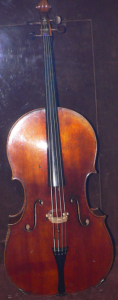
The Servais Stradivarius (a cello—turns out he
made those too!) in the Smithsonian. Photo by
Mark Pellegrini, used under a CC BY-SA 2.5
license (source).
Who Was Saint John Lateran?
This coming Sunday, like this past, has been displaced—this time by a feast, which is a little more normal. This one is the Feast of the Dedication of the Basilica of St. John Lateran. What does any of that mean?
The church whose dedication we’ll be commemorating is exceptional in many respects. It is an exceedingly old church building: the “Lateran” part comes from the Lateranus family, to whom the property originally belonged. The Lateranī were a very venerable sept of the Sextia clan1 (in 366 BC, Lucius Sextius Lateranus was the first plebeian2 to become a consul), and a number of Lateranī served under the early emperors in administrative roles. However, during the reign of Constantine, the Lateran Palace came into the emperor’s hands via marriage, and he made it a gift to the papacy in 312 or 313. As a result, the church built here (which opened in 324, the year before the First Council of Nicæa) became the cathedra, or episcopal seat, of the pope—yet all this accounts for less than half of its imposing full title:
Archibasilica Sānctissimī Salvātōris
ac Sānctī Jōannis Baptistæ et Jōannis Evangelistæ
ad Lateranum
or
The Archbasilica of the Most Holy Savior
and of Holy John the Baptist and John the Evangelist
at Lateran
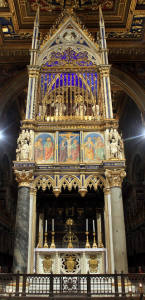
The high altar and baldachin3 of the Lateran
Basilica. Photo by Wikimedia contributor
Wiki ktulu, used under a CC BY 3.0 license
(source).
St. Peter’s Basilica on Vatican Hill may be the most famous and recognizable church in the world, and the one most associated with the pope; yet St. Peter’s is not his see, his seat as a bishop. It is an important church in the Diocese of Rome—it was there that St. Peter himself was interred—but it is not “HQ.” That is the Lateran Basilica, which is devoted not to St. Peter but to a little trinity of Christ, the Baptist, and St. John (so, no, there isn’t really a saint named “St. John Lateran,” it’s just a shorthand expression). This basilica is the mother-church of Rome itself, and thus of the entire Roman Catholic Church.
Why these three figures specifically were chosen as the patrons of the Lateran, I don’t know for certain.4 The Baptist and the Evangelist on either side, so to speak, do represent the transition from the Torah being the primary divinely-sanctioned means of relating to God, to that means becoming the Gospel: the mediation of the covenant passes from angels on the celestial side and mortal high priests on the terrestrial, to the single and permanent mediation of Jesus Christ, whose double nature—the “twy-formed ambiguity,” as Charles Williams loved to call it—makes him a suitable representative of Heaven to mankind and of mankind to Heaven alike; the earthly sanctuary is fully identified with the divine sanctuary. Hebrews is entirely about this theme, which makes it striking that, judging from 13:24, that letter was likely addressed to Rome, certainly to Italy.
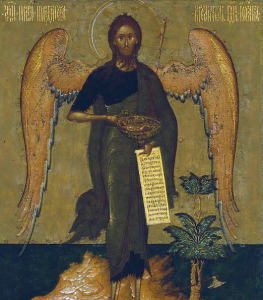
Russian ikon of St. John the Baptist
(ca. 1625), written by a member of
the Stroganov school of iconographers.
And yet, with both of the other two figures being named John, the continuity is accented at the same time in this dedication. It is, moreover, a peculiarly appropriate name for continuity-accenting purposes. Many names in many cultures are theophoric, i.e. referencing a god or gods: Heracles (“glory of Hera”), Isidore (“gift of Isis”), and Oswald (“power of the god/s”) are non-Biblical examples. The Bible is extremely rich in theophoric names, mostly in Hebrew and some in Greek; this in turn has provided English with many, probably most, of its theophoric names. John is—at many removes!5—descended from the name יוֹחָנָן [Youchânân], which contains two elements. The first is a clipped form of יהוה, the Tetragrammaton or Most Holy Name (which we don’t write out the theoretical reconstructions of on this blog [big teeth-clenchèd what-is-wrong-with-some-people smile]); that’s the theophoric part, now much-disguised. This is followed by an element which is sometimes seen as related to the name כְּנַעַן [K’nauan], or Canaan, whose etymology is uncertain.
- It may come from a radical meaning “to be low, be humble.” This in turn might be
- literal, contrasting the lower hills of Canaan with the mountainous highlands of Aram (modern Syria), or
- metaphorical, since Canaan was typically a subject territory in antiquity (usually to Egypt).
- This explanation has fallen out of favor, but there’s a chance the name comes from the Hurrian language, spoken in the Bronze Age in northern Mesopotamia; the Hurrians were largely vassals of the Hittites. The Hurrian word kinaḫḫu apparently refers to purple or deep red, and this origin would make Canaan mean essentially the same thing as Phoenicia: “land of purple (dye).”
- Finally, it could be related, maybe, to the noun explained below. (The catch is that, if so, it’s odd that one has a ḥeth [ח] in it and the other has a kaf [כ]. These letters sound more similar to English-speakers than they really were; Classical Hebrew distinguished many more guttural sounds than English does.)
If any of these explanations are correct, then the name John is intimately tied to the names of both the Lord our God and the Promised Land. That such a name is also the name of the Lord’s herald and one of his foremost emissaries is … words fail me. Fitting. But, whether or not it’s related to the name Canaan, that second element in the name is a derivative of the verb חָנַן [ḥânan]. This means “to pardon, grant amnesty; to take pity upon, treat with kindness, be merciful to.” Hence the most common explanation of the name’s meaning, which itself evokes the climactic vision of Moses: The LORD is merciful.
Let’s turn to our text.
John 2:13-22, RSV-CE
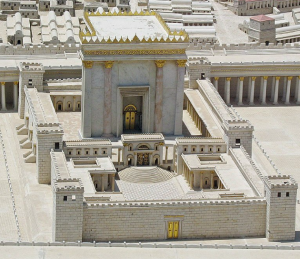
Holyland Model‘s Second Temple. Photo by
Wikimedia contributor Ariely, used under
a CC BY-SA 3.0 license (source).
The Passovera of the Jewsb was at hand, and Jesus went up to Jerusalem. In the templec he found those who were selling oxen and sheep and pigeons, and the money-changersd at their business. And making a whip of cords, he drove them all, with the sheep and oxen, out of the temple; and he poured out the coins of the money-changers and overturned their tables. And he told those who sold the pigeons, “Take these things away; you shall not make my Father’s house a house of trade.” His disciples remembered that it was written, “Zeal for thy house will consume me.” The Jews then said to him, “What sign have you to show us for doing this?” Jesus answered them, “Destroy this temple, and in three days I will raise it up.”e The Jews then said, “It has taken forty-six yearsf to build this temple, and will you raise it up in three days?” But he spoke of the temple of his body. When therefore he was raised from the dead, his disciples remembered that he had said this; and they believed the scriptureg and the word which Jesus had spoken.
John 2:13-22, my translation
And it was near the Jews’b Pesach,a and Jesus went up to Jerusalem. And in the Templec he found those selling oxen and sheep and doves, and the coin-changersd sitting there; and making a whip out of cords, he threw them all out of the Temple with the sheep and oxen, and poured out the money-brokers’ coins and turned over their tables, and told those who were selling doves, “Take these things out of here—do not make my Father’s House a house of merchandise.” His students remembered that it is written: “The ardor of your House eats me up.”
Then the Jews responded and said to him, “What sign do you show us, that you are doing these things?”
And Jesus responded and told them, “Break up this shrine and in three days I will raise it.”e
So the Jews said, “Forty-six yearsf this shrine has been being built, and in three days you will raise it?”
But he was talking about the shrine of his body. Then, when he was raised from the dead, his students remembered that he said this, and believed in the Writg and in the word which Jesus spoke.
Textual Notes
a. Passover/Pesach | τὸ πάσχα [to pascha]: Because the sound rules in English are fairly flexible,6 Pesach is a somewhat better approximation of the Hebrew פֶּסַח [pesaḥ] than the Greek term manages. (Greek lent its name to Latin, and it is thus ancestral to the adjective paschal and the name Pascal.)

Two sheep, of the Suffolk breed (originating
in the English county of Suffolk). Photo by
Jacquie Wingate, used under
a CC BY-SA 1.0 license (source).
b. of the Jews/the Jews’ | τῶν Ἰουδαίων [tōn Ioudaiōn]: Allusions to “the Jews” in the Gospel of John are by no means uniformly hostile, but they do seem to implicitly contain the idea that Judaism and Christianity are, at its time of composition, already recognizably distinct. Since Christianity originated as a Judaic sect, this is one of a number of traits that have led many commentators to consider John not only the last of the Gospels to be composed, but a fairly late composition in general—it is typically dated to the last decade of the first century. That said, internal evidence suggests that it was composed by someone who, at minimum, had access to eyewitness sources on the Temple and its rituals (e.g., the relation of Jesus’ proclamation in John 7:37-38 to the washing of the altar during Sukkot, or the allusion in 10:22-23 to his walking in Solomon’s Portico, a roofed colonnade, apparently on account of the weather).
There is another idea about the use of Ἰουδαίοι [Ioudaioi] in the Fourth Gospel, one which is rather fringe to the best of my knowledge; I think it’s possible, but unlikely. Let’s start with hard facts. The province of Iudæa was roughly divided into three unequal chunks, bounded by the deep gorge of the Jordan on the east and the Mediterranean Sea on the west. Judea proper lay in the south, reaching from an ill-defined boundary with Idumea around the latitude of the southern end of the Dead Sea, up to a few miles north of Jerusalem. Samaria was in the middle; continuing north across the Jezreel Valley, a crescent-shaped river valley northeast of the ridge of Mount Carmel, we reach the Galilee. Please consult the MS Paint-worthy map below for guidance.
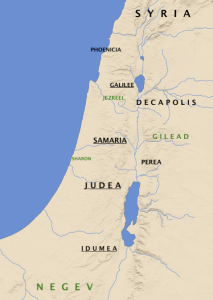
Black type indicates political divisions;
green, geographic labels. Created courtesy
of freebibleimages.org.
Christianity rapidly became associated, thanks to both its founding rabbi and its early leadership, with the Galilee. Indeed, because of the hometown of the aforesaid rabbi, they were known at first as “Nazarenes”—Ναζωραίοι [Nazōraioi] in Greek, ܢܵܨܪ̈ܵܝܹܐ [Nātsrāyē] in Aramaic; a derivative via the Syriac language, Nasrani, persists to this day as a name for Christians in regions influenced by the Syriac Churches, such as India and many Arabic-speaking countries. Even within the Roman world, as late as the mid-fourth century, it was perfectly possible to quote Emperor Julian the Apostate referring to Christians as Galileans. Now. While Galileans (unlike, say, Samaritans) adhered mostly to mainstream Judaism, the Galilee was not especially affluent or celebrated for its scholarship. Quite the contrary; its populace even had a quite distinctive “hick” accent (cf. Matthew 26:73). This was no longer the land of Issachar (see note e of this post), not after the Assyrian and Babylonian deportations—it had become “Galilee of the Gentiles.” This much is easily verifiable.
Where we branch into the speculative is with the following hypothesis (which I’d be happy to credit, but I’ve only really heard of it by word of mouth). The hypothesis is that the contrast intended in John is not between Jesus’ students and “the Jews,” conceived as disowned outsiders, but that—in the mind of the author, at least—this is an internal community dispute, one not between Jews and Gentile Christians, but between Judeans and Galileans, animated by intra-ethnic class distinctions and/or resentment against a “religious establishment.”
There are, to my mind, some attractive things about this theory; there are a couple of otherwise-curious turns of phrase that it would explain (such as the allusion in John 3:25 to a heated halakhic argument ἐκ τῶν μαθητῶν Ἰωάννου μετὰ Ἰουδαίου [ek tōn mathētōn Iōannou meta Ioudaiou], “of the students of John with a Jew” or, on hypothesis, “with a Judean”—since after all the Baptist’s followers would also have been Jews). The main thing that seems to me to be going for it is the way it gels with the Apostles’ personal context.
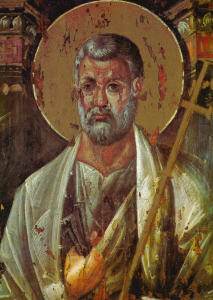
Anonymous encaustic ikon of St. Peter
(6th century), preserved in the famous
Monastery of St. Catherine on Mount Sinai.
With or without this hypothesis, I’d assume that the authors of the New Testament would have had intensely two-sided feelings about many of their countrymen. Except for Paul, all of them grew up in Iudæa, and all of them including Paul grew up as observant Jews; it was the only life they had ever known. Jesus came into their lives, radically changed most of that, and then left. Even with the hope the Resurrection and Pentecost afforded them, after the Ascension, most of the Apostles had to endure around thirty years of what I would think must have still felt very like bereavement of their Master.
Which might have been one thing, if they could have won over the bulk of their fellow Jews, or at least achieved substantial enough numbers among them to gain a visible presence on the Sanhedrin. (Maybe that wouldn’t have changed much about history—I don’t know—but it’s hard to think the hope of that didn’t enter their minds, especially once Levitical priests started joining the Natsraye [see Acts 6:7].) It was presumably quite another to endure that absence, and at the same time have to face the continued rejection of their Master’s doctrine from the religious authorities, seemingly followed at some point by expulsion from the synagogue (note the “already” of John 9:22)—perhaps some or all of the surviving Apostles were subjected to חֵרֶם [ḥêrem], roughly equivalent to excommunication, though it’s difficult to be sure. This “Judeans vs. Galileans” theory might even go some way toward explaining why the authors of the New Testament, all or most of whom were Jews themselves, were capable of such angry outbursts against their own nation from time to time. This was perhaps not merely because they felt they had what are crudely called “n-word privileges,”7 but because the bitterest conflicts are generally the “civil8 war” variety.
Page from a 14th-15th century psalter.
For it was not an enemy that reproached me;
…..then I could have borne it:
neither was it he that hated me that did magnify himself against me;
…..then I would have hid myself from him:
But it was thou, a man mine equal,
…..my guide, and mine acquaintance.
We took sweet counsel together,
…..and walked unto the house of God in company.
—Psalm 55:12-14
However. All of that might be true, without the specific hypothesis “‘Jews’ in John doesn’t mean Jews per se but Judeans.” The theory is superfluous from that perspective. And there are problems with it—foremost among them being, where’s the other evidence for this usage? Maybe such evidence exists, but I know of none. Granted, it isn’t as if I had a doctoral specialty in Judeo-Greek usages of the early Imperial period; it wouldn’t be weird if I were just missing something. But I never have heard of such a thing. I’ve never even heard of something clearly parallel to it. And it would cause difficulties as well: for example, if the writer of the Fourth Gospel were using Ἰουδαίοι to mean “Judeans,” then what pray tell would he use to mean Jews? (I guess he could say Ἑβραΐδες [Hebraïdes] if he really wanted to, but it’d be a strained usage: in every other occurrence of Ἑβραΐς in the New Testament, it’s referring to language, not people.9) And while it does explain some verses, as noted above, it also has clear counterexamples like 4:22, where Ἰουδαίοι contrasts with Σαμαρῖται [Samaritai], “Samaritans,” for specifically religious purposes. So, albeit without absolute certainty, I’m inclined to dismiss the “Ἰουδαίοι = ‘Judeans’ in John” thesis.
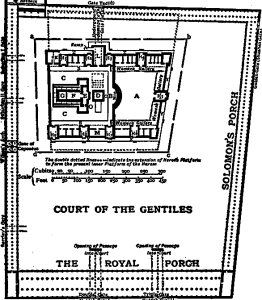
A plan of the Second Temple from the 1911
Encyclopædia Britannica; “up” here is north.
c. in the temple/in the Temple | ἐν τῷ ἱερῷ [en tō hierō]: The Temple consisted in six main courts (or in a sense, seven, if you counted the holy city itself as the outermost). The innermost was the Holy of Holies; this lay beyond the Holy Place containing the Table of Showbread and the seven-branched Menorah. The next one out was the Court of the Levites, followed by the Court of the Israelites (labeled C in the diagram above), beyond which (A) was the Court of Women. The sixth and outermost was the Court of the Nations, or, by an alternative translation, of the Gentiles. It was part of the sacred precinct, but it was of comparatively little ritual importance. As the name indicates, both “God-fearers” (those who worshiped the God of Israel without full conversion) and גֵּרִים [gerym], Gentiles who converted to Judaism,10 were allowed in this court; so far as I can tell, even גֵּרִים, converts proper, could come no further inside.
d. those who were selling oxen and sheep and pigeons, and the money-changers/those selling oxen and sheep and doves, and the coin-changers | τοὺς πωλοῦντας βόας καὶ πρόβατα καὶ περιστερὰς καὶ τοὺς κερματιστὰς [tous pōlountas boas kai probata kai peristeras kai tous kermatistas]: Even when it was to somewhere near enough to be conducted overland, short-term travel in the ancient world was expensive—an expense exacerbated by how much slower it was, since this increased the food bill that went with it. (Today, it’s possible to fly e.g. from Rome to Jerusalem in three and a half hours; two thousand years ago, the same journey by ship, which was the quick way, could be expected to take a couple of weeks in a decent vessel. Provided it was the right time of year. And nothing went wrong.) Doing that with an animal, one you weren’t even going to be riding part of the way? Forget it. Hence, Jews who were coming to Jerusalem for reasons of religious pilgrimage would wait until they arrived to purchase animals they needed for sacrifice, which were generally calves or lambs, sometimes pigeons.11

A wild rock dove (i.e., a pigeon) in Aliabad,
Pakistan. Photo by the organization Birds
of Gilgit-Baltistan, used under
a CC BY-SA 2.0 license (source).
To serve this need—and also to give those coming from further away a place where they could exchange whatever currency they had with them for Tyrian shekels, the type of coinage required to pay the mandatory Temple tithe12 which supported the priests—a bazaar was set up. I imagine most people would agree this was, in itself, a perfectly reasonable thing to do. Indeed, ever since I can remember, I’ve been suspicious of interpretations of “ye have made it a den of thieves” that rely on the idea that the people selling sacrificial animals and the money-changers were cheating people. That is of course possible, and if the possibility was realized then obviously it was a grave sin; but the accusation does not unambiguously appear in any of the Gospels. The closest we come is the “den of thieves” remark in the Synoptics, and given Christ’s almost incessant use of metaphor, that alone doesn’t convince me this was about sharp dealing. Moreover, as you can see, even that remark is absent from the Johannine account. This implies there was something else “wrong with this picture,” something that would be wrong even if every merchant and official there was as honest as the daylight.
It isn’t difficult to work out what the something else was. It was where they chose to erect this bazaar: the Court of the Gentiles. To judge from the Gospel accounts, this aroused Christ’s anger for two reasons. One appears in our text; however comparatively unimportant it might be, the Court of the Gentiles was part of the Temple, and (according to Jesus) carrying on any kind of business there, even business whose immediate concern was the operation of the Temple, was a disgrace. That reason is at its most explicit in John and one other Gospel, which also happens to be the Gospel to set forth the other reason at its most explicit.
Jesus went into the temple, and began to cast out them that sold and bought in the temple, and overthrew the tables of the moneychangers, and the seats of them that sold doves; and would not suffer that any man should carry any vessel through the temple. And he taught, saying unto them, “Is it not written, ‘My house shall be called of all nations the house of prayer’? but ye have made it a den of thieves.”
—Mark 11:15b-17, italics mine
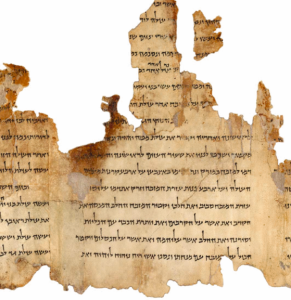
This was the only part of the Temple in which גּוֹיִים [gouyim], “the nations,” could pray. And rather than fostering an atmosphere for reflection, penitence, and meditation, the authorities in Jerusalem were making anyone who did come to seek the God of Israel contend with the human and animal sights, sounds, and smells of a Mediterranean bazaar.
e. raise it up/raise it | ἐγερῶ αὐτόν [egerō auton]: There’s an oddness in the Greek here: αὐτόν, a form of what was originally a reflexive pronoun, does not refer to an it, but to a him. This reflects an ambiguity that probably13 existed in the Aramaic: the word for the Temple in that language, מַקְדְּשָׁא [maqhd’shâ], like its Hebrew cognate מִקְדָּשׁ [miqhdâsh], is masculine, and unlike Greek, these Semitic tongues have no neuter grammatical gender, not even in pronouns—everything is either feminine or masculine. So with every object a her or a him, he would have worded things the same whether he were talking about a masculine-gendered object like the Temple, or a male person like himself.
f. forty-six years | Τεσσεράκοντα καὶ ἓξ ἔτεσιν [Tesserakonta kai hex etesin]: Strictly speaking, it was not the Temple per se that had been under construction for forty-six years—the Second Temple had been completed, or completed enough to use, by around 516 BC. What they’re referring to is a Herodian renovation of the Temple complex (occupying the whole plateau atop Mount Moriah, the eastern of the two principal hills on which Jerusalem sits—its western companion is Mount Zion). This renovation took place beginning in 20-19 BC.
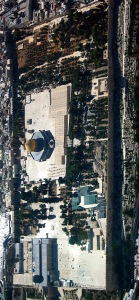
A modern view of the Temple Mount (north is
“up”) with the Dome of the Rock at its center.
Photo by Wikimedia contributor Neukoln,
used under a CC BY-SA 3.0 license (source).
Taken by itself, this would imply that this exchange took place in 27 AD, give or take. This is close to, but doesn’t quite align with, the dating of Chris’s ministry given in Luke: that Gospel states (3:1) that St. John the Baptist’s ministry began in or around 28, and that Jesus’ own ministry began some while after John’s; Matthew and Mark tell us (4:12-17 and 1:14) it was inaugurated after the Baptist’s arrest. This again doesn’t seem exactly to match what John says (cf. 3:22-24 and 4:1-3), though there are potential explanations for the discrepancy. John seems to present an initial phase of Christ’s ministry in the south, in Judea proper, rather than one headquartered in the Galilee from the start: perhaps that phase was so brief, and/or so closely associated with that of John the Baptist, that the Synoptics simply left it out.
Complicating things a bit further is the question of whether there was one cleansing of the Temple, or two. The majority theory is that there was only one, and I find the idea that there were two extremely difficult to credit. For one thing, any act of this kind would have galvanized the Sanhedrin to move against Jesus in some concrete way; they would hardly have allowed this to occur a second time. Yet that aside, I can see only two reasons for arguing that there were two cleansings:
- to get out of, or at least ameliorate, the puzzle of dating set forth above—a methodology which feels a little less than honest; or
- due to a sweeping commitment to hyper-literalism that insists on viewing this cleansing as early in Christ’s ministry (and therefore distinct from the one during Holy Week) simply because it’s in the second chapter of the book.
Yet I think even most Dispensationalist scholars would allow that John, as much as Matthew, structures his narrative according to theme more than in strict chronological order. And the thematic structure of John is fascinating; by both the early interrogation of John the Baptist and this placement of the cleansing of the Temple (which would evoke the near-immediate sequel of the Crucifixion), the writer is making his Gospel something like a trial, with the reader in the judge’s seat, forced to give a verdict—what now you shall do with Jesus who is called Christ.
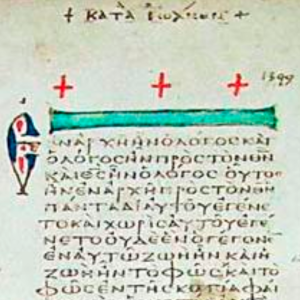
The beginning of the Gospel of John in Codex
Vaticanus (4th-c.); note the use of the lunate
sigma, a form of the letter Σ written like our C.
So that leaves us with that forty-six years/27 AD problem. Admittedly, a difference of a few years either way doesn’t utterly wreck the credibility of the Gospels any more than getting a date wrong would destroy the scholarship of a historian, but still, it’s a puzzle. Moreover, both the great precision of that figure and the fact that it’s not a number with any tradition of symbolic meaning behind it (though it has since become the number of days in the Roman form of Lent, when Sundays are included) make it relatively unlikely to be a mere fabrication or mistake. However, at least some architectural work seems to have gone on well past the time of Christ; cursory Googling suggests a completion date of 64, only two years before the revolt began. If, and only if, we bear in mind that conjectures are just guesses until they’ve received some kind of evidential confirmation—we could conjecture that there may have been long pauses in the construction, easily enough to make up the difference in timeline between John and the Synoptics.
g. scripture/Writ | τῇ γραφῇ [tē grafē]: I have preferred the admittedly archaic word “writ” here, because it has the same relationship to the verb “to write” that the Greek noun γραφή has to the verb γράφω [grafō].
As to what this says: I’m not sure whether to take “his students believed in the Writ” as a general statement about their faith in Scripture, or whether it is specifically talking about the text just quoted (Psalm 69:9). I did notice that it forms an interesting apposition with an equally if not more cryptic statement in chapter 20.
The first day of the week cometh Mary Magdalene early, when it was yet dark … and seeth the stone taken away from the sepulchre. Then she runneth, and cometh to Simon Peter, and to the other disciple, whom Jesus loved, and saith unto them, “They have taken away the Lord out of the sepulcher, and we know not where they have laid him.” Peter therefore went forth, and that other disciple … So they ran both together … Then cometh Simon Peter following him, and went into the sepulcher, and seeth the linen clothes lie, and the napkin, that was about his head, not lying with the linen clothes, but wrapped together in a place by itself. Then went in also that other disciple, which came first to the sepulcher, and he saw, and believed. For as yet they knew not the scripture, that he must rise again from the dead.
—John 20:1-9, italics mine
Not only are both statements structurally similar, but both are specifically related by the author to the Resurrection. What to make of this parallel … I have no clue. (And no, it isn’t any clearer without the “fond thing, vainly invented”14 of my liking for King James English.)
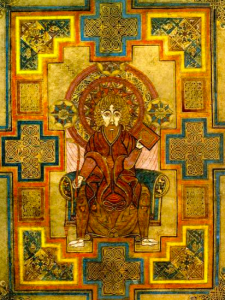
Portrait of St. John the Apostle in
the Book of Kells (ca. 800).
Footnotes
1It is more usual in contexts like these to speak of a Roman gēns and its cognomina, rather than borrowing the language of the Scottish Highlands with its clans and septs. I opted for the latter as seeming slightly more intuitive, since “family” in modern English now normally means only the nuclear family (which is, historically speaking, rather exceptional).
2Plebeians (plēbeiī in Latin), i.e. commoners, were one of the two important hereditary classes in ancient Rome, the other being the patriciī or “fatherly ones,” conventionally referred to as patricians. (Most families fell on one side or the other of this divide, though some had both plebeian and patrician branches.) Over two hundred years of Roman history were reportedly taken up with a struggle between the patricians and plebeians. Under the monarchy, the patricians had enjoyed the aristocratic privilege of exclusive access to political office; when the Republic was instituted, they at first expected to retain this exclusivity, but the plebeians began to seek increased, and eventually total, political equality. In 367 BC, the lēx Licinia Sextia (“Licinio-Sextine law”) opened the consulship to plebeians—a major milestone, since the consulship was the highest office in the Republic, save the state-of-emergency office of dictātor.
3Or rather, “baldachin” is not quite the right word: that usually means a cloth canopy. The canopy in this case is made of stone, and such a canopy—now don’t get cross—is usually called a ciborium. Yes, exactly like the Eucharistic vessel, and no, not because it has anything to do with the Eucharist. I had hitherto assumed ciborium came from the Latin cibus “food,” and examined things no further. But I was wrong (it was bound to happen eventually): ciborium is a Latinization of κιβώριον [kibōrion], a word which originally referred to the cup-shaped seed pod of the Egyptian water lily (!), and was later applied by analogy to the shape of a cup or goblet. This, apparently, is how the Latin term got its meanings. Modern Eucharistic ciboria are often stemless, but older vessels, including many still in use, are visually extremely similar to chalices, while the stone altar canopies that go by this name resemble an inverted cup.
4I’m struck by the fact that, since Jesus gave Mary to John as his adoptive mother (see John 19), all of these figures are relatives—three sons of “the Father of our Lord Jesus Christ, of whom the whole family in heaven and earth is named” (Ephesians 3:14-15), though the Greek can be rendered instead as “from whom every family in the heavens and upon earth is named.”
5The sequence goes, probably, like this: Modern/Middle English John ← Anglo-Norman French Jehan ← Late Latin Jōhānnēs ← Classical Latin Iōannēs ← Koiné Greek Ἰωάννης [Iōannēs] ← Middle Aramaic יוֹחָנָן [Youchânân] ← Classical Hebrew יְהוֹחָנָן [Y’houḥânân]. This name not only goes back exceedingly far, but has flowered in many eras and a great many (mostly Near Eastern and European) languages, in forms as non-transparent to ear and eye as João (Portuguese), Ewan (Welsh), and Hans (Danish); my own birth and legal first name, Ian (also spelled Iain), is the Scots form of the name.
6English phonotactics (sound rules) are highly permissive partly because they allow more and longer consonant sequences than most languages—as many as three consonants at the beginning of a syllable, and as many as four (in some accents, five) at the end of one. Another reason is the number of vowels in English. We distinguish about eleven; most languages make do with five or six, and many have as few as three.
7It also bears saying that antisemitism as we know it was not a normal feature of Roman civilization—though “as we know it” and “Roman” are what you’d call load-bearing terms in that sentence. Contempt for Jews and Judaism was not uncommon among Greeks, and Greek influence in Anatolia, Egypt, and greater Syria could and did produce antisemitic eruptions there. (Apion of Alexandria, fl. ca. 40 AD, is a prominent example. He gives us what may be the earliest instance of antisemitic blood libel, claiming—perhaps based on older rumors, perhaps out of his own imagination—that the Seleucid monarch Antiochus IV had discovered that the Jews would slaughter and eat a Greek every Passover. Sure, buddy.) Exactly why the Greeks, rather than some other ethnicity, should at this time have been peculiarly prone to forming this sort of animosity, I don’t know. Maybe the Jews were simply the first people they’d met who were less impressed with Hellenic culture than it was with itself, which was fine with the Hellenes because they didn’t want to play anyway. Things were different in Rome. Like most Gentiles, the Romans found many Judaic customs ridiculous or puzzling, such as circumcision or the taboo against eating pork; however, they admired the high value the Jews placed on the family (a value they shared, though the Jews surpassed even Roman standards by expecting fidelity from husbands as well as wives and by frowning on divorce). Indeed, the mere fact that the Jews were honoring ancestral precepts by observing their religion counted for a great deal. It is noteworthy that even during the Bar-Kochba Revolt of 132-136—probably the nadir of Jewish-Roman relations in the pre-Christian Empire, which did make Jewish martyrs—Judaism was never outlawed, unlike Christianity or Druidry.
…..By contrast, antisemitism in the modern sense is heavily influenced by Christianity and post-Christian secularism, neither of which closely resembles imperial-era paganism; it is also far more general in society, compared with the seemingly Greek-specific form of the first and second centuries. So, modern-style antisemitism didn’t exist back then for obvious reasons. The reason this point about antisemitism is worth making is that, although they were writing in Greek, the authors of the New Testament were probably not thinking in terms of a civilization-wide prejudice against Jews which they needed to sensitively navigate. This is probably partly why they did write things that, horrifically, Gentiles would later “run with” as pretexts for many kinds of violence against Jews.
8The dry jest that this adjective is rather inapt is not original, but I’m making it anyway.
9We conflate adjectives for those two categories a lot of the time in English. To get a sense of why that could sound weird, think of how we don’t generally refer to the Cæsars ruling the Latin Empire, or discuss Hannibal defeating the Latin armies at Cannæ.
10Conversion to Judaism today is a fairly standardized process, but this was not necessarily true in the first century. Instruction in the Torah, circumcision (for males), and immersion in a mikveh were already normative; further details (e.g. how many witnesses were required to validate the immersion) seem to have been less agreed. For those interested, while I was looking for a little background material, I chanced upon this article by Professor Ishay Rosen-Zvi of the University of Tel-Aviv, which explores the contextual meanings of the term גֵּר in the Tanakh.
11I didn’t learn until I was grown-up that dove and pigeon are, effectively, synonyms. There’s a tendency to prefer the word dove for smaller species in the family Columbidæ (and of course for any specimen which has all-white plumage), but there’s no firm distinction, either colloquial or scientific.
12The Tyrian shekel was required for this purpose thanks in part to its consistently high metallic purity. Silver was the most common basis of coinage across the ancient Mediterranean, but other coins declined in worth fairly often. For comparison—if this chart on, sigh, Wikipedia is to be trusted—between the introduction of the Roman dēnarius in 211 BC, and the outbreak of the First Roman-Jewish War in 66 AD, its silver purity wobbled from around 98% to 93.5%, while its silver content sank from 4.55 to 3.4 grams. By contrast (and for this I have a clearer source, a guy who has at the very least written a PhD thesis), the Tyrian shekel during approximately the same period stayed reliably at 97% purity. (It also had a far higher silver content in absolute terms—14 grams—but the shekel was both a larger denomination, about equivalent to four dēnariī, and a physically bigger coin.)
13I say “probably,” because of course we can’t know from the Greek what Aramaic term Jesus used: there might have been a feminine word which indicated the Temple too. In the Greek, he does use the term ναός [naos] “inner sanctum” here, which is a little unusual; but ναός, like the more typical οἶκος [oikos] “house,” is masculine.
14If you aren’t familiar with this expression, number XXII of the Thirty-Nine Articles of the Church of England (the statement of the specifically Anglican faith) asserts that “The Romish doctrine concerning Purgatory, Pardons, Worshipping, and Adoration, as well of Images as of Reliques, and also invocation of Saints, is a fond thing vainly invented, and grounded upon no warranty of Scripture, but rather repugnant to the Word of God.” At the time, fond meant “foolish, simple-minded, silly,” while vainly was still closer in meaning to “in vain” (and thus, as a pejorative, more like “vacuous, empty” or “made up”) than to “with conceit, arrogantly.”













 Ad-Free & Subscriber Log-In