

Mount Olivet
The title I’ve chosen for this one is a little ironic. See, this post is about the Olivet Discourse, an episode common to all three Synoptics. The “classical” form, the one people usually think of, is Matthew’s, found in chapter 24; he appends a selection of parables about the Last Day (which may have originally been told at other times but are linked thematically to the Olivet Discourse), and these make up chapter 25. Parallel forms of the discourse appear in Mark 13 and Luke 21, differing slightly in details, and both lacking St. Matthew’s “appendix.”
Much of Jesus’ preaching is apocalyptic in its content and style—from the start, his message was that “the kingdom of heaven is at hand”—and the Olivet Discourse is the most pronouncedly apocalyptic passage in all the Gospels. The irony of this post’s title is because there is a part of the Bible that’s straightforwardly called “the Apocalypse of Jesus Christ.” It isn’t the Olivet Discourse; it isn’t even in the Gospels. It’s the book of Revelation. That work is only called “the Apocalypse of John” in retrospect; in the first chapter, in the first verse, it says, plain and simple: “The Revelation [or apocalypse] of Jesus Christ, which God gave unto him, to shew unto his servants things which must shortly come to pass,” etc. Why we so resolutely don’t use that title, I genuinely don’t know! Anyway.
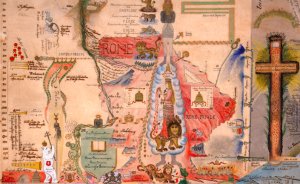
A small part of a diagram (1890) by Henri
Dunant, “explaining” the books of Daniel and
Revelation. Don’t worry: I’ll be clarifying
none of this.
The Olivet Discourse is so named because it was given on the Mount of Olives, a ridge to the east of Jerusalem, separated from it by the Kidron Valley. In all three of the Synoptics, Jesus delivers it in answer to questions from his disciples,1 which in turn have been prompted by a rather abrupt statement on their rabbi’s part. They’re in Jerusalem, a couple of days before Pesach, and after a visit to the Temple, he interrupts their admiration of its architecture with the remark that the Holy City—very specifically, the Temple—is going to be razed to the ground. According to most interpretations, including that of the Christians of Jerusalem about forty years after the Olivet Discourse was given, this part at least was fulfilled in the year 70, when the Second Temple was indeed destroyed, leaving nothing except the Wailing Wall2 (originally the western retaining wall of the artificially expanded hilltop on which sat the templar complex).
“That Ye Be Not Soon Shaken in Mind”
More broadly, this discourse is central to many versions of Christian eschatology, or the study of last things (from ἔσχατος [eschatos] “last”). This includes both the last things individuals experience, i.e. death and what comes after it, and also what are popularly called “the end times”—the Second Coming of Christ, also known as the Parousia, and the Last Judgment and new creation which follow. This is a pretty contentious area of debate between one Christian tradition and another, and sometimes even within Christian traditions. To generalize, there are two basic kinds of approaches to apocalyptic prophecy among Christians, often called the historicist and idealist positions.
- The idealist view does not see most prophecies as strongly tied to any specific moment in time—some versions would dispense even with the Second Coming—but instead considers prophecy a disclosure of spiritual events or states, which the elect or humanity in general must go through on their itinerarium mentis in Deum.3
- Historicist views, on the other hand, do expect to see something like a one-to-one correspondence between prophecies and events in time (however cryptic the relationship may be). Two common versions of historicism, the futurist and preterist schools of thought, are typically treated as basic positions in their own right. The short version of these is that the futurists are the people who produced the Left Behind series, and preterists think most-to-all prophecy in the New Testament was fulfilled as of the destruction of the Temple in 70 AD. (A few preterists join with some idealists in anticipating no literal Second Coming.)
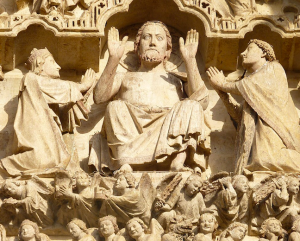
Sculpture (13th-c.) of Christ in judgment, from
the façade of Amiens Cathedral in northern
France. Photo by Wikimedia contributor Savant-
fou, used under a CC BY-SA 3.0 license (source).
Over the last couple hundred years, most of the contending here has been either intra-Protestant, or consisted in Protestant polemic against the doctrine of Purgatory (albeit a polemic overwhelmingly grounded in a complete misunderstanding of Purgatory), with some Catholic counter-critique, especially of Dispensationalist4 Protestant eschatology, usually short-handed as “the Rapture.”5 This sometimes has, sometimes hasn’t gone hand-in-hand with attempts to predict the Second Coming. At its most recklessly silly, eschatological speculation in these centuries gave rise to the Millerite movement of the 1830s and 1840s; its culmination on October 22, 1844 was known as “the Great Disappointment,” if that gives you any idea.6
And speaking of disappointments, we’ll be examining none of all that in detail. Not my circus—not my monkeys. We’ve had our periods of obsessive millenarianism, such as the fourteenth century; but nowadays among Catholics, the only element of eschatology that receives much attention is prayer for the souls in Purgatory, and even this is not much accented. (It is, after all, a mainly practical belief. Rather like the living, you don’t pray for the dead by winning a debate about the legitimacy of prayer for the dead; you just pray for them.) As for the rest, to judge from my own time in the Catholic faith, the normal sentiment—besides a certain sort of alarmist trad who is much more influenced by American Protestantism than he or she would ever willingly admit—seems to be: Christ will come back; that is all we need to know about this, and also all we do know about it. I hope I’m right in perceiving that as the most common Catholic attitude on this topic, because I’m also of the opinion that it is the correct attitude. My reasons for thinking so are rather neatly expressed in the Olivet Discourse itself, the focus of which is (to my mind, rather obviously) not at all on giving us tools for predicting the Parousia, but on bringing our attention to the spiritual implications of our ignorance. They’re the focus of textual note b below.
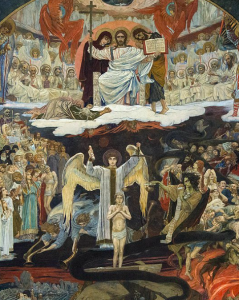
The Last Judgment (1904), by Viktor Vasnetsov.
Luke 21:5-19, RSV-CE
And as some spoke of the temple, how it was adorned with noble stones and offerings,a he said, “As for these things which you see, the days will come when there shall not be left here one stone upon another that will not be thrown down.” And they asked him, “Teacher, when will this be, and what will be the sign when this is about to take place?” And he said, “Take heed that you are not led astray; for many will come in my name, saying, ‘I am he!’ and, ‘The time is at hand!’ Do not go after them. And when you hear of wars and tumults, do not be terrified; for this must first take place, but the end will not be at once.”b
Then he said to them, “Nation will rise against nation, and kingdom against kingdom; there will be great earthquakes,c and in various places famines and pestilences;d and there will be terrors and great signs from heaven. But before all this they will lay their hands on you and persecute you, delivering you up to the synagogues and prisons,e and you will be brought before kings and governors for my name’s sake. This will be a time for you to bear testimony. Settle it therefore in your minds,f not to meditate beforehand how to answer; for I will give you a mouth and wisdom, which none of your adversaries will be able to withstand or contradict. You will be delivered up even by parents and brothers and kinsmen and friends, and some of you they will put to death; you will be hated by all for my name’s sake. But not a hair of your head will perish. By your endurance you will gain your lives.”g
Luke 21:5-19, my translation
And while some were speaking about the Temple, that it had been arranged with beautiful stones and votives,a he said: “Behold these things; days are coming in which not a stone will be permitted [to be] upon a stone, which shall not be destroyed.”
The south rose window of Angers Cathedral,
with zodiacal symbols in the upper petals.
Photo by Wikimedia contributor Chiswick Chap,
used under a CC BY-SA 3.0 license (source).
They questioned him, saying, “Teacher, when then will these things be, and what will be the sign whenever these things are about to happen?”
He said, “Look [and] do not be led to err; for many will come in my name, saying ‘I am’ and ‘The season is near’; do not follow behind them. Whenever you hear of wars and upheavals, do not be frightened; for these things are bound to happen first, but the end will not [come] straightaway.”b Then he told them: “Nation will be roused against nation and kingship against kingship, as well as great tremors,c and there will be famines and pestilencesd here and there; there will also be great terrors and signs from heaven.
“Before all these things, they will lay hands on you and chase you down, handing you over to the assemblies and jails,e leading you away to kings and leaders because of my name; it will be made to turn out for you as a witness. So keep it in your mindsf not to pre-plan how to defend yourselves, for I will give you a mouth and a wisdom which they will not be able to withstand, to speak against all those who oppose you. And you will be handed over by parents and siblings and relatives and friends, and they will put [some] of you to death, and you will be hated by everyone because of my name. And not a hair of your head will be lost. In your endurance, you will acquire your souls.”g
Textual Notes
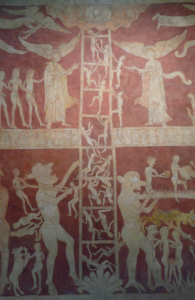
Part of a doom painting (mural depicting the
Last Judgment) from ca. 1170 in the Church of
St. Peter and St. Paul in Chaldon, Surrey, UK.
a. offerings/votives | ἀναθήμασιν [anathēmasin]: This word may look familiar; it is a relative of the term anathema. This derives from a verb, ἀνατίθημι [anatithēmi], the most rigidly literal rendering of which would be “to put up” or “to put back”; predictably, it acquired a wide range of meanings, including “to entrust to,” “to give credit to, refer to,” “to retract,” and “to set up, set in place.”
It appears to be through this last meaning that it came to mean “to dedicate”—dedication being something generally done in a temple. Sacrifices were a form of dedication, both in classical paganism and in Judaism. A thing that was being dedicated to God or to the gods needed, for reasons of symbolism, to be made unusable for the worshiper. After all, anybody can say “I had solemnly dedicated my silver unto the Lord from my hand” and then do with it whatever they had wanted to do with their silver anyway; but that doesn’t mean much, does it? Destroying or at least forsaking something, on the other hand, that has a cost. This is why objects dedicated to divinities were left at the deity’s shrine, and why animals sacrificed to them were killed—to dignify the act of offering by making it irrevocable. Via this concept of “devotion to destruction,” anathema went on to assume its later, retrospectively counter-intuitive, meaning: damnation. (Consider the parallel of a judge in a capital case pronouncing the death penalty and concluding with “May God have mercy on your soul,” so that that phrase took on the ominous atmosphere of its surroundings.)
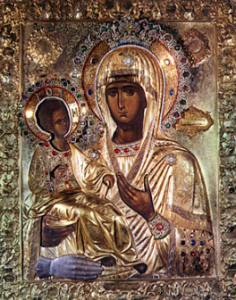
The Panagia Tricherousa [All-holy Three-handed]
ikon (date uncertain—8th-14th c.), a votive
traditionally ascribed to St. John of Damascus;7
it is now preserved at Mount Athos.
b. for many will come in my name, saying, ‘I am he!’ and, ‘The time is at hand!’ Do not go after them. And when you hear of wars and tumults, do not be terrified; for this must first take place, but the end will not be at once/for many will come in my name, saying ‘I am’ and ‘The season is near’; do not follow behind them. Whenever you hear of wars and upheavals, do not be frightened; for these things are bound to happen first, but the end will not [come] straightaway | πολλοὶ γὰρ ἐλεύσονται ἐπὶ τῷ ὀνόματί μου λέγοντες· Ἐγώ εἰμι καί· Ὁ καιρὸς ἤγγικεν· μὴ πορευθῆτε ὀπίσω αὐτῶν. ὅταν δὲ ἀκούσητε πολέμους καὶ ἀκαταστασίας, μὴ πτοηθῆτε· δεῖ γὰρ ταῦτα γενέσθαι πρῶτον, ἀλλ’ οὐκ εὐθέως τὸ τέλος [polloi gar eleusontai epi tō onomati mou legontes: Egō eimi kai: Ho kairos ēngiken: mē poreuthēte opisō autōn. Hotan de akousēte polemous kai akatastasias mē ptoēthēte: dei gar tauta genesthai prōton, all’ ouk eutheōs to telos]: It’s hard to be sure of the winner, but I think this text is in the running for “passage of Scripture most frequently ignored by self-professed Christians.” People come in Christ’s name claiming to know when the Second Coming is all the time. They are invariably wrong, and they invariably win an audience—not usually a huge audience, but sometimes they do manage that. And an audience of any size greater than zero is a crying embarrassment to everyone in it, when we are explicitly told that we do not know, that even the angels do not know, when the Parousia will occur. This is at its most explicit in the versions of the Olivet Discourse found in Matthew and Mark; but I’d like to outline why I think even Luke, who superficially seems to gloss over this “unknowability” doctrine, is in fact in full harmony with it.
Look back over the signs Jesus highlights in our text as indicative of his return. I count seven, some of them repeated in slightly different phraseology:
- False prophets (“many will come in my name … do not follow behind them”).
- Wars (“wars and upheavals … kingship against kingship”).
- Earthquakes (“great tremors”).
- “Famines.”
- Pestilences.”
- Omens from heaven (“great terrors and signs”).
- Persecutions (“they will lay hands on you … because of my name”).
Matthew 24:10-14 adds two more signs to our list:
- Apostasy (“the love of many shall wax cold”).
- Universal evangelization (“this gospel of the kingdom shall be preached in all the world”).

Composite photograph of the 15 April 2014
total lunar eclipse, seen from Charleston WV.
Photo by Robert GaBany, used under
a CC BY-SA 3.0 license (source).
Okay. Think hard: at what periods in history have there been wars?
Right, tuck that away. At what periods have there been natural disasters (droughts, plagues, volcanic eruptions, etc.)?
Good. Now. What periods of history have featured religious turmoil?—persecution, evangelization, apostasy, etc.
And finally: which centuries have had people hawking astrological predictions? or, really seeing comets and eclipses?
If you said “All of them” to all of those questions, you are correct. And I’m pretty sure that that’s the point here. Jesus has given us a list of signs that are thoroughly useless! That is, they’re useless if you’re trying to predict his coming. Which he assures us, in the clearest terms imaginable, we cannot, cannot do. Attempting it is prying into secrets the angels themselves do not know; the knowledge was apparently withheld even from Christ’s own humanity! Aside from the impiety, the sheer silliness—

Margaret Roper (née More), from a reproduction
(1593) of a portrait of the women of the More
family by Hans Holbein the Younger.
There is a scene in A Man for All Seasons,8 during Thomas More’s imprisonment, where he is finally permitted to see his family after months of refusals. The refusals were an attempt to break him, and the attempt was well-chosen: More doted on his family, especially his eldest daughter, Margaret (Meg); he personally educated her, teaching her rhetoric and logic and the finest Latin of the Renaissance, and early in the film we see her speaking it more fluently than the king! But for all his affection, being separated from them has not broken More’s will, and so another tactic is tried. Mrs. More, his son-in-law William Roper, and Meg, Roper’s wife, are let into his cell; More is overjoyed; but as soon as greetings have been made, a sudden discomfort fills the place.
MORE: What is it?
MEG: (Pause) Father, come out. Swear to the act and come out.
MORE: (Pause) Is this why they’ve let you come?
ROPER: Meg’s under oath to persuade you.
MORE: (Disappointed and horrified) That was silly, Meg.
That is the meaning I want to invoke when I call end-times predictions “silliness.” It is not silly the way a game is silly—because it’s not a game. It is childish, yet capable of inflicting disaster. People’s real lives get caught up in this nonsense, sometimes even ruined by it. Miller and his “Great Disappointment” sound funny, but there are people who’ve sold everything they own in response to predictions of the Parousia, because they believed the predictions and thought they wouldn’t need possessions any more.
So if they’re not for predictive purposes, what is the point of these signs, according to me? I think they were given to accent the central point of the Olivet Discourse, which is that of incessant preparedness. In practice, that means focusing on the task in front of us, whatever that may be, according to our station in life and vocation (“Who then is the faithful and wise servant?”). Wars and rumors of wars, pestilence and famine, omens and apostasies—these things are always happening; therefore any moment could be the moment of his return. As George MacDonald put it in Unspoken Sermons,
Do those who say, lo here or lo there are the signs of his coming, think to be too keen for him, and spy his approach? When he tells them to watch lest he find them neglecting their work, they stare this way and that, and watch lest he should succeed in coming like a thief! So throughout: if, instead of speculation, we gave ourselves to obedience, what a difference would soon be seen in the world!
c. earthquakes/tremors | σεισμοί [seismoi]: Σεισμός [seismos] is actually a little broader in meaning than even my translation, covering not only earthquakes but windstorms and even, by analogy, anything that can be generically called “commotion.”
d. pestilences | λοιμοὶ [loimoi]: This term could also refer to diseases, but to some extent implied pestilence specifically: i.e., the kind of thing caused by a pest, an infestation of some sort—rats, weevils, lice, etc.
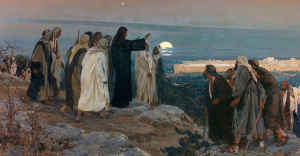
Flevit Super Illam [He wept over it] (1892),
by Enrique Simonet; cf. Luke 19:41.
e. synagogues and prisons/assemblies and jails | συναγωγὰς καὶ φυλακάς [sünagōgas kai fülakas]: Both the RSV’s choice here and mine, about both words, are not only translations, but interpretive decisions.
The former, synagogues versus assemblies, is one of those cases where making a somewhat-interpretive choice is unavoidable. Συναγωγή [sünagōgē] comes from a basic Greek verb, ἄγω, meaning “to lead, bring, gather, draw along,” plus the simple preposition σύν “with.” Hence, a συναγωγή is literally a “gathering place” or “hall of assembly.” But the word had already begun to carry the specialized it now has in our loanword “synagogue,” i.e. a place in which specifically Jews gather for sabbath services: evidently it was already clear even to Gentiles that what was done at a synagogue was not the same kind of thing as what was done at a shrine to Apollo or Cybele or Isis. (We are so far removed from the religious outlook of antiquity, we often fail to appreciate how starkly different revealed religions are from—I’m not sure what else to call them—unorganized religions.) So this text can be read either as an at-least-possibly generalized warning of persecution (the way I’ve translated it), or one that specifically “expects trouble,” so to speak, from establishment Judaism.
As for prisons versus jails, the difference is of course not very great; but insofar as it exists, prison indicates a place you’re sent as a long-term punishment, whereas jail is a place you’re held temporarily, while the authorities figure out whether to send you to prison or fine and release you or what. Since the prison system is a predominantly modern phenomenon,9 “jail” seemed like the more fitting term.
f. Settle it therefore in your minds/So keep it in your minds | θέτε οὖν ἐν ταῖς καρδίαις ὑμῶν [thete oun en tais kardiais hümōn]: Literally, “Put it, then, into your hearts.”
g. By your endurance you will gain your lives/In your endurance, you will acquire your souls | ἐν τῇ ὑπομονῇ ὑμῶν κτήσασθε τὰς ψυχὰς ὑμῶν [en tē hüpomonē hümōn ktēsasthe tas psüchas hümōn]: The RSV’s rendering here is very probably the correct interpretation; and, for a change, I won’t maunder about “interpretation masquerading as translation” here, because ψυχή [psüchē] does mean “life” as well as “soul”—at its most literal, it means “breath” (and is thus parallel in sense to the Latin spiritus, with its related derivatives like “inspire” and “conspire”10). Nonetheless, the idea of gaining a soul by means of perseverance, as if one didn’t have a soul before then but built it out of suffering, resonates with me. It reminds me of the opening passage of The Prophet:

First edition (1923) cover of The Prophet. The
design, showing souls like flames in the hand
of God, is (if I recall correctly) also by Gibran.11
…Almustafa, the chosen and the beloved, who was a dawn unto his own day, had waited twelve years in the city of Orphalese for his ship that was to return and bear him back to the isle of his birth.
…And in the twelfth year, on the seventh day of Ielool, the month of reaping, he climbed the hill without the city walls and looked seaward; and he beheld his ship coming with the mist.
…Then the gates of his heart were flung open, and his joy flew far over the sea. And he closed his eyes and prayed in the silences of his soul.
…But as he descended the hill, a sadness came upon him, and he thought in his heart:
…How shall I go in peace and without sorrow? Nay, not without a wound in the spirit shall I leave this city.
…Long were the days of pain I have spent within its walls, and long were the nights of aloneness; and who can depart from his pain and his aloneness without regret?
…Too many fragments of the spirit have I scattered in these streets, and too many are the children of my longing that walk naked among these hills, and I cannot withdraw from them without a burden and an ache.
…It is not a garment I cast off this day, but a skin I tear with my own hands.
…Nor is it a thought I leave behind me, but a heart made sweet with hunger and with thirst.
…Yet I cannot tarry longer.
…The sea that calls all things unto her calls me, and I must embark.
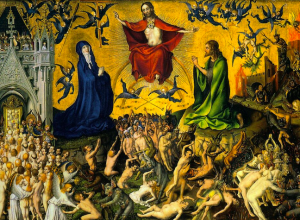
Het Laatste Oordeel [The Last Judgment] (ca.
1435), by Stefan Lochner.
Footnotes
1In Matthew, it’s specified that this discourse was delivered quasi-privately to SS. Peter, James the Greater, John, and Andrew. Judging from the four listings of the Apostles found in the Gospels and the book of Acts, these four may have been the “AP students” of the bunch. (The first three, sans Andrew, appear to have been Christ’s “inner circle”; they were the only ones permitted to witness certain events, including the resurrection of Jairus’ daughter, the Transfiguration, and the prayer in agony at Gethsemane.)
2This expression is rarely if ever used by Jews, some of whom find it offensive (looking into it a little, I found conflicting reports on that question); it originates from periods when Gentile authorities, generally either Christian or Muslim, were in control of Jerusalem and, in some cases, only allowed Jews into the city on Tisha b’Av (“the Ninth of Av“), an observance in mid-summer commemorating the Temple’s two destructions. The more usual terms among Jews are “the Western Wall” or “the Kotel,” from the Hebrew הַכּוֹתֶל הַמַּעֲרָבִי [ha-Kouthel ha-Maurâvy] which means the same thing.
3This Latin phrase (used by St. Bonaventure as the title of a book) means “the journey of the soul into God.”
4Dispensationalism is a school of Biblical interpretation among Protestants which took shape in the nineteenth century, associated with the names of missionaries and scholars such as John Nelson Darby, Dwight L. Moody, and Cyrus Scofield. Among other … novel elements in their system, this school interprets the text of the Bible as being essentially literal in all cases (or at most presented in a sort of code, like a roman à clef), ignoring distinctions of genre.
5That is, I assume and hope that most Catholic allusions to the Rapture are using the term as a shorthand for Dispensationalist beliefs about the end times in general. For any who are unfamiliar, in the strict sense, “the Rapture” is the belief that at some point preparatory to the Second Coming, Christians in general will be assumed into heaven; this usually goes along with the broader complex of Dispensationalist eschatology, which requires a complex timeline of events that is difficult to explain without diagrams. Catholic apologists are habitually derisive about “the Rapture,” which is why I infer that by this they generally mean the whole complex of Dispensationalist eschatology. I can understand derision for that; it rapidly becomes harder to follow than the apocalyptic books it ostensibly interprets. But to single out the Rapture as a shorthand for this doctrinal complex, and therefore say things like “the Rapture isn’t in the Bible,” seems to me not only unkind but unwise. See, when taken in the strict sense and apart from the rest of the complex—and many Protestants define their beliefs eclectically, so they habitually do exactly this—the Rapture is just about the only thing in Dispensationalism that can claim serious warrant from the New Testament. The Olivet Discourse (Matthew 24:37-42) and the writings of Paul (I Thessalonians 4:13-17) both describe something that, at the very least, does sound like the Rapture; you don’t need any tortuous hermeneutics to see how they got from those texts to this doctrine—the tortuous hermeneutics only come in with all the other stuff they claim about the end times. As a result, ridiculing the Rapture plays into the hands of many Protestants who (in a sense, laudably) wish to convert Catholics. They often see some success, especially among the poorly-catechized, who may pardonably think denying the Rapture confirms their Protestant friends’ assertions that the Catholic Church contradicts the Bible and tries to hide it from the laity. It would be better to instead just take a few extra seconds and say explicitly that Catholics reject the labyrinthine, and genuinely unscriptural, Dispensationalist approach to eschatology as a whole.
6Miller was exceedingly influential in his day—bizarrely, he even affected the formation of the Bahá’í faith (a sect of Bábism, which is in turn derived from Shia Islam). After the “Great Disappointment,” the main body of the Millerites stuck with their provèdly-false prophet and continued experimenting with their belief system. The majority ultimately evolved into the Seventh-day Adventist Church, which was found in a survey conducted in 2007 to be the twelfth-largest Protestant denomination in the world. To their credit, the Seventh-day Adventists have for the most part become increasingly normal as time has gone on (e.g. by eventually accepting the doctrine of the Trinity).
7Reputedly, this votive has three hands for the same reason it was made in the first place: St. John of Damascus, who had been serving as vizier to Caliph Al-Walid I, was falsely accused of betraying his lord and had his hand cut off as a punishment. While praying before an ikon of the Mother of God, his hand was miraculously restored, and he created this ikon as an act of thanksgiving, including a silver replica of his restored hand (visible at the lower left corner).
8By and large, the film and the play it is based on are fairly historically accurate—More’s speech before his sentencing is taken almost word-for-word from Will Roper’s biography of his father-in-law, written in the 1550s during the reign of Mary I (though not printed until 1626). However, while More’s behavior and dialogue remain in character even in the unhistorical episodes of both, they do contain unhistorical elements, this scene among them. (In reality, Margaret Roper often visited her father during his imprisonment, and smuggled letters in and out of his cell.) Another inaccuracy is the development of Roper’s beliefs: the play and film represent him as reverting to Catholicism in order to marry Meg, but historically, he was already her husband when he embraced Lutheranism, though he did credit his father-in-law’s arguments with him and prayers for him for his eventual reversion.
9Long-term imprisonment was not absolutely unknown in the Classical world, but dedicated prisons were very few, and imprisonment did not become a standard penalty for crime until the sixteenth century. Normal punishments in Europe included: public humiliation, e.g. via the stocks; fines; flogging; hard labor; degradation, i.e. loss of class privileges—this of course applied only to nobility and clergy; enslavement; exile, either permanent or temporary; and execution. Most of these punishments were also standard elsewhere during the same periods, though other societies (such as the Chinese or the Inca) were more apt to include bodily mutilation as a form of legal punishment.
10Hyper-literally, these words mean “to breathe into” and “to breathe together with,” the latter suggesting the image of conspirators whose heads are so close together that they must breathe the same air.
11G. Kahlil Gibran (1883-1931), Lebanese by birth, immigrated to the United States with his family in 1895, and became an internationally acclaimed artist and writer. The Prophet is his most celebrated work, showing the influence both of Sufi mysticism and of his own heritage as a Maronite Catholic.









 Ad-Free & Subscriber Log-In