

The Last Solemnity of the Year
The final Sunday of the liturgical year, coming up on the 23rd, is the Solemnity of Our Lord Jesus Christ, King of the Universe. In Latin, it is called Sollemnitās Dominī Nostrī Jēsū Christī Ūniversōrum Rēgis, which has got an excellent ring to it. (The new liturgical year, MMXXVI [2026], will begin at sunset on 29th November, civil year 2025.)
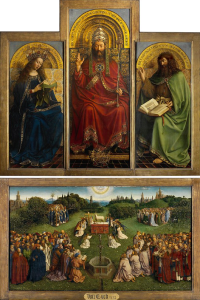
Central panels of the Ghent Altarpiece (1432),
by either Jan or Hubert van Eyck; the upper
panels show Christ in glory flanked by the
Virgin (left) and St. John the Evangelist (right).
Personally, I’m a little torn about the title of this feast. Part of me kind of wishes we’d rendered it “Creation” instead of “the Universe,” partly because I think the word “creation” sounds a little nicer than “universe” in English—not that “universe” sounds bad or something. (That doesn’t work so well with the Latin creātiōnis, which would tend to mean the act of making rather than the thing made, though you could of course use creātūræ for “creation,” or say creātōrum “created [things].”) It’s partly also because I like the way “creation” alludes to the beginning of time: this is the closest thing we have to a feast of the Parousia (which we can’t really commemorate, as it’s in the future!), and it feels appropriate to thus tie the two ends of time together—especially since Doomtide deliberately puts us in mind of Christ’s second advent before we transition into preparation for the anniversary of his first advent in the eponymous season.
However, I’m torn rather than disappointed, because there is also something to be had from its being “universe” and not “creation.” That something is the sense of the cosmic. I’ve often said that certain elements of the Christian faith have a distinctively sci-fi atmosphere; I point especially to the non-human and, for the upper choirs, technically extraterrestrial intellects brought in by angelology, and the trippy relationship (or lack thereof?) between time and causality established by the doctrine of the Immaculate Conception. This comes through strongly in some of the Church Fathers, and in certain artistic motifs and Dominical titles. Depictions of the Ascension or the Last Judgment occasionally evoke this feeling, as do a few examples of what’s called the Session of Christ (session here means “sitting,” i.e. enthronement, from Lat. sedēre “to sit”), which are frequently related to both.
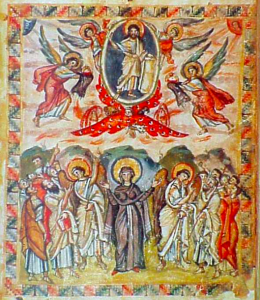
Illumination of the Ascension from the Rabula
Gospels (6th c.), a Byzantine Gospel-book
composed in Syriac.
This solemnity, originally a feast, was introduced in the 1920s. Coincidentally—or not—this was right around the last time fascism was ramping up in what had been liberal democracies until recently. Heads of state in general, especially authoritarians, and really especially fascists, resent Christ’s claim to total allegiance: they want, expect, demand, our total allegiance. And one of the essential elements of the Christian faith is telling them No. They don’t get to have that.
I often find myself frustrated with fellow left-leaning believers who talk about “Christ is Lord” being a piece of political theology. They have a tendency to proceed from there immediately into things like what the modern state’s poverty policies ought to look like; which, to me, feels like claiming Christ-hood for their particular political program. Even when I agree with their political program, I consider it totally inappropriate to give it that kind of loyalty, because a political program can never be more than probably best under the circumstances, never more than the best efforts of mere human beings in the world we know (and will probably be a good deal less). But it’s nevertheless true: “Christ is Lord” is a piece of political theology. That phrase does not necessarily conceal the kind of fifth-column designs that many rulers think or fear it does, but it does contain a permanent rebuke to the divinization of Cæsar. Whether he be the vacillating, world-weary type who rolls his eyes at the local loony and says “Oh, and what’s truth? Do tell,” or a son of her bosom who is so pious as to be downright superstitious (and perhaps feels accordingly that he’s earned special treatment), or a committed anti-Christian warrior determined for reasons of principle to stamp out this foreign influence—it speaks of a loyalty that will outlast all loyalties to him, and which he will one day have to face.
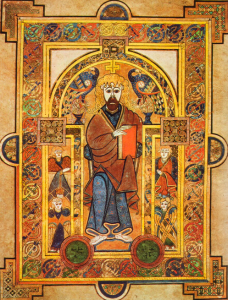
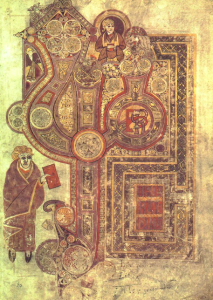
Illumination of Christ enthroned
from the Book of Kells (ca. 800).
Our readings for this feast come from the letter to the city of Colossæ and the Gospel According to St. John. (Well, and also the Lesson is from II Samuel, but my Hebrew isn’t nearly good enough to tackle that, so I’m just doing the Epistle and Gospel!) In this post, I’m just doing the first, as I turned out to have a lot to say about it.
Colossians
Colossians is traditionally ascribed to St. Paul. Many (not all) modern scholars dispute the ascription, but I accept it, as I find the case against unpersuasive—see this post for my rant about the Pauline epistles generally.
The city of Colossæ now consists only in ruins. Its history may go as far back as the seventeenth century BC, if it is the same place as the one the Hittites called Huwalušija; its great days of prosperity were under the Persian Empire in the fifth and fourth centuries BC. The city had shrunk somewhat by the first century CE, when Christianity came there. Oddly, it is not known for certain who brought it. Acts doesn’t mention Colossæ, and a couple of phrases in the letter itself suggest that Paul had never personally visited the city. It’s possible the gospel reached the city through Epaphras: he’s mentioned twice in Colossians and once in Philemon, was apparently a student of Paul’s on a similar level to Timothy, and is traditionally credited with being the first Bishop of Colossæ (followed by Philemon). In any case, the place continued to wane, and it was ultimately abandoned at an unknown date near the end of the Early Middle Ages. (The meaning of its name is uncertain, although at least one ancient author relates it to the adjective κολοσσός [kolossos], as in “the Colossus of Rhodes.” Κολοσσαί [Kolossai] would appear to be the feminine plural, which made me think of the beautiful yet baffling T. S. Eliot line, “The worlds revolve like ancient women.”)

The remains of Colossæ’s acropolis (close to
modern Honaz, Turkey), photographed
by A. Savin.
The text from Colossians which we hear at Mass for this solemnity is just a bit silly: it is selected from the middle of what is, in the Greek, a single, gigantic run-on sentence! My three-verse extensions in both directions are not because the selection the USCCB has made can’t be understood without the extra context, but merely to bring us back to the beginning, and then take us forward to the end, of the Greek sentence in question.
Colossians 1:9-11, 12-20, 21-23, RSV-CE
And so, from the day we heard of it, we have not ceased to pray for you, asking that you may be filled with the knowledgea of his will in all spiritual wisdom and understanding, to lead a life worthy of the Lord, fully pleasing to him, bearing fruit in every good work and increasing in the knowledge of God. May you be strengthened with all power, according to his glorious might, for all endurance and patience with joy, giving thanksb to the Father, who has qualified us to share in the inheritance of the saints in light. He has delivered us from the dominion of darkness and transferred us to the kingdom of his beloved Son, in whom we have redemption, the forgiveness of sins.
He is the imagec of the invisible God, the first-born of all creation;d for in him all things were created, in heaven and on earth, visible and invisible, whether thrones or dominions or principalities or authoritiese—all things were created through him and for him.f He is before all things, and in him all things hold together. He is the head of the body, the church;g he is the beginning,h the first-born from the dead,i that in everything he might be pre-eminent. For in him all the fulness of Godj was pleased to dwell, and through him to reconcile to himself all things, whether on earth or in heaven, making peace by the blood of his cross.
And you, who once were estranged and hostile in mind, doing evil deeds, he has now reconciled in his body of flesh by his death, in order to present you holy and blameless and irreproachable before him, provided that you continue in the faith, stable and steadfast, not shiftingk from the hope of the gospel which you heard, which has been preached to every creature under heaven, and of which I, Paul, became a minister.
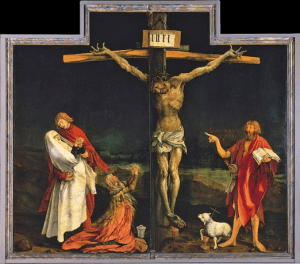
Crucifixion from the Isenheim Altarpiece
(1512-1516) by Matthias Grünewald.
Colossians 1:9-11, 12-20, 21-23, my translation
On account of this we too, from the day we heard of it, have not stopped praying for you and asking in order that you may be filled with recognitiona of his will and spiritual intelligence, to walk in a way worthy of the Lord, in all complaisance, bearing fruit in every good work and growing in the recognition of God, empowered in every power according to the strength of his glory in all endurance and longsuffering with joy, giving thanksb to the Father who qualifies you for a part in the lot of the holy ones in the light, who rescued us from the authority of darkness and removed us into the kingship of the Son of his love, in whom we have the ransom, the remission of errors; who is the imagec of the unseen God, the firstborn of all creation,d because in him were created everything in the heavens and on earth, seen and unseen, whether thrones or lordships or princes or authorities;e all things are created through him and for him;f and he is before everything, and all things have held together in him, and he is the head of the body, the convocation;g who is the prince,h firstborn of the dead,i in order that he might come to have first place in everything, because it seemed good to all the fullnessj to dwell in him and through him to conciliate everything in him, making peace through the blood of his cross, whether on earth or in the heavens; and you, when you were estranged and hostile by mindset in oppressive works—now, you are conciliated in the body of his flesh through death—to present you holy and unblemished and irreproachable before his face, if indeed you remain in the faith, founded and settled and not stirred upk away from the hope of the good news which you heard, that heralded in all creation which is under heaven, of which I, Paul, became a servant.
Textual Notes
a. knowledge/recognition | τὴν ἐπίγνωσιν [tēn epignōsin]: The Greek term γνῶσις [gnōsis] has been borrowed into English, sort of, especially in the context of discussions about Gnosticism. Now, before we proceed, it is important to note that I have forbidden everyone in the world (yes, THIS MEANS YOU) to use the word “Gnosticism.” Only I am allowed, until you have all proven to me that you can behave. And for your information, young man, referring to things as “a modern form of Gnosticism” is proof to me that you cannot behave.
As it happens, Gnosticism will be coming up in note j, but it doesn’t really affect this. Here, I want only to note the connotations of the term ἐπίγνωσις [epignōsis], which reproduce a verbal distinction common in several other European languages, but which English has to get at by periphrasis. The difference is between two kinds of knowing—if you studied French or Spanish in high school, you may recall the connaître–savoir or conocer–saber distinctions, where one verb means “to know” as you know someone on a personal level, while the other means “to know” as you know mere facts about something or someone. The word ἐπίγνωσις roughly aligns with the former sort of knowing, hence my decision to translate it as “recognition” instead of the more generic “knowledge.”
b. giving thanks | εὐχαριστοῦντες [eucharistountes]: I note this not for linguistic reasons per se, but because of a gripe it prompts me to about the Lectionary itself. The Second Reading, as presented on the USCCB’s website, begins “Brothers and sisters: Let us give thanks to the Father, who has made you fit,” etc.
I’m not here complaining of the insertion of “Brothers and sisters”—that is a stock phrase added to many readings from the epistles, intended to signal that these words are for us as well as the original addressees of the reading, and maybe wake up anybody who dozed off during the Psalm. My issue is with the grammatical change this introduces into the text: it alters the subject of this sentence. Look back at the beginning of the reading: “we too … have not stopped praying for you and asking that you may be filled with recognition of his will … giving thanks to the Father,” etc. Now, for grammatical reasons,1 the “we” of that phrase in both the RSV and my version is a little vague: it could be pointing either to the addressees of the letter (the Colossians), or to its authors (SS. Paul and Timothy). That’s not what the modified reading provided by the USCCB suggests. It makes of this a general exhortation, addressed to an inclusive “us.”
Now, it must be said that the change in meaning here is absolutely minuscule. “We pray that you give thanks” and “Let us, collectively, give thanks” is a tiny difference, noticeable only on technical grounds; and obviously both the indicative We pray that you do X and the soft-imperative Let us do X are, under virtually any circumstances, both going to apply, and both do apply here. I am not seriously contending that anyone is going to somehow extract some heretical meaning from this redaction of the epistle, or that it’s “not Colossians any more,” or anything like that.
What I don’t like about it is simply and solely that it is a change at all. I don’t like the light-minded attitude to Scripture that this suggests, or the example it sets of fiddling with its text; I’m inclined to regard it as scandalous, especially in a world where such huge numbers of extremely ignorant people think the Church has been deliberately corrupting the text of Scripture for thousands of years. Because maintaining the original subject, by just adding in even part of verse 9, would be simplicity itself. I don’t like seeing a change made for convenience, when the alternative inconvenience would cost practically nothing. (It is only fair to add that even if my concern is valid in principle, I may still be nitpicking.)
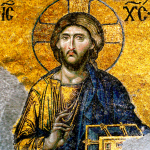
c. image | εἰκὼν [eikōn]: This word is the source of our icon (and its variant, which I use when referring to the religious object, ikon). However, it bears saying that an εἰκών in antiquity was not normally a thing of solely or even primarily symbolic force; the word implied exact visual similarity—one of its senses is “reflection in a mirror.”
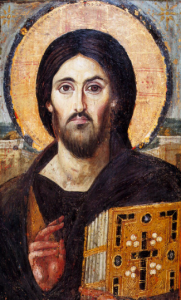
6th-c. ikon of Christ Pantokrator from St.
Catherine’s Monastery, one of the oldest
Byzantine ikons in existence.
d. first-born of all creation/firstborn of all creation | πρωτότοκος πάσης κτίσεως [prōtotokos pasēs ktiseōs]: This is occasionally taken by Arianizing2 sects (e.g. Jehovah’s Witnesses) as evidence that the Son must be a created being rather than, in the strict sense, God, the way the Father is God. However, this is based on a misunderstanding—not of the Greek exactly, but of the legal significance of being a “firstborn.” This was a kind of office in the ancient world (particularly the ancient Near East): not all eldest sons qualified, and it carried a certain responsibility for, and prestige with, the family as a whole. The title firstborn is about nobility and authority—not about where in the literal temporal sequence its holder fell.
e. thrones or dominions or principalities or authorities/thrones or lordships or princes or authorities | θρόνοι εἴτε κυριότητες εἴτε ἀρχαὶ εἴτε ἐξουσίαι [thronoi eite küriotētes eite archai eite exousiai]: These are generally understood to be not earthly powers, but various types of angelic beings. In the famous corpus of pseudo-Dionysius,3 the names θρόνοι, κυριότητες, ἀρχαὶ, and ἐξουσίαι correspond to what we now call Thrones, Dominations, Principalities, and Powers (whose roles are sketched briefly in the opening part of this post). Whether they had these precise meanings in the first century—or, for that matter, how settled angelological jargon even was at the time—seems less certain.
f. through him and for him | δι’ αὐτοῦ καὶ εἰς αὐτὸν [di’ autou kai eis auton]: More literally, “through him and into him.”
g. the church/the convocation | τῆς ἐκκλησίας [tēs ekklēsias]: The traditional rendering of this word is “church” (which does also come from Greek, but not from ἐκκλησία; it descends, rather, from κυριακόν [küriakon], “[thing] pertaining to the Lord,” which has a slightly more transparent offspring in the Scots cognate kirk). In the Septuagint, ἐκκλησία is often used to translate the Hebrew word קָהָל [qâhâl], the ancestor of the Ladino4 word kal—still used in some Sephardic circles as the equivalent of the Yiddish shul, “synagogue.”
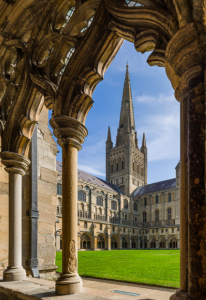
The spire of Norwich Cathedral, viewed from
the church’s cloister. Photographed by David
Iliff, used via a CC BY-SA 3.0 license (source).
Within Greek, the noun is a derivative of ἐκκαλέω [ekkaleō], meaning “to call forth, summon.” The typical rendering of ἐκκλησία is therefore “assembly.” However, as I took the word “assembly” only last week to translate συναγωγή [sünagogē], I didn’t like to inconsistently also use it for this quite unrelated term, so I cast about for a synonym; I settled on “convocation” because, etymologically,5 it does in fact have the same structure and significance as ἐκκλησία.
h. beginning/prince | ἀρχή [archē]: This represents one more installment in my endless quest to figure out some way of representing ἀρχή in English that I don’t find hopelessly unsatisfying. It has two basic strands of meaning, one connected with “authority, rulership, power de jure,” while the other centers upon “origin, source, beginning.” Prince, with its faintly-perceptible etymological link to priority, is my best attempt so far—though come to think of it, perhaps there’s something I can do with “priority.”
i. the first-born from the dead/firstborn of the dead | πρωτότοκος ἐκ τῶν νεκρῶν [prōtotokos ek tōn nekrōn]: Since we’ve already touched upon the meaning of πρωτότοκος, what I have to say here is not so much a comment on the text’s meaning, more just an observation: the title “firstborn of the dead” is incredibly metal and I love it.
j. all the fulness of God/all the fullness | πᾶν τὸ πλήρωμα [pan to plērōma]: The insertion of the phrase “of God” here is not (as far as I can tell) due to a difference in manuscripts—some reading πλήρωμα τοῦ θεοῦ [plērōma tou theou], “fullness of God,” and others simply πλήρωμα, “fullness,” say. Everything from the Textus Receptus to my hardcopy of the 1993 Nestle-Aland has πλήρωμα by itself.6 So this is a, sigh, clarification put in the text by the editors of the RSV; in other words, it is my bête noire: interpretation representing itself as translation. (I note with pleasure that the USCCB’s version does not do this.)
The rest of this note (the part in small print) is of primarily historical interest—feel free to skip it if you’re just here for the strictly textual commentary.
Now then, about Gnosticism.
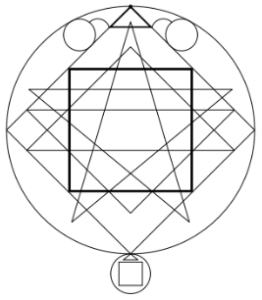
Diagram of the Valentinian Gnostic concept of
the Pleroma, by Wikimedia contributor Gesbar.7
Gnosticism is a vague name for a vaguer collection of sects, many of which were Christian heresies, that throve8 primarily in the second and third centuries CE. It was, to a degree, more of a vibe than a clearly-defined set of beliefs. Applying the name isn’t unlike calling something “New Age”: it’s not meaningless, but it’s not an academically rigorous label, either.
Common Gnostic beliefs included the following:
- A strong moral dualism, explained as a cosmic warfare between good and evil. This was almost invariably associated with the symbols of light and darkness.
- Identification of the moral duality with the duality of spirit and matter: the spiritual is good, almost without qualification in some sects; the material is evil, especially the body.
- The deity who created the material universe is not the supreme God, but a lesser Demiurge—in the words of one Charles Bigg, “one who, while powerful enough to create, is silly enough not to see that creation is wrong.”9
- Complex pantheons or hierarchies of spiritual beings which emanate from, or constitute, the Godhead.
- The elect—which need not mean humans in general, and usually didn’t—were originally exalted spirits, or parts of some greater spirit, but sank or were broken off and fell into the material plane.
- Another of the divine emanations descended into material creation to rescue the elect from darkness by sharing secret knowledge (γνῶσις [gnōsis]), often including secret allegorizations of the Bible. This savior is often, but not always, Jesus, or a spirit associated with Jesus.
- The assignment of the planets (and sometimes the zodiacal constellations as well) to the control of malevolent spirits, sometimes known as the Archons. In some sects, the γνῶσις in question literally meant magical formulæ the initiate needed in order to force the Archons aside during their post-mortem ascension out of the physical world.
- An ascetic moral code. This often laid special emphasis on avoiding all association with sex, endorsing not only celibacy but vegetarianism for this reason.10
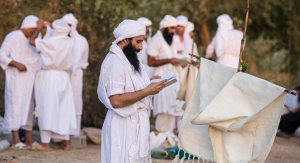
Modern-day Mandæans. Photo by Morteza Jaberian
of the Tasnim News Agency, used via
a CC BY-SA 4.0 license (source).
As I said, these are common traits of Gnostic churches, but none of them was universal. Cerinthus attributed creation to the Demiurge, but saw him as an exalted and holy being; the Mandæans (the only Gnostic sect to survive to this day) revere John the Baptist but consider Jesus an apostate; Marcion rejected all allegorical interpretations of the Bible; Valentinus took the basically Platonist line that there was nothing really wrong with matter, it was just inferior to spirit. And the ascetic ethic, while more usual among Gnostics, was prone to being surprisingly inverted: the Barbeloites, Cainites, and Carpocratians (reputedly) reasoned that since the body is evil, it is a duty to defile it, and were therefore moral libertines.
Moreover, later groups with some similar traits are sometimes also loosely referred to as Gnostic, or as theosophical (both terms are a little anachronistic when so used). Manichæism is an example: it was a real “who’s who” of religions, syncretized from Buddhist, Christian, Gnostic, Jewish, and Zoroastrian elements by the third-century prophet Mani, a native of the Parthian Empire. Manichæism rose to the status of a world religion for several centuries; it saw its greatest success in Central and Northern Asia, and had a significant presence in Yuan China, but was devastated—possibly altogether eradicated—by a combination of the Black Death and the xenophobic policies of the newly-enthroned Ming dynasty in the fourteenth century. The heretical beliefs of the Medieval Cathars, a.k.a. Albigenses, are a little murky, but it has long been speculated that they were influenced by the (still murkier) Bogomils of the Bulgarian Empire, who in turn are speculated to have had Manichæan influences of their own; the Jewish mystical tradition of the Kabbalah may also owe something to Gnosticism.11
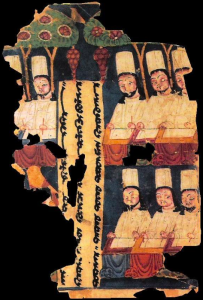
Fragment of a manuscript (8th-9th c.) in the
Sogdian language with an illumination of
Manichæan scribes, created in the Tarim Basin
in what is now northwestern China.
I digress into Gnosticism here, because that term—πλήρωμα—was a key one in some prominent versions of Gnosticism. In the fairly successful Valentinian Gnostic church, for instance, a pleroma of thirty αἰῶνες [aiōnes], meaning “ages” or “worlds,” were the divine offspring of Bythus, (the artist formerly known as God the Father, now re-titled Βυθός [Büthos], “the Deep”; no this isn’t weird, why would this be weird). The youngest αἰών, Sophia (same as σοφία “wisdom”), attempted to grasp Bythus within herself and therefore shattered, but was rescued from her self-made mess by another αἰών, I forget which. In any case, the elect are those fragments of Sophia which still need to be reunited to her and thus drawn back up into the pleroma. (Incidentally, Valentinus had been a serious candidate for the papacy; it was after he lost the election to St. Pius I in the year 140 that he took his ball and went home, and turned the ball into an insane series of emanations and ogdoads and whatever. And modern trads complain about Amoris Lætitia as “innovation” and “confusing,” despite the fact that it’s a perfectly tame restatement of the pastoral principle of gradualism, a concept so new that it’s only existed since the days of the First Temple. Seriously, people. Get ahold of yourselves.)
The upshot of all … that, is that πλήρωμα was one of the terms used by Gnostics to try and “sell” their ideas as authentically Christian. It may also have come up in exchanges between Gnostics and Platonists: in Middle Platonism and Neo-Platonism, the world of νοῦς [nous] or the noetic plane bears some resemblance to the Gnostic conception of the πλήρωμα, and we know there was interchange between Neo-Platonism and Gnosticism, because Plotinus (the third-century founder of Neo-Platonic philosophy) devotes part of his Enneads to refuting Gnostic ideas.
k. stable and steadfast, not shifting/founded and settled and not stirred up | τεθεμελιωμένοι καὶ ἑδραῖοι καὶ μὴ μετακινούμενοι [tethemeliōmenoi kai hedraioi kai mē metakinoumenoi]: It struck me for the first time while reading this that this sequence of participles, perhaps accidentally, parallels the famed sequence of verbs in the opening verse of Psalm 1:
Blessed is the man that walketh not in the counsel of the ungodly,
nor standeth in the way of sinners,
nor sitteth in the seat of the scornful.
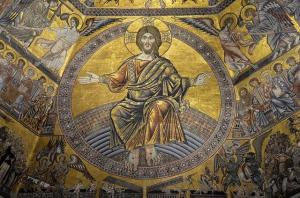
Christ in majesty from the ceiling of the
Florentine baptistery.
The increasingly fixed posture of the foolish of Psalm 1, who go from walking to standing to sitting, sounds like someone running out of energy; that stillness is superficially reflected in the increasingly secure position of the faithful as presented by St. Paul here—first founded (as one who lays a foundation), then settled (as one who finishes building and takes rest), and at last undisturbed (as one who resists outside pressure or inward weakening).
For this solemnity’s Gospel, go here.
Footnotes
1Specifically, the grammatical reason is that the form of the participle εὐχαριστοῦντες could be either nominative or accusative (the ending -ες was used for both in the third declension, and in Greek, present participles are generally third-declension words). If it were the nominative, then it would refer back to Paul and Timothy; in the accusative, it would apply to the Colossians.
2This has nothing to do with the word “Aryan,” in either its genuine anthropological meaning or its silly racist meaning. “Arian,” with an i, refers to the doctrine of the fourth-century heretic Arius, who denied the Trinity by claiming that God the Son was a created being—the highest created being, to be sure, and the means of all other creation, but a creation himself also.
3This corpus (a total of four works: The Divine Names, Mystical Theology, The Ecclesiastical Hierarchy, and The Celestial Hierarchy) was long thought to be written by St. Dionysius the Areopagite, a convert of St. Paul’s at Athens (see Acts 17:34); it was determined in the sixteenth century that they were in fact forgeries, dating probably to the early sixth century or a little before.
4Ladino is Judæo-Spanish, in the same sense that Yiddish is Judæo-German (though Ladino is much less widely spoken, and is considered an endangered language).
5“Convocation” comes to us from the Latin convocāre, meaning “to summon, call together, convene.”
6If the last couple sentences seemed like meaningless babble, I suggest reading my “Crash Course in Criticism,” which introduces some of the basics about the Greek manuscripts the New Testament is translated from.
7I’d explain; but the minute I see stuff like “the Hexalpha or interlaced Triangles ✡ the Hexad, which with their syzygies make 12, or the Dodecad,” I want to start shoving my fist into the speaker’s mouth until they can’t get sound out any more. Fortunately for me, I do not now have, and never have had, any real likelihood of meeting G. R. S. Mead or Helena Blavatsky (the authors of the foregoing quote, and of more, and worse, and longer passages)—so I am not likely to put that desire into practice.
8This delicious word is in fact the correct past tense of thrive.
9I have not read Charles Bigg’s 1909 work The Origins of Christianity myself; I know of this quote only from p. 23 of the 2002 Regent College Publishing edition of Charles Williams’ The Descent of the Dove. Which is a pity, because it seems like the fun of asking people “Have you read Mr. Bigg?” would be spoilt somewhat if you had to admit that you hadn’t read Mr. Bigg either.
10It utterly baffles me that it’s necessary to say this, but, because I personally had to have this conversation with some weird rando on Twitter: no, it does not follow from this in any way that Catholics may not be vegetarians. The fact that something’s allowed doesn’t make it a duty. That’s kind of the entire point of the distinction there. Catholics shouldn’t subscribe to heretical reasons for being vegetarians, but this is because of the badness of heresy, not the badness of vegetarianism. Maybe they take issue with the cruelties of the meat industry. Maybe they just don’t happen to like meat. There are any number of perfectly orthodox reasons a Catholic might decide not to eat meat; unless you are that specific person’s spiritual director, it’s not your business.
11To be specific about dates:
• Cerinthus flourished some time around the turn of the second century CE (I John has occasionally been argued to have been written “at” Cerinthus, though this is not a majority view);
• the founding date of the Mandæans is not known with certainty, but was probably in the first or second century;
• Marcion of Sinope was born in the late first century, excommunicated from the Church in Rome in 144, and died some time after that, but not before setting up a Marcionite Church that persisted for centuries;
• Valentinus was born in the late first or early second century, and died some time around 180;
• Mani lived from the spring of 216 to the mid-270s;
• the Bogomils were founded in the tenth century, and persisted until about the middle of the fifteenth;
• the Cathars are first recorded in the twelfth century, and were mostly extinguished by the Albigensian Crusade (1209-1229); and
• the Kabbalah first enters the historical record with the thirteenth-century Spanish rabbi Moses de Léon.








 Ad-Free & Subscriber Log-In