

Crown of Thorns

Detail from a 19th-c. reliquary for the
putative Crown of Thorns preserved
at Notre-Dame, Paris.
After the metaphysical grandeur of this solemnity’s Epistle, festooned with majestic titles like The In-All-Things-Preëminent, The Beginning, and The Firstborn of the Dead, we turn to the Gospel—taken, in this case, from Luke. And here we see, not the man haloed by the Shekinah from the peak of Mount Tabor, nor the wonderworker, nor even the rabbi handily scoring off other rabbis with a well-chosen challenge. No. The tone changes completely. We see a man whom nearly all of his friends and family abandoned when he was abruptly arrested. A man who was given two trials by the ecclesiastical court, and condemned at both of them. A man whom the local administrative and legal figureheads found so insufferable, they bonded over it. Above all, we see a man who has been whipped, stripped, and strung up, and actually surprised his executioners by dying more promptly than they had dared to hope. Chose what adjectives you will for this figure, but I don’t think anyone would reach for words like victorious, strong, successful, lordly, or powerful—even Christians at our most spiritual (and/or cheeky) tend to reach for terms like loving, glorious, beautiful, or priceless when describing the Crucifixion.
This Gospel text, used for this feast, inverts ordinary ideas about what power and victory mean. It is more directly set forth in one of St. Paul’s letters:
God hath chosen the foolish things of the world to confound the wise; and God hath chosen the weak things of the world to confound the things which are mighty; and base things of the world, and things which are despised, hath God chosen, yea, and things which are not, to bring to nought things that are: that no flesh should glory in his presence.
But of him are ye in Christ Jesus, who of God is made unto us wisdom, and righteousness, and sanctification, and redemption: that, according as it is written, “He that glorieth, let him glory in the Lord.” And I, brethren, when I came to you, came not with excellency of speech or of wisdom, declaring unto you the testimony of God. For I determined not to know any thing among you, save Jesus Christ, and him crucified. And I was with you in weakness, and in fear, and in much trembling. And my speech and my preaching was not with enticing words of man’s wisdom, but in demonstration of the Spirit and of power: that your faith should not stand in the wisdom of men, but in the power of God.
Howbeit we speak wisdom among them that are perfect: yet not the wisdom of this world, nor of the princes of this world, that come to nought: but we speak the wisdom of God in a mystery, even the hidden wisdom, which God ordained before the world unto our glory: which none of the princes of this world knew: for had they known it, they would not have crucified the Lord of glory.
—I Corinthians 1:27-2:8
It seems especially important for us to bear this in mind in the present political climate; but I will say more about that in the “Williamsine Coda” below. Let us turn now to our text.
Luke 23:35-43, RSV-CE
And the people stood by, watching; but the rulers scoffed at him, saying, “He saved others; let him save himself, if he is the Christ of God, his Chosen One!” The soldiers also mocked him, coming up and offering him vinegar, and saying, “If you are the King of the Jews, save yourself!” There was also an inscription over him, “This is the King of the Jews.”
One of the criminals who were hanged railed at him, saying, “Are you not the Christ? Save yourself and us!” But the other rebuked him, saying, “Do you not fear God, since you are under the same sentence of condemnation? And we indeed justly; for we are receiving the due reward of our deeds; but this man has done nothing wrong.” And he said, “Jesus, remember me when you come in your kingly power.” And he said to him, “Truly, I say to you, today you will be with me in Paradise.”
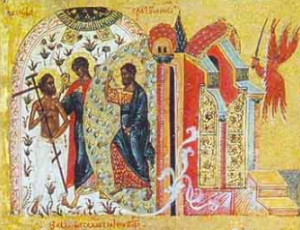
An ikon (17th c.) of Christ bringing the
penitent thief into heaven, written at the
Solovetsky Monastery in northwestern Russia.
Luke 23:35-43, my translation
And the people stood there looking on. And the ruling princes were sneering, saying: “He saved others; let him save himself, if he is God’s Anointed, the Elect.” The soldiers too came up to him and belittled him, bringing him vinegar and saying: “If you are the king of the Jews, save yourself.” There was also a superscription above him: This is the Jews’ king.
One of the wrongdoers hanged there vilified him, saying, “Aren’t you the Anointed? Save yourself, and us.”
The other, rating him in reply, said: “Don’t you fear God, since you are in the same judgment? And we are rightly [here], for we are receiving things worthy of what we have done; this man has done nothing amiss.” And he said, “Jesus, remember me, whenever you come into your kingship.”
And he told him: “Amen, I tell you, today you will be there with me in Paradise.”
Textual Notes
a. scoffed at him/sneering | ἐξεμυκτήριζον [exemüktērizon]: This word (its dictionary form is ἐκμυκτηρίζω [ekmüktērizō]) is great. It’s almost an onomatopoeia, and I’m not saying that as a whimsical flourish—its most literal rendering is “to blow one’s nose at.”

b. !/. | . [.]: Punctuation did exist in Koiné Greek, though it was limited, and functioned mainly as an aid to oral delivery rather than serving a grammatical role. (The following system was invented by Aristophanes of Byzantium around 200 BC; note that this is not the Aristophanes who wrote the famous comedies, and only sort of the Byzantium that became New Rome in 330 CE—the city was refounded by Constantine.) Initially, there were three punctuating marks, all consisting in a single dot known as a στιγμή [stigmē]: if it came along the lower guideline of the letters, like so . , it was a ὑποστιγμή [hüpostigmē] (the conceptual ancestor of the comma), which marked off phrasal units smaller than full clauses; if it was place in the middle, thus · , it was a στιγμή μέση [stigmē mesē], which indicated a pause after a clause but not a full stop; and if it was against the top line, like so · , it was a στιγμή τελεία [stigmē teleia], which did indicate a full stop. The New Testament, since it consists mostly if not entirely in works that were expected to be read aloud in local Christian gatherings, may have been written with these punctuation marks.
Greek didn’t have the question mark at the time. That seems to have been invented in the late eighth century—part of the intellectual revival at the Frankish court which we know as the Carolingian Renaissance. The exclamation mark came even later, dating to the fourteenth. So the RSV’s use of the exclamation mark here, and indeed in any other part of the New Testament, is strictly interpretive and an anachronism—though to be fair, presenting the text in twenty-first century English is anachronistic too!
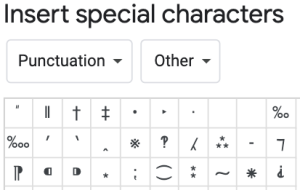
I’m an open-minded guy; I’ve used a dagger
(†) in my day, even a double dagger (‡). But,
I’m sorry, I simply refuse to believe any human
has ever wanted an inverted interrobang.
c. railed at/vilified | ἐβλασφήμει [eblasfēmei]: Greeklish words, we meet again: here we have the old root of the English term blaspheme, the Greek verb βλασφημέω [blasfēmeō]. The latter element of the word comes from an ancient verb φημί [fēmi], one of the many words meaning “to say, speak, tell”; the prefixed blas– is a little less certain. I assumed it came from βλάπτω [blaptō], meaning “to harm, injure, strike,” and some sources align with that. However, at least one source1 instead derives it from the word βλάξ [blax], meaning “sluggish, slow; stupid.” I’m not positive which of the two is more sound. The reasoning offered for the βλάξ etymology is that it means “slow to praise [the praiseworthy],” which forms an intriguing parallel with δόξα [doxa] originally meaning “belief, opinion” and coming thus to mean “repute, honor; glory.” On the other hand, it’s a little circuitous, whereas the βλάπτω etymology is very clear and intuitive, and has the advantage of being a primitive word, i.e. the sort that most typically gets taken up for use in compounds. I therefore lean toward βλάπτω, but not with certainty.
I’m not displeased with the English rendering I settled on. Vile, the root of vilify, now means “repulsive, evil, corrupt, wicked,” which lines up nicely with the βλάπτω etymology, especially in light of the semantically unrelated but phonetically similar “violence” and its relatives. However, its Latin ancestor, vīlis, meant merely “cheap” in both senses, which can be related to the modern meaning by lines a bit like those which would get us from βλάξ to blaspheme.
d. wrong/amiss | ἄτοπον [atopon]: I love this little word, ἄτοπος [atopos]. Hyper-literally, it means “un-place”—as in out of place, strange, or improper; it has a funny conceptual parallel in the English untoward. I was on the edge of translating it “improper,” which is the nearest equivalent to its meaning in most of its occurrences in the New Testament; alas, St. Luke, who introduced me to the term, also threw a wrench into my desired translation, for he tells us in Acts 28:6 that the people of Malta decided St. Paul was a god because he was bitten by a snake and yet nothing ἄτοπος happened to his body, like swelling up or going into convulsions. “Something improper happened to his body” would just sound like a weird joke when describing the symptoms of snakebite. There too went my next-favorite choice, “out of place.” So, here we are—or here we aren’t? Un-here we are? I don’t know. What’s important is, this note is done now.
e. Jesus, remember me when you come in your kingly power/Jesus, remember me, whenever you come into your kingship | Ἰησοῦ, μνήσθητί μου ὅταν ἔλθῃς ἐν τῇ βασιλείᾳ σου [Iēsou, mnēsthēti mou hotan elthēs en tē basileia sou]: Though much modern scholarship is intensely skeptical of a great deal of the Gospels, interestingly, this remark has generally been esteemed as a genuine event, for a reason that I at least find quite funny: the fact that the criminal in question uses his name, “Jesus,” rather than saying “Lord” or some similar honorific. It is felt that, were the story a “pious fiction,” the criminal would surely have had an honorific put in his mouth.
f. Paradise | τῷ παραδείσῳ [tō paradeisō]: This word comes into English through Latin from Greek, which borrowed it from the Persian for an enclosed garden (the form of the word in Persian when the borrowing was made is often given as pairidaēza, though I wasn’t able to find a source that definitely supported that). This came in Judaic thought to be specially associated with the Garden of Eden, and thus with the “bosom of Abraham,” where the souls of the just were cherished, separated from the grimmer parts of Sheol, the abode of the dead, until the general resurrection. Paradise displaced the equivalent Anglo-Saxon word, ᚾᛖᚩᚱᚳᛋᚾᚪᚹᚪᛝ [neorcsnawang]—can’t think why.
A Williamsine Coda

An illustration (1912) of the Dolorous Blow
struck by Sir Balin against the guardian of the
Grail, drawn by Lancelot Speed for
The Legends of King Arthur and His Knights.
This Gospel reminded me, as most things do, of Charles Williams. The lines below come from “The Crowning of Arthur,” one of the poems contained in Williams’ first volume of Arthurian poetry, Taliessin Through Logres. The current fascist and fash-adjacent Right, which often indulges in the trappings of Catholicism because it is old and traditional, nonetheless revolts against that which lies at the heart of the Catholic faith—reconciliation, love, sacrifice, compassion. It craves obedience, but primarily for other people; one can see that much in this Right’s ceaseless fuming against any pope which does not give it the commands it would like.
To set the scene: with the aid of Merlin, Taliessin (the court poet and a cavalry officer), and Sir Lancelot, Arthur has won the Battle of Badon Hill, the last of his great battles to restore the order of the realm. He is now King Arthur, and is to be wed. The allusions to Byzantium may seem strange, but—setting aside a few artistic liberties Williams takes with time (like making Palomides a Muslim even though the Arthurian period is usually envisioned as being in the fifth or sixth centuries)—it should be borne in mind that, for centuries, Byzantium was New Rome, the real center of Roman civilization and power. In establishing his kingdom, Arthur represents a reconnection with Byzantine civilization. But we, looking back on this from centuries later, know that the reconnection will not last; and the cracks in the edifice are already visible.
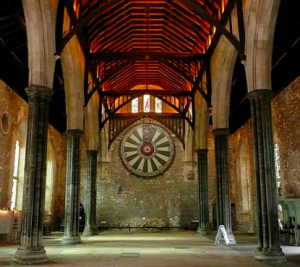
The Great Hall of Winchester Castle, with a
13th-c. “Round Table” hanging on the wall.
Photo by Graham Horn, used via
a CC BY-SA 2.0 license (source).
Note that in Williams, Arthur’s emblem is a dragon rampant (likely in red on a golden field), while Lancelot’s is a lion (likely golden on a red field, like the arms of the Plantagenet kings); Guinevere also has a coat of arms, a red chalice on a white field.2 Note too that the cathedral in Williams’ Camelot, built in the domed Byzantine style, is dedicated to St. Stephen.
Wars were at end; the king’s friend stood
at the king’s side; Lancelot’s lion
had roared in the pattern the king’s mind cherished,
in charges completing the strategy of Arthur;
the king’s brain working in Lancelot’s blood.
Presaging intelligence of time climbed,
Merlin climbed, through the dome of Stephen,
over chimneys and churches; from the point of Camelot
he looked through the depth to the dome of Sophia;
the kingdom and the power and the glory chimed.
… Through the magical sound of the fire-strewn air,
spirit, burning to sweetness of body,
exposed in the midst of its bloom the young queen Guinevere.
Lancelot moved to descend; the king’s friend kneeled,
the king’s organic motion, the king’s mind’s blood,
the lion in the blood roaring through the mouth of creation
as the lions roar that stand in the Byzantine glory.
Guinevere’s chalice flew red on an argent field.
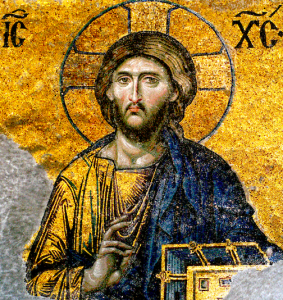
Remains of a mosaic of Christ Pantokrator from
Hagia Sophia. Photo by Edal Anton Lefterov,
used via a CC BY-SA 3.0 license (source).
So, in Lancelot’s hand, she came through the glow,
into the king’s mind, who stood to look on his city:
the king made for the kingdom, or the kingdom made for the king?
Thwart drove his current against the current of Merlin:
in beleaguered Sophia they sang of the dolorous blow.
Doom in shocks sprinkled the burning gloom,
molten metals and kindling colors pouring
into the pyre; at the zenith lion and dragon
rose, clawed, twisted, screamed …
—”The Crowning of Arthur” ll. 11-20, 53-69
It is hard to surpass C. S. Lewis’s comments in his (now sadly hard to find!) volume Arthurian Torso.
Externally all is well: nay, more than well, all is gorgeous. The poem is full of torch-light, flute music, heraldry. The heraldic beasts on the shields, conventionalized into symbols of honor and order, are an expression of the long-desired union … But the union is precarious. All is not as well as it looks. Merlin, looking down on the pageant from the dome of St. Stephen’s, sees all in the light of Byzantium (“the dome of Sophia”) and can therefore already discern, along with much that is good and fair, the elements of possible corruption. … [H]e sees … Guinevere and Lancelot, and, worst of all, the fatal flaw in the king himself. “The king made for the kingdom, or the kingdom for the king?” That is the question. The right answer has been given in the quotation from Dante’s De Monarchia prefixed to the whole Taliessin volume: “Hence it is that the proper operation does not exist for the sake of the essence, but the essence has its being for the sake of the operation.”4 Lovers exist for the sake of love, poets for the sake of poetry, kings for the sake of kingdoms: not vice versa. And Arthur is already wrong in heart about this matter. … The Empire itself—considered as an earthly expression of the Divine Order—is already endangered; Sophia therefore already “beleaguered,” already singing of the Dolorous Blow. On this note of doom, sounding in the midst of splendor and victory, the first movement of the cycle closes.
—”Williams and the Arthuriad,” pp. 111-112

Arthur’s Tomb (1854), by Dante Gabriel Rossetti;
alternatively titled “The Last Meeting of Lancelot
and Guinevere.”
I don’t believe it’s a coincidence that the Arthurian cycle, arguably the greatest and most tragic of all the tales of chivalry, involves a king trying to establish a kingdom—that is, a civil state; a polity; a thing which by nature rests upon the use of violence (however justified that use may be, violence it remains)—under the auspices of the Church. There is, of course, nothing mysterious about this: that was the whole project of Christendom. But back when Christendom was the serious project of Europe, from the latest centuries of the Roman Empire until the continent-wide shocks of the Reformations,5 we may (if we choose) see a certain naïveté in the project: a failure to fully grasp that setting up a kingdom that is of this world, and yet Christian, is something of a contradiction in terms. The ends do not justify the means, not because the ends are not good enough to do so, but because the means carry within them the ends they are capable of producing. “If my kingdom were of this world, then would my servants fight, that I should not be delivered to the Jews: but now is my kingdom not from hence” (John 18:36).
Personally I don’t believe that the old, Medieval kind of naïveté about Christendom is still possible. If there is any truth in the analogy often made between the life and maturation of an individual person and that of a civilization, I don’t think Christendom is the sort of mistake a civilization makes twice. Not sincerely, anyway. There are all sorts of mistakes we insincerely talk ourselves into making.
Footnotes
1I have been slow to name the source in question, mainly because H.E.L.P.S. Ministries has an unbearably cringe name. (I put forth considerable effort to dig up what that acronym stood for, only to find something bland and cloying that was not worth those ten minutes. In order to avenge myself on my readers, who didn’t ask this of me and have in general done me no harm, I won’t tell you, in the hope that I have whetted your curiosity enough that you will also spend a small but irretrievable fraction of your life Googling a uselessly generic acronym. I considered calling this “paying it backward,” but that just adds up to “payback”—regarding which vid. sup., “unrelated readers” etc.—so I have chosen to dub it “robbing it forward.”) More importantly, I’m also not quite clear on their academic credentials, and don’t know what their source or reasoning may be for deriving βλασφημέω from βλάξ rather than βλάπτω.
2These differ from the usual attributed arms of these characters. The queen’s differ, I believe, by existing at all; Sir Lancelot is normally given a white shield with three diagonal red stripes (blazoned argent three bends gules). Arthur’s arms vary: Geoffrey of Monmouth does give the king a dragon, but he is more frequently assigned a blue field with a collection of golden crowns, typically three (blazoned azure three crowns Or). My guess at the colors for Arthur and Lancelot envisioned by Williams is based partly on the poem itself, partly on further rules of heraldry,3 and partly on my more general acquaintance with Williams. For Arthur’s and Lancelot’s colors to invert each other makes the most sense to me, and this would also make the devices on Arthur’s and Guinevere’s arms the same color, while still having her add her white field to his golden field—and if there was anything Williams liked, it was a threefold color scheme of gold, white, and red (it pops up not only all over his Arthurian poems, but even in his other writings, notably in the climax of All Hallows’ Eve).
3For example, one major rule is about how colors are allowed to border each other. There are seven basic heraldic colors: two metals, known as Or (yellow, representing gold) and argent (white, for silver); and five tinctures, namely gules (scarlet), azure (royal blue), sable (black), vert (emerald green), and purpure (deep purple); there are a handful of additional rarer colors, but they behave like tinctures for the purpose of the aforesaid rule. That rule is “metal on tincture, tincture on metal”: i.e., with a very few exceptions, neither metal is supposed to touch the other metal, nor are tinctures supposed to touch anything except one of the metals. (One of these rare exceptions is the flag of the Vatican: the pope, who is simultaneously not permitted to carry arms and also in theory one of the few universal objects of chivalric loyalty, is allowed to have argent and Or adjacent on his standard.)
4The original Latin, in which Williams gives this quotation, is Unde est, quod nōn operatiō propria propter essentiam, sed hæc propter illam habet ut sit. As Lewis indicates in the succeeding sentences, the idea here (expressed in more modern, Catholic jargon) is that your vocation does not exist to benefit or please you, but you to fulfill and serve your vocation.
5This usage is admittedly unusual, but I believe it more accurate and illuminating than talk of “the Protestant Reformation,” which confers a false unity and a false exclusivity on the religious movements of the fifteenth and sixteenth centuries. For example, I mention the fifteenth century because the Hussite Wars (1419-1432), and the doctrine of Jan Hus (d. 1415) which gave rise to them, seem to me to form a natural grouping with certain forms of Protestant Christianity and certain conflicts with the Catholic Church, principally within the Holy Roman Empire; the Hussites hardly seem more distinct from the Anabaptists, Anglicans, Calvinists, Dissenters, Lutherans, Unitarians, and Waldenses than those are from one another. Furthermore, the claim sometimes advanced about the changes often known as “the Counter-Reformation”—the claim that, unless forced to by the Protestant Reformers, the Catholic Church would never have changed—is simply untrue. Catholic reformers and reforming movements were already active for decades before Fr. Martin Luther set theses to Wittenberg church door.








 Ad-Free & Subscriber Log-In