

A Few Words on Luke’s Outline
This past Sunday’s Gospel came from Luke 12. This places it in the middle of the book (Luke has 24 chapters of, very roughly, similar length).
Now, I haven’t hitherto said much about the structure of Luke, and there’s a reason for that: It hasn’t got much. There is one, in an extremely general sense—a three-part structure sort of shared by Matthew and John (Mark has only the second and third parts of this otherwise-common structure):
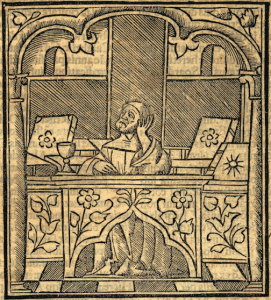
No, don’t start, Joachim of Fiore.1 I realize
you had no ill intent, but just trust me:
eschatology never goes well.
- The first two chapters are about the annunciations, conceptions, nativities, and youths of the Lord and his cousin St. John the Baptist;
- The next sixteen and a half chapters describe the Lord’s earthly ministry;
- The last five and a half cover the events of Holy Week, from the Triumphal Entry through the Resurrection (with Luke alone among the Gospels going on to mention the Ascension).
Those middle sixteen-and-a-half chapters kinda meander, though. There are even passages that feel like they just have to be out of place chronologically. Take the Transfiguration, which not only has the feel of a high point Christ would have been readying the Apostles for for quite some time, but directly alludes to “the exodus he is about to accomplish at Jerusalem” (implying, though not stating, that the fatal Holy Week is imminent): a little over a third of the way through Luke’s Gospel, this has been duly dispatched, before we finish chapter 9.2
Matthew and John both rearrange their timelines to suit a symbolic or topical structure. Luke doesn’t seem to be doing that, yet he also doesn’t give the impression of tracking the sequence of things as carefully as the author of Mark. This is consistent with the majority view among scholars today, that the traditional attributions of the Gospels are false; however, it makes extra sense (so to speak) if the traditional ascriptions are accurate—because in that case, Luke is the only Gospel not written by an eyewitness of Jesus’ ministry. Having access to eyewitnesses would of course net him plenty of material, but he might easily have gotten unclear or contradictory reports of where or when the Lord said such-and-such. It may be he just decided not to fixate on the exact chronology of when everything happened, any more than on the exact locations of where everything happened.
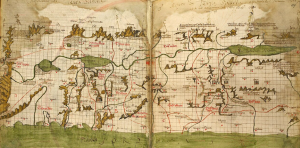
A fourteenth-century map of the Holy Land—and
if it looks like it can’t be, tilt your head to the left:
medieval maps put not north but east at the top.
For Luke is often vague about where this or that in his Gospel took place—which forms an interesting counterpart to his composition of Acts: in the later book, he gets rather good at letting you know where we are geographically, but is positively maddening in giving us almost no externally-fixed information about timing.
But let’s turn to our passage. In Luke 12, the last place that’s been explicitly mentioned was Bethany, at the close of chapter 10. (Even this is not named, merely mentioned as “a village,” but we can identify it as Bethany because it is said to be where St. Martha lives, and we know she and her siblings were Bethanites3 from John.) This might have allowed us to guess Judea rather than the Galilee as the locale for this, if it weren’t promptly spoilt by the start of chapter 11, which moves us to “a certain place.” (Isn’t every place “a certain place,” Saint Luke? No look, never mind. It’s fine.)
There’s an optional shorter form of the reading, which you may have heard on Sunday, that shaves off the first three and last eight verses. Those parts of the text have been put in grey.
Luke 12:32-34, 35-40, 41-48, RSV-CE

“Fear not, little flock, for it is your Father’s good pleasure to give you the kingdom. Sell your possessions, and give alms;a provide yourselves with purses that do not grow old, with a treasure in the heavens that does not fail, where no thief approaches and no moth destroys. For where your treasure is, there will your heart be also.
“Let your loins be girded and your lamps burning, and be like men who are waiting for their master to come home from the marriage feast,b so that they may open to him at once when he comes and knocks. Blessed are those servantsc whom the master finds awake when he comes; truly, I say to you, he will gird himself and have them sit at table, and he will come and serve them. If he comes in the second watch, or in the third, and finds them so, blessed are those servants! But know this, that if the householder had known at what hour the thief was coming, he would have been awake and would not have left his house to be broken into.d You also must be ready; for the Son of man is coming at an hour you do not expect.”
Peter said, “Lord, are you telling this parable for us or for all?” And the Lord said, “Who then is the faithful and wisee steward, whom his master will set over his household, to give them their portion of food at the proper time? Blessed is that servant whom his master when he comes will find so doing. Truly, I tell you, he will set him over all his possessions. But if that servant says to himself, ‘My master is delayed in coming,’ and begins to beat the menservants and the maidservants,f and to eat and drink and get drunk,g the master of that servant will come on a day when he does not expect him and at an hour he does not know, and will punish him, and put him with the unfaithful. And that servant who knew his master’s will, but did not make ready or act according to his will, shall receive a severe beating. But he who did not know, and did what deserved a beating, shall receive a light beating.h Every one to whom much is given, of him will much be required; and of him to whom men commit much they will demand the more.”
Luke 12:32-34, 35-40, 41-48, my translation
“Fear not, little flock, because it seems good to your Father to give you the kingship. Sell your things and give charity;a make yourselves purses that do not grow old, a ceaseless treasury in the heavens, where no thief comes near, nor moth corrupts; for where is your treasury, there also your heart will be.
“Let your waists be belted up and your lanterns burning, and yourselves alike to people receiving their own lord when he returns from weddings,b so that when he comes and knocks, right away they open for him. Those slavesc will be happy whom, when their lord comes, he finds awake: amen, I tell you that he will belt himself up and sit them down and come near and serve them. Even if it is the second or third watch when he comes and finds them like this, these will be happy. And know this, that if the master of the house were aware at which hour the thief is coming, he would not have permitted his house to be broken into.d You too—get ready, because at an hour you will not deem likely, the Son of Man comes.”

Ruins of a deserted caravanserai
under a night sky.
Rocky said, “Lord, are you saying this analogy to us, or to everyone alike?”
And Jesus replied: “Then who is the faithful house-steward, the prudente one, whom the lord set up over his attendants to give them their grain-measure on time? Happy this slave will be whom, when his lord comes, he finds doing so; I tell you truly that he will set him up over all his things. Yet if that slave should say in his heart, ‘My lord delays to come,’ and begins to hit the boys and the maids,f and to eat and drink and get boozed up,g the lord of that slave will appear on a day he does not expect and in an hour he does not know, and cut him in two, and put his part among the unfaithful. So this slave, who knew his lord’s will and did not make ready or do his will, he will be thrashed many times; while the one who, not knowing this, did things worthy of lashings, will be thrashed a few times.h For everyone to whom is given much, much will be sought from him, and with whom is deposited much, more abundantly will he be asked.”
Textual Notes
a. alms/charity | ἐλεημοσύνην [eleēmosünēn]: The term ἐλεημοσύνη here more strictly means “pity, mercy” (the second element of the phrase Kyrie eleison, “Lord, have mercy,” is the verb that corresponds to this noun). This term underwent an evolution in Greek comparable to the evolution of the French charité when it was borrowed into English.

A slot for donating zakat (obligatory alms in
Islam) at the Zawiya4 of Moulay Idris II in Fez,
Morocco. Photo by Wikimedia contributor
Mx. Granger.
b. the marriage feast/weddings | τῶν γάμων [tōn gamōn]: I gather the use of the plural here is just one of those things, like how “pants” are inherently plural.
The other interpretation, I suppose, would be that this indicates a polygamous groom who had literally just celebrated weddings in the plural. This is not impossible; polygamy5 was not formally forbidden among Jews until around the year 1000, and even that rabbinic ruling only applied to Ashkenazi Jews, going ignored by Sephardim and Mizrachim.6 However, although lawful, polygamy was not a very frequent practice among Jews at the time: the financial burden it involved would have been considerable if any more than one wife were fertile; any rivalry between wives would have made life a misery for everybody involved—the stories of the patriarchs Abraham and Jacob seem almost like they were invented for the express purpose of communicating this; and Jewish sentiment tended to view male and female as two halves of a single whole, so polygamy ran against the grain in any case. (Even if one insisted on taking this view of the text, though, I for one find it difficult to believe that any man with a brain in his head would want, ask, or plan for multiple betrotheds to be married to him at the same time, and frankly, any man who was that stupid wouldn’t have my sympathies.)
c. servants/slaves | δοῦλοι [douloi]: The RSV here is more delicate than I am—not with the Greek, but with its readers’ sensibilities. The word δοῦλος [doulos] means “slave,” no two ways about it; “servant” is a different word, διάκονος [diakonos] (the source of the term “deacon”). “Slave” is not a word Americans like much, and the Biblical language which makes us God’s “slaves” is not often on our lips—not even the great statement of the Mother of God from Luke 1:38, Ἰδοὺ ἡ δούλη κυρίου [Idou hē doulē küriou], which usually receives the prettier rendering “Behold, the handmaid of the Lord.” I believe this fudging of the language springs from two motives, one bad and one good.
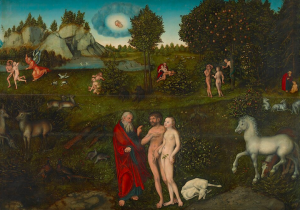
Paradies [Paradise] (1530), by Lucas Cranach
the Elder. Note the different moments in Eden
all shown within the single painting.
I didn’t recognize the good motive for rather a long time, until it was pointed out to me by a fellow student while I was in Campus Crusade. I hope I’m doing justice to it here. This good motive is, we don’t like using the language of an institution that was fundamentally wrong (however ancient), and especially not one that was so entangled with racism, in the context of religious devotion. It is worth remembering that certain things which later became attached to slavery, racism included, had no connection with it in classical antiquity; I’d even say straightforwardly that classical slavery wasn’t as bad as slavery in the American South before 1865. Still, that only goes so far. However far the remove, treating human beings as property is still treating human beings as property. Even at the tasteful remove of a few hundred years, thinking about God as (even metaphorically) in a class with John C. Calhoun, Edward Covey, Jefferson Davis, and Delphine LaLaurie7 is, and should be, uncomfortable.
The thing is, that’s one of the things I dislike about gently altering Biblical language in this way: it removes discomfort. The Bible often uses metaphors for God that are, to put it mildly, pretty flawed—and I believe we lose something by smoothing over that fact. I’m not sure I know what the something is,8 but I’m confident it’s there, for much the same reason I’m confident the unrelieved darkness of Psalm 88 is meant to be in the Bible.
Page from St. Florian’s Psalter (ca. 15th
cent.?), illuminator unknown.
But there is also a bad motive: We don’t like the idea of surrendering our autonomy to God. We want to be in charge of what we do. Not that we’d be ungenerous to God! far from it; we’re more than happy to donate a portion of our time to his needs. As long as it’s understood that we set the terms. (And while we’re at it, perhaps we could give him a little talk about give and take in relating to humans. He has to learn some time.)
Of course, plenty of people would argue that words like “servant” or “handmaid” rebuke this ridiculousness just as effectively, but I don’t think they do. “Servant,” while not typically used as a job title, is still a job even today: maids, chauffeurs, nannies, personal assistants, etc.; we know it’s not the same thing as being a slave. And “handmaid” doesn’t do the same work at all—it’s too archaic, too pretty, almost too fairy-tale in its sound.
d. broken into | διορυχθῆναι [diorüchthēnai]: This verb is in turn based on a word meaning “to cut” or “dig,” e.g. cutting a cavity into the bedrock of a hillside.9 As a verb describing burglary, it therefore has less the feel of the expression “breaking and entering,” and more of “undermining,” though I felt translating it so would have been slightly too free. I therefore went with “break into” in the hopes that the vague association with “break ground” on a construction site would be resemblance enough.
e. wise/prudent | φρόνιμος [fronimos]: This is different from the word more usually rendered “wise,” which is σοφός [sofos]. Σοφός originally referred to skill, wits, or cunning; however, by the first century (thanks in no small part to its association with φιλοσοφία [filosofia]), this adjective, and still more the noun σοφία [sofia] derived from it, had begun to acquire the mystical aura it bore among Gnostic sects and some of the mystery religions. By contrast, φρόνιμος is still an everyday word for good sense.
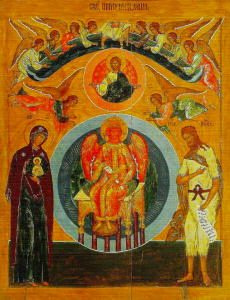
Ikon of Holy Wisdom (16th c.) from a church in
Vologda in northwestern Russia.
g. the menservants and the maidservants/the boys and the maids | τοὺς παῖδας καὶ τὰς παιδίσκας [tous paidas kai tas paidiskas]: Here we have—or so it seems to me—another softening of the text. In most slave societies, it’s common both for children to be born into slavery and to refer to slaves, irrespective of their age or maturity, with infantilizing terms; this is the ultimate origin of the French garçon, and of the English knave (a descendant of Anglo-Saxon ᚳᚾᚪᚠᚪ [cnafa], “boy; servant”; I’ve used the word “maid” on similar grounds, given its relationship to the term “maiden”). This was of course a belittling behavior—no pun intended. But I strongly suspect that it is also extremely appealing to the ego of slave-owners: ego, not in a “power” sense, but in an “I’m a good person” sense. Such an affectionate form of address, after all; it’d doubtless help reinforce their own belief that they were benevolent and kind, toward the human beings they owned as property.
f. get drunk/get boozed up | μεθύσκεσθαι [methükesthai]: Here, I particularly wanted a term not related to the verb “drink,” because the Greek word isn’t related to the word for “drink” that appears in this very same verse. Incidentally, what it is related to is the English word “mead”—a word that goes all the way back to a reconstructed Proto-Indo-European root, *médhu. This could mean “honey” or “honey wine,” so apparently the English word preserves the original meaning as well as still being close to how the original sounded. The Greek μέθυ [methü], by contrast, had shifted in primary meaning to “wine,” though it could be used for intoxicating drinks in general. This is why the Greeks, believing that a certain type of gem could ward off intoxication, named that gem species “undrunkenite,” ἀμέθυστος [amethüstos], which we transliterate amethyst.

St. Edward’s Crown,11 part of the English royal
regalia, is adorned with (among hundreds of
other stones) seven amethysts.
g. a severe beating … a light beating/thrashed many times … thrashed a few times | δαρήσεται πολλάς … δαρήσεται ὀλίγας … [darēsetai pollas … darēsetai oligas]: This just kinda sounds bad, however you translate it—note c above touches on some reasons why. Here in particular, it’s worth adding that what’s being described was, in this social context, a very normal form of discipline: the point being not “and therefore it’s unproblematic,” but “and therefore, if you want to understand the parable better, imagine exchanging it for some form of discipline we consider very normal.”
Footnotes
1Joachim of Fiore was a twelfth-century mystic who was popularly esteemed as a prophet. He himself disclaimed the title, and carefully submitted all of his writings to the judgment of the Church; this not only stood him in good stead when, posthumously, certain of his works were condemned as heretical but he was not branded a heretic, but helped salvage something of his (again posthumous) reputation when certain heretical groups claimed his writings as their inspiration, such as the notorious arsonists and murderers known as the Apostolic Brethren of Fra Dulcino, a millenarian cult who conducted a campaign of terror in the northwest of Italy for the better part of a decade in the early fourteenth century.
2When I first began to study the Gospels, I took this as a sign that Luke’s arrangement was probably the most chronologically accurate, there being no theological reason for him to futz with it. However, I’ve since become convinced (for a few reasons) that Mark’s is probably the most chronologically correct—which is a bit of a pity, given he’s the shortest, both absolutely and on unique material!
3I’m guessing here; this may not actually be what one calls an inhabitant of Bethany. However, I thought “Bethanites” sounded both more interesting and more euphonious than “Bethanians.” The other alternative is “Bothans,” which no it’s not, that’s something from Star War.
4A zawiya is a type of building associated with Sufi Islam (occasionally spelled zaouia). Zawiyas may have one or more of several purposes, making translations like “monastery,” “shrine,” “school,” “mausoleum,” or even “center” all not-quite-right, though “shrine” is perhaps the least-wrong of the bunch.
5More strictly, polygyny, the taking of multiple wives; taking multiple husbands is polyandry, which was never lawful among Jews, though it was not unknown in certain cultures (e.g. precolonial Hawaii).
6Ashkenazi, Mizrachi (or Mizrahi), and Sephardi are the three largest Judaic minhagim, or cultural expressions of religion—the nearest Catholic equivalent would probably be ritual families—Byzantine, Latin, Ethiopic, etc. The minhagim as known today were established mostly during the European Middle Ages. Ashkenazim hail mainly from Central and Eastern Europe (what’s now Austria, Belarus, Czechia, Germany, Hungary, Lithuania, Poland, Slovakia, Ukraine, and the former Yugoslavia), though they were also present in Western Europe (chiefly in France and the Low Countries); they are associated with the Yiddish language, a.k.a. Judeo-German. Mizrachim are from the Near East and North Africa, and mostly went on speaking Aramaic or adopted Sharh, a.k.a. Judeo-Arabic (though some spoke Middle Persian). Sephardim originated mainly in Portugal, Spain, and southern France, and spoke Ladin, or Judeo-Spanish. There are a also few other, much smaller minhagim as well, like the Romaniotes of Greece and the Temanim of Yemen.
7Calhoun was the Vice President of the country under Presidents Adams (not that Adams, the other one) and Jackson; he was an outspoken anti-abolitionist, opposing even the “containment policy” of slavery established by the Missouri Compromise, and—unlike most Southerners at the time, who spoke on behalf of slavery as a necessary evil, Calhoun outrageously claimed that it was a positive good.
Covey is profiled in Frederick Douglass’s autobiographies; he was sent to work on Covey’s farm for a while because Covey had a reputation as a man with a talent for “breaking” slaves—i.e., treating them with enough cruelty to destroy their resistance and desire for freedom.
Davis was of course the head of the short-lived Confederate States of America (though that nation did not last long enough for him to finish the six-year term its laws entitled him to). Though less extreme than Calhoun, he too considered slavery nothing to apologize for, and owned over a hundred slaves.
LaLaurie was a New Orleans socialite and, to all appearances, the nation’s first serial killer: locals responding to a fire at her residence in 1834 discovered a dedicated torture chamber in the slaves’ quarters. This shocked the conscience even of the Deep South, and LaLaurie fled the country; she never faced justice in this life.
8It is also true, I think, that we should from time to time give thought to the unattractive aspects of life in the time of Jesus. However, this is a subsidiary point, and a primarily intellectual one—it’s not (as far as I know) the spiritual significance of these ominous elements in Scripture.
9This was a normal element in the creation of winepresses: you needed a clean stone vat for the stuff pressed to flow into, and, as people so vehemently dislike to lug gigantic stone vats about in the hot sun that they’ll straight-up tell you “no” if you instruct them to do it,10 you needed it on-site.
10This might not sound like it’s worth specifying; but—oddly, given how pointlessly obstinate most of us are, all the time—it is nevertheless also true that, if you tell someone to do something, more often than not, he’ll do it, even and in fact especially if you don’t explain. Human beings are weird, man.
11Though modeled on and named after the crown actually preserved as a relic of St. Edward the Confessor, the current “St. Edward’s Crown” is not the original, which is believed to have been destroyed in Cromwell’s time. The present crown was created in 1660 for the coronation of King Charles II, on the occasion of the Stuart Restoration.











 Ad-Free & Subscriber Log-In