

You can find my two-part introduction to the Gospel of John at these two links, and my index/outline for it here; for the previous installment on John 4:4-42, go here.
The Second Sign (John 4:43-54)
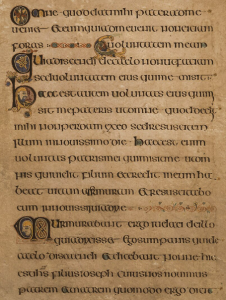
Folio 309r from the Book of Kells (early 9th
c.), containing part of the Gospel of John.
Though a comparatively short bit of narrative, this passage has a good deal of structural significance. After the episode in Samaria, the action returns to the Galilee—where, compared with the Synoptics, we spend very little time in the Fourth Gospel. Interestingly, the moment we come back to this typically Synoptic setting, we immediately get a typically Synoptic story with a typically Synoptic remark from Yeshua: a miraculous healing, prefaced by what certainly seems to be a negative attitude toward the kind of faith that is based on miracles. Some commentators take this to be the Johannine version of the story of the believing centurion found in Matthew 8 and Luke 7 (the sources of the Domine Non Sum Dignus,1 which we recite immediately before the communion rite in the Mass). If so, this evangelist exhibits a dramatically different perspective of the events, though the total lesson—about the relations among the word of Christ, miracles, and faith—is much the same in all three.
If we take his two moments of “clairvoyance” (1:48 and 4:17-18) to be miraculous as well, then this is strictly his fourth miracle;2 however, John declares this his second σημεῖον [sēmeion], his second “sign,” placing it among the “seven signs” according to which the opening half of John is structured. It is also the first of either three or four miracles of healing in John: the others are the cure of the paralytic in chapter 5, the cure of the man born blind in chapter 9, and—if this counts as a “healing”—the resurrection of Lazarus in chapter 11, which are the third, sixth, and seventh signs.
Much as the “new-creation week” of 1:29-2:11 formed a coherent arc, John 2:1-4:54 also forms a coherent, interlocking arc (as touched on in §IV.2.b.א of the “Outroduction”, Johannine literature loves its interlocking arcs). It exhibits two directions of movement. The first is cyclical, beginning at Qanah in the Galilean fringe, moving to the beating heart of Judaism in Yrushalem, and then slowly moving north until it again reaches Qanah. The second is linear, as Yeshua is progressively “paired” with some other main interlocutor, in a series of five: his Mother; Nikodemos; Yochanan the Baptist; the woman from Süchar; and, in this text, a royal official. The first three are Jews—the first, presumably a Prysha, who has complete faith in Yeshua (even in the face of what at first seems to be a refusal of her request); the second, a Prysha who in some fashion wants to have faith, but does not yet understand him; the third, (seemingly) an Essene who again has faith (though here Yeshua is, in terms of narrative content, absent). The fourth and fifth are a Samaritan, who has faith herself and brings her whole town to it, and this text’s “royal official,” whose ethnicity and religion are both left obscure but who might easily be a Gentile based on his position. These last two thus complete the “outward” missionary motion of this arc, coëxisting with its circular geographical motion.
John 4:43-54, RSV-CE
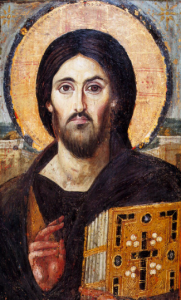
Encaustic ikon of Christ Pantokrator [Almighty]
(6th c.), preserved in St. Catherine’s Monastery
on Mount Sinai, Egypt.
After the two days he departed to Galilee. For Jesus himself testified that a prophet has no honor in his own country. So when he came to Galilee, the Galileans welcomed him,a having seen all that he had done in Jerusalem at the feast, for they too had gone to the feast.
So he came again to Canab in Galilee, where he had made the water wine. And at Capernaumb there was an officialc whose sond was ill. When he heard that Jesus had come from Judea to Galilee, he went and begged him to come down and heal his son, for he was at the point of death. Jesus therefore said to him, “Unless you see signs and wonders you will not believe.” The official said to him, “Sir, come down before my child dies.” Jesus said to him, “Go; your son will live.”e The man believed the word that Jesus spoke to him and went his way. As he was going down, his servants met him and told him that his son was living. So he asked them the hour when he began to mend,f and they said to him, “Yesterday at the seventh hourg the fever left him.” The father knew that was the hour when Jesus had said to him, “Your son will live”; and he himself believed, and all his household. This was now the second sign that Jesus did when he had come from Judea to Galilee.
John 4:43-54, my translation
So after the two days he left there for the Galilee; for Yeshua himself witnessed that “A prophet has no honor in his own fatherland.” Then when he came into the Galilee, the Galileans received him;a they had all seen the kind of things he did in Yrushalem at the feast, for they too had gone to the feast. So he came again to Qanahb in the Galilee, where he made water wine.
Now there was a certain royal officialc whose sond was sick in K’far-Nachum.b This man, when he heard that Yeshua had come from Judea into the Galilee, came to him and asked that he come down and heal his son, for he was about to die. Then Yeshua said to him: “Not unless you [all] see signs and wonders, you will not have faith.”
The royal official says to him, “Sir, come down before my little boy dies.”
Yeshua says to him, “Go your way; your son will live.”e
The man had faith in the word which Yeshua told him and went his way. Already when he is coming down, his slaves met him, saying that “Your boy will live.” Then he inquired of them the hour at which he had [become] better;f so they told him that “Yesterday at the seventh hourg the fever quit him.” Then the father knew that it was that hour in which Yeshua told him ‘Your son will live,’ and he and his whole household had faith.
So Yeshua did further this second sign when he came from Judea into the Galilee.
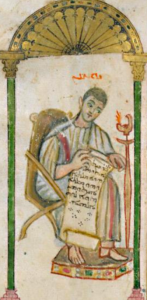
Portrait of St. John the Evangelist from the
Rabbula Gospels, a 6th c. Syriac evangeliary.
Textual Notes
a. For Jesus himself testified that a prophet has no honor in his own country. So when he came to Galilee, the Galileans welcomed him/for Yeshua himself witnessed that “A prophet has no honor in his own fatherland.” Then when he came into the Galilee, the Galileans received him | αὐτὸς γὰρ Ἰησοῦς ἐμαρτύρησεν ὅτι προφήτης ἐν τῇ ἰδίᾳ πατρίδι τιμὴν οὐκ ἔχει. ὅτε οὖν ἦλθεν εἰς τὴν Γαλιλαίαν, ἐδέξαντο αὐτὸν οἱ Γαλιλαῖοι [autos gar Iēsous emartürēsen hoti profētēs en tē idia patridi timēn ouk echei. hote oun ēlthen eis tēn Galilaian, edexanto auton hoi Galilaioi]: This is an extremely odd pair of statements to place in immediate succession. Professor Moloney illuminates the juxtaposition in Sacra Pagina‘s volume on John:
The narrator recalls a word of Jesus … to claim that the motive for Jesus’ journey from Judea to Galilee was because a prophet has no honor in his own country. Jesus is traditionally known as “of Nazareth” (cf. Matt. 2:23) and as a Galilean (cf. Mark 14:70). There is no immediate background for such a negative statement … The Matthean and Lukan narratives at least situate his birth in Judea, but “this Gospel does not even tell us that Jesus was born in Judea” (Brown, Gospel 1:187) …
However, in the light of 1:43 the first three days of Jesus’ ministry take place in Judea (cf. 1:19-42). The fourth day (1:43-51) and the following revelation of the doxa [the glory] (2:1-12) take place in Galilee. Jesus returned immediately to Jerusalem (2:13) and remained in Judea until he began his journey to Galilee via Samaria (cf. 4:3-4). … Whatever the synoptic tradition might say, an impression of Jesus’ regular presence in Judea is created. … Once this is accepted, v. 44 makes good sense. In Judea Jesus has met rejection from “the Jews” (2:13-22); many have come to him looking for miracles but Jesus has not trusted himself to them (2:23-25); a Jewish leader, Nicodemus, has been unable to accept Jesus’ teaching (3:1-12). …
The welcome afforded Jesus on arrival in Galilee looks enthusiastic, but there are reasons for concern. Looking back to the feast of the Passover that has just been celebrated in Jerusalem (cf. 2:13, 23-25), the narrator reports that the Galileans had been in Jerusalem and had seen the signs Jesus had done. Their enthusiastic reception of Jesus matches the response of those in Jerusalem who “believed in his name when they saw the signs that he did” (2:23). … Jesus did not trust himself to such enthusiastic believers. … “At Capernaum there was a royal official (basilikos) whose son was ill” (v. 46b). Recent research has shown that a figure described as a basilikos might be either Jewish or Gentile … The use of the word in the present Johannine context leads to the suggestion that this man is a Gentile. … He is not from Cana, but from the border town of Capernaum, well known for the presence of Gentile soldiers. … It is most likely that this particular basilikos is … presented to the reader … as a final example of the reception of the word of Jesus from the non-Jewish world.3
b. Cana … Capernaum/Qanah … K’far-Nachum | τὴν Κανὰ … Καφαρναούμ [tēn Kana … Kafarnaoum]: The distance between these two towns was about twenty miles, give or take—a little under a full day’s journey; or at least, it would be, if you were coming from somewhere other than the shores of the Sea of Galilee, where K’far-Nachum sits. You may recall that the Sea of Galilee, like the Jordan Valley, is (for geological reasons) surprisingly far below sea level, around -700′. Now, it’s not known for certain which of the possible modern sites for the Biblical Qanah is correct. Candidates include:
- Ain Qana, Lebanon, at an elevation of well over +2000′.
- Kafr Kanna, Israel, a little over +900′ above sea level.
- Khirbet Qana, Israel; this sits at about +700′ in elevation.
- Qana, Lebanon (the site favored by Christian tradition), slightly below +1000′ above sea level.
Even if we’re “only” talking about getting to the nearest of those four possibilities, Khirbet Qana, that is a minimum difference of 1400′ in elevation—granted, across slopes; it isn’t like he had to rock climb it or something, but still. This man hiked to get to Yeshua.
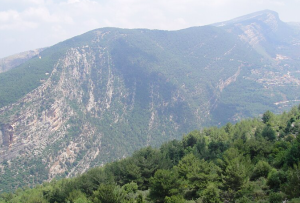
Mount Lebanon (more properly a mountain range),
on whose southernmost slopes Ain Qana is located.
Photo made available as public domain by Wiki-
media contributor Linaduliban.
c. an official/a certain royal official | τις βασιλικὸς [tis basilikos]: This could bear any of several meanings, applying either to someone in the employ of Herod Antipas (the ruler of the Galilee at this time) or to a figure from the Roman imperial government—the Herods employed Gentiles (indeed, they were themselves of Idumean stock), and the Romans would work with Jews, especially in Judea.
d. son | τὸν υἱόν [ton huiou]: This is taken by some commentators (and I’m inclined to agree) to suggest that this is a discrete episode from that the of the centurion, reported by Matthew and Luke. Those narratives stick to the term παῖς [pais], or “boy,” a word that as in English could be applied to one’s children, but would also be used for a slave or hired servant. This text mostly uses υἱός [huios] “son.” A couple verses further on, the official pleads for his παιδίον [paidion], a diminutive formed from παῖς, and thus “little boy”; this could be read as evoking the παῖς text of the Synoptics, but is also obviously the sort of thing any father might say about his son, and would be likelier to say about a son than a servant or slave.
e. will live | ζῇ [zē]: Really this is a present-tense verb, not a future: a truly strict translation would render it “is living.” I decided to use the implied future in my rendering because using the present struck me as giving it an uncomfortably Delphic sound (i.e., seeming to rely on carefully-worded ambiguity to disguise an unpleasant meaning), which isn’t really what the Greek suggests.
f. when he began to mend/at which he had [become] better | ἐν ᾗ κομψότερον ἔσχεν [en hē kompsoteron eschen]: The phrase κομψότερον ἔσχεν, while not difficult to understand, goes rather awkwardly into English. Κομψότερον, taken quite literally, means “more finely dressed”!—but was metaphorically extended, and could cover convalescence from illness. As for ἔσχεν, it is a form of the very ordinary verb ἔχω [echō], “to have.” Because this verb is, cross-linguistically, so common, and can be meant in so many senses, it gets into a lot of idioms; English has multiple verb tenses governed partly or entirely by adding some form of “to have” to the sentence as an auxiliary (or “helping verb”). It so happens that the way this shook out in Greek got them “to have [oneself] more finely dressed” as an idiom for “to recover from illness.”
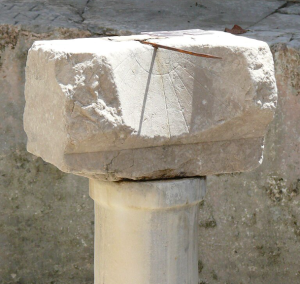
Remains of a Roman sundial on display in Side,
Turkey. Photo by Ad Meskens, used via
a CC BY-SA 3.0 license (source).
g. the seventh hour | ὥραν ἑβδόμην [hōran hebdomēn]: One o’clock in our reckoning—basically. Variation would apply for several reasons. The ancients reckoned the hour from sunset and sunrise, rather than from midnight and noon like we do; they did not have the inane practice of “Daylight Saving Time” to contend with; and, in the case of this text, we don’t know exactly when in the course of the year it took place. Besides all this, the peoples of Classical Antiquity usually employed relative hours (also referred to as “seasonal,” “variable,” “temporal,” or, when in reference to Judaic practice, “halakhic hours”). In this method of timekeeping, an hour was not an absolute unit of time equivalent to sixty minutes: an hour was instead one-twelfth of the day, which of course varies according to the time of year, except in the tropics. We may speak of the “long daylight hours of summer” idiomatically, but in this system, those hours are literally longer than the daylight hours of other seasons. At Canaanite latitudes, according to the system of relative hours, each hour of the day on the summer solstice would equate with a little more than seventy minutes.
Footnotes
1For those not familiar, this prayer is combined with the pre-communion Prayer of Humble Access in the Anglican Use, the text of which is as follows (the Domine Non Sum Dignus, which is the direct allusion to the centurion’s story, is underlined):
…Congregants: We do not presume to come to this thy Table, O merciful Lord, trusting in our own righteousness, but in thy manifold and great mercy. We are not worthy so much as to gather up the crumbs under Thy table. But thou art the same Lord whose property is always to have mercy. Grant us therefore, gracious Lord, so to eat the flesh of thy dear Son Jesus Christ, and to drink his blood, that our sinful bodies may be made clean by his body, and our souls washed through his most precious blood, and that we may evermore dwell in him, and he in us. Amen.
…Celebrant: Behold the Lamb of God, behold him that taketh away the sins of the world. Blessed are those who are called to the supper of the Lamb.
…Congregants (three times): Lord, I am not worthy that thou shouldest come under my roof, but speak the word only and my soul shall be healed.
2By counting these and adding Christ’s own resurrection in ch. 20 and his gift of a miraculous catch of fish and prophecy of St. Peter’s martyrdom in ch. 21, we would bring the total number of miracles (both those designated as σημεῖα [sēmeia] and those not labeled) from seven to twelve—nine before Easter Sunday and three from Easter Sunday forward.
3Moloney, pp. 151-153. Note that this was published in 1998, so the “recent research” was as of now about thirty years ago, at least.











 Ad-Free & Subscriber Log-In