

You can find my two-part introduction to the Gospel of John at these two links, and my index/outline for it here; for the previous installment on John 3:22-4:3, go here.
The Witness of Sychar (John 4:4-42)
Christ’s “trial” before the reader proceeds with further testimony. At this point, however, John has covered enough territory that we begin to get echoes of earlier parts of the narrative—in musical terms, we get variations on earlier motifs, featuring inversions and retrogrades. Its setting, however, is almost unique; there is only one other place in the five Evangels1 that has a “scene” set in Samaria lasting more than a couple of sentences, namely Acts 8:4-25. This is by far the most unexpected and interesting depiction of Samaria in the Gospels, and is the only passage in the New Testament to indicate to us that Yeshua ever stayed there or preached there. (Incidentally, the “woman at the well” is given the name St. Photine by Greek Orthodox tradition.)
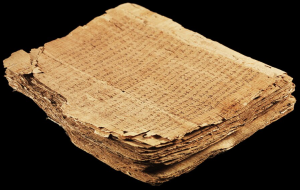
Bodmer Papyrus 66 (c. 200?), one of the
earliest witnesses of the Gospel of John.
This pericope is bound together with the previous two by means of water imagery, though the implied “use” here shifts from water for washing to water for drinking. At the same time, as Yeshua gradually withdraws from the environs of the Temple over 2:23-4:43, his interlocutors also go from the heart of Judaic society to its outermost fringe. At the beginning of this sequence, we saw him conversing with Nikodemos: a fellow Prysha, a Judean man, one with a position on the Sanhedrin, approaching him from the first for theological discussion. And yet—or rather, therefore—this man came only under cover of darkness, is sadly bewildered by what Yeshua has to tell him, and to all appearances leaves without knowing what to think.
Next, we returned to Yochanan the Baptist: a man who sounds and looks like an Essene (the dubious fringe of Judaism at the time), who dresses in rags and eats insects, who was being cross-examined for his prophecies earlier in the book, and who is soon to be remanded to the prison where he will be martyred. His disciples seemed inclined to jealousy on his behalf over the baptisms taking place under Yeshua’s ægis, yet this part of the text features no direct interaction with Yeshua himself—only the Baptist’s reaffirmation of the validity of Yeshua’s mission.
In this third passage (which is somewhat longer than the last two), we meet a figure who is the opposite of Nikodemos along many axes: a Samaritan, a woman, a pariah in her town (see textual note c), simply doing an everyday task. Curiously, although Nikodemos came at night and she comes in the middle of the day, both do so (almost certainly) for the same reason—privacy. Her reactions also invert those of the Prysha: she does not begin to suspect that Yeshua has “come from God” until after he displays a “work,” his supernatural perception of her life; after that, to all appearances, she not only listens to the rest of what he has to tell her but understands it, accepts it, and promptly goes to fetch others to hear it.
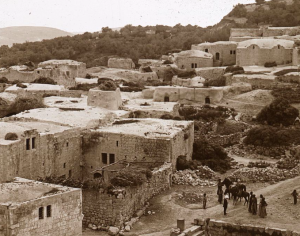
The village of Samaria, ca. 1915.
John 4:4-42, RSV-CE
He had to pass through Samaria.a So he came to a city of Samaria, called Sychar,a near the field that Jacob gave to his son Joseph. Jacob’s wellb was there, and so Jesus, wearied as he was with his journey, sat down beside the well. It was about the sixth hour.
There came a woman of Samaria to draw water.c Jesus said to her, “Give me a drink.” For his disciples had gone away into the city to buy food. The Samaritan woman said to him, “How is it that you, a Jew, ask a drink of me, a woman of Samaria?” For Jews have no dealings with Samaritans.d Jesus answered her, “If you knew the gift of God, and who it is that is saying to you, ‘Give me a drink,’ you would have asked him, and he would have given you living water.”e The woman said to him, “Sir,f you have nothing to draw with, and the well is deep; where do you get that living water? Are you greater than our father Jacob, who gave us the well, and drank from it himself, and his sons, and his cattle?” Jesus said to her, “Every one who drinks of this water will thirst again, but whoever drinks of the water that I shall give him will never thirst; the water that I shall give him will become in him a spring of water welling up to eternal life.” The woman said to him, “Sir, give me this water, that I may not thirst, nor come here to draw.”
Jesus said to her, “Go, call your husband, and come here.” The woman answered him, “I have no husband.” Jesus said to her, “You are right in saying, ‘I have no husband’; for you have had five husbands, and he whom you now have is not your husband; this you said truly.” The woman said to him, “Sir, I perceive that you are a prophet. Our fathers worshiped on this mountain; and you say that in Jerusalem is the place where men ought to worship.”g Jesus said to her, “Woman, believe me, the hour is coming when neither on this mountain nor in Jerusalem will you worship the Father. You worship what you do not know; we worship what we know, for salvation is from the Jews.h But the hour is coming, and now is, when the true worshipers will worship the Father in spirit and truth, for such the Father seeks to worship him. God is spirit, and those who worship him must worship in spirit and truth.” The woman said to him, “I know that Messiah is coming (he who is called Christ); when he comes, he will show us all things.”i Jesus said to her, “I who speak to you am he.”j
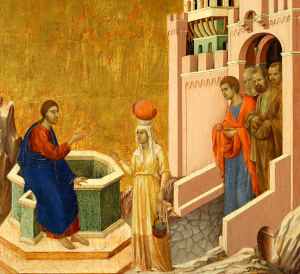
Christ and the Samaritan Woman (1311), by
Duccio di Buoninsegna. Note the octagonal design
of the well, resembling an immersion font.
Just then his disciples came. They marveled that he was talking with a woman, but none said, “What do you wish?” or, “Why are you talking with her?” So the woman left her water jar, and went away into the city, and said to the people, “Come, see a man who told me all that I ever did. Can this be the Christ?” They went out of the city and were coming to him.
Meanwhile the disciples besought him, saying, “Rabbi, eat.” But he said to them, “I have food to eat of which you do not know.” So the disciples said to one another, “Has any one brought him food?” Jesus said to them, “My food is to do the will of him who sent me, and to accomplish his work. Do you not say, ‘There are yet four months, then comes the harvest’?k I tell you, lift up your eyes, and see how the fields are already white for harvest. He who reaps receives wages, and gathers fruit for eternal life, so that sower and reaper may rejoice together. For here the saying holds true, ‘One sows and another reaps.’ I sent you to reap that for which you did not labor; others have labored, and you have entered into their labor.”l
Many Samaritans from that city believed in him because of the woman’s testimony, “He told me all that I ever did.” So when the Samaritans came to him, they asked him to stay with them; and he stayed there two days. And many more believed because of his word. They said to the woman, “It is no longer because of your words that we believe, for we have heard for ourselves, and we know that this is indeed the Savior of the world.”m
John 4:4-42, my translation
But it was necessary for him to go through Samaria.a So he came to a city of Samaria called Süchar,a near the land which Yaqov gave to his son Yousef; Yaqov’s fountainb was there. Then Yeshua, labored from traveling, sat thus at the fountain; it was about noon. A woman of Samaria came to draw water.c Yeshua said to her, “Give me a drink” (for his students had gone into the city, in order to buy provisions in the market).
So the Samaritan woman says to him: “How do you, being a Jew, ask a drink from me, being a Samaritan?” For Jews do not use things in common with Samaritans.d
And in reply, Yeshua says to her, “If you knew the gift of God, and who it is that says to you ‘Give me a drink,’ you would ask one from him, and he would give you living water.”e
The woman tells him, “Sir,f you have no pail, and the well is deep; where are you getting this living water from, then? Are you greater than Yaqov our father, who gave us this well and drank from it himself, as well as his sons and his livestock?”
And in reply, Yeshua tells her: “Everyone who drinks of this water will get thirsty again; whoever shall drink of the water which I will give to him, he will not thirst through the age, but the water I give him will become within him a fountain of water springing up to age-long life.”
The woman said to him: “Sir, give me this water, so that I may neither get thirsty nor have to come to this place to draw [water].”
He tells her, “Go call your husband and come to this place.”
And the woman said in reply, “I do not have a husband.”
Yeshua tells her, “You spoke well that ‘A husband I do not have’; for you had five husbands, and now the one you have is not your husband; you have said this truthfully.”
First page of the Psalms in Hebrew and Latin
in a 12th-c. manuscript.
The woman tells him: “Sir, I behold that you are a prophet. Our fathers worshiped on this mountain; yet you say that in Yrushalem is the Place where it is necessary to worship.”g
Yeshua says to her, “Have faith in me, ma’am, that the hour is coming when they will worship the Father neither on this mountain nor in Yrushalem. You worship what you do not know—we worship what we know, because salvation is from the Jews;h but, hour is coming, and it is now, when the true worshipers will worship the Father in Spirit and truth, for the Father too searches for such people as his worshipers; Spirit is God, and it is necessary for those who worship him to worship in Spirit and truth.”
The woman tells him, “I know that Meshicha is coming, called ‘the Anointed’; whenever he comes, he will explain everything to us.”i
Yeshua says to her: “I am, who am talking to you.”j
And his students came to the place, and were amazed he spoke with a woman; nonetheless, no one said ‘What are you searching for?’ or ‘Why are you speaking with her?’ Then the woman quit her water-jug and went into the city and told people: “Come see a person who told me everything which I have done; isn’t he the Anointed One?” They came out of the city and began coming toward him.
In the meanwhile, his students pressed him, saying, “Rabbi, eat.”
He said to them, “I have food to eat which you do not know of.”
So his students began saying to each other: “No one brought him anything to eat, [did they]?”
Yeshua told them: “My food is that I will do the will of the one who dispatched me, and that I will finish his work. Don’t you say that ‘It is four months yet, then harvest comes’?k Look, I tell you—lift up your eyes and behold the fields, that they are white with harvest; already the harvester receives a reward and gathers fruit for age-long life, in order that the sower and the harvester may rejoice alike. For in this, the word is true, that ‘One is the sower and another the harvester’; I have sent you to harvest what you have not labored over; others labored, and you have come into [the produce of] their labor.”l
Many people from that city of the Samaritans had faith in him, because of the word of the woman who witnessed that “He told me everything that I have done.” So when the Samaritans came to him, they pressed him to stay with them; and he stayed there two days. And many more had faith because of his word—they even told the woman that “We no longer have faith [only] because of what you said; indeed, we have heard him ourselves, and we know that this is truly the Savior of the world.”m
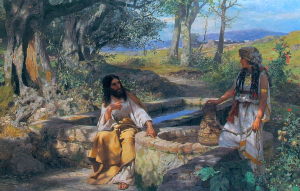
Chrystus i Samarytanka [Christ and Samaritan]
(1890), by Henryk Siemiradzki.
Textual Notes
a. Samaria … Sychar/Samaria … Süchar | Σαμαρείας … Συχὰρ [Samareias … Süchar]: Samaria is the Latin spelling of the Hellenized pronunciation of the Aramaic form of the Hebrew name שׁוֹמְרוֹן [Shoum’roun], which means something like “watchtower hill.” (A few sources I found gave the Aramaic as Shamerayin, but only thus, in Roman letters.) The region’s origins lie in Canaan’s Iron Age II period. “Samaria” was initially the name of an Israelite capital built by King Omri (r. ca. 880s-870s BC); according to the Tanakh, Omri founded a modestly successful dynasty which produced three more kings of Israel and one reigning queen of Judah.2 About a hundred to a hundred and fifty years after Omri, the Neo-Assyrian Empire decisively destroyed the Kingdom of Israel. Its people were deported—or rather, the aristocrats and scribes were deported: commoners were probably ignored for the most part. The Assyrians also resettled other foreigners they had conquered in the area, who mingled with the Hebrew populace (or were presumed to do so).
Hence, when exiles of the Judahite upper classes came back from their own exile in the late sixth century BC and began to rebuild the Temple, and the contemporary residents of Samaria (now held to be of mixed Gentile and Jewish descent) offered to help, the Judeans refused. There was reason for this. The Torah lays down strict rules about exactly who is allowed to go where and do what in the house of God: “strict,” as in “when transporting the Tabernacle, a specific Levite family was designated to carry the sanctuary furniture, and you weren’t even supposed to let another family of Levites do it.” In consequence, welcoming the assistance of people whose ancestry was not even unambiguously Jewish, let alone Levite, and whose customs surrounding divorce and remarriage were (reportedly) far more lax than those of the Jews (and might therefore result in children who were illegitimate by Jewish standards), would have meant pollution of the sacred precinct on a massive scale. This refusal may or may not have been what crystallized Samaritan identity, or their rivalry with Judean Jews. (The book of Ezra suggests that the initial offer of help was insincere. It may have been made with knowledge that it would be refused due to Judean ceremonial purity requirements, seeking to provoke a confrontation—perhaps for the sake of some political advantage.)
The Samaritans went on to build their own temple on Mount Gerizim, where their recension of the Torah directed worship, and indeed its remnants have been excavated there. According to II Maccabees 6:2, this temple even got in on the “being desecrated by Antiochus Epiphanes” game in the persecution that prompted the Maccabean Revolt (167-141 BC). But in 110 BC, the Hasmonean ruler John Hyrcanus I climbed Mount Gerizim with an army and razed the Samaritan temple to the ground (and destroyed a city or two, since he was up anyway).
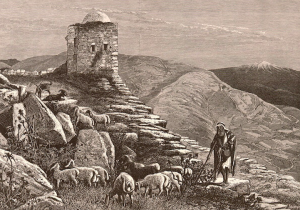
Ruins on the Summit of Mount Gerizim, on
the Site of the Samaritan Temple (1884), by
Harry Fenn. Part of a series titled “Pictur-
esque Palestine, Syria, and Egypt.” G. how s.
Süchar (or Sychar as it usually appears) is not clearly identifiable today. From the dialogue in this text, it appears to have been on the slops of Mount Gerizim, as are some settlements today, e.g. Nablus, which lies near the middle of the northern “lobe” of the West Bank between that mountain and Mount Ebal. Some authors have proposed that Süchar may have been an alternate name for Shechem, but unfortunately I couldn’t find out why.
As for its own etymology, Strong’s derives the name from the Hebrew שֵׁכָר [shêkhâr], meaning “intoxicant.” Perhaps the village specialized in producing some type of liquor? If this was the case, there are a few possibilities.
- Winemaking was a commonplace activity, and would therefore probably not be the “intoxicant” in question, but it’s possible Süchar made some particularly tasty or unusually high ABV wine. Alternatively, they might have made arak, a grape-based liquor that incorporates anise seed (the flavoring agent of licorice), similar to ouzo.
- Barley was grown in the Holy Land, and barley can mean beer. However, I gather that, then as now, beer was mainly a northern European product; the Mediterranean climate causes beer to spoil more quickly than it would in places like Germania.
- If Süchar was a bee-keeping village, mead would be a possibility. However, I know of no evidence for this; even the honey of the “land flowing with milk and” was apparently date honey, a syrup obtained by boiling dates, used as a sweetener.
- Several fruit brandies or liqueurs would be credible. Almonds, plums, and pears will grow happily in Canaan, and juniper might; these would make amaretto, grappa, perry, and gin possibilities—not necessarily in the forms we know them today, of course. I assume there’s also some sort of drink that can be made out of pomegranate arils, but trying to look it up just gets you eighty thousand results for how to make a pomegranate martini. (To save you the 6.75 seconds opening another tab to look for yourself, the secret is: make a martini; then, put some pomegranate in.)
- My favorite guess, if this conjecture is right in the first place, would be a liqueur now associated mainly with Sardinia and Corsica. The common myrtle—incidentally, the plant for which Esther was named in Hebrew (see Esther 2:7): הֲדַסָּה [hàdhassâh] means “myrtle”—grows throughout the Mediterranean, and its berries are used to make a liqueur named mirto. Modern descriptions say mirto has a taste in-between sweet and aromatic, and often cite both juniper and citrus as notes in the flavor.
b. Jacob’s well/Yaqov’s fountain | πηγὴ τοῦ Ἰακώβ [pēgē tou Iakōb]: The site known as “Jacob’s well” is located outside Nablus. Mainstream Judaism does not seem to attach any importance to the site, but apparently, both the surviving population of Samaritans and Christian tradition identify this as a well dug by the patriarch Jacob. The well currently sits within an Eastern Orthodox monastery.
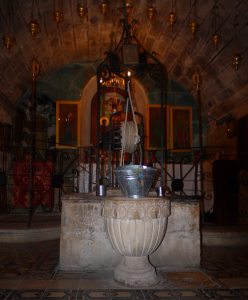
Site identified by Christian tradition as
Jacob’s Well in 2013. Photo by Jeremiah
K. Garrett, used via a CC BY-SA 3.0
license (source).
c. There came a woman of Samaria to draw water/A woman of Samaria came to draw water | Ἔρχεται γυνὴ ἐκ τῆς Σαμαρείας ἀντλῆσαι ὕδωρ [erchetai günē ek tēs Samareias antlēsai hüdōr]: Drawing water was a standard “women’s chore” at this time, not unlike grocery shopping in the ’50s. But doing this at “the sixth hour,” roughly noon, in the Mediterranean? This is a bizarre choice:3 no one would go out in the hottest part of the day to get one of the heaviest resources you have to carry back home, unless they had to. So why did this woman have to? It can hardly have been an emergency, or she wouldn’t be lingering to talk to an unfamiliar Galilean-Jewish weirdo. But we know this woman had a … colorful marital history, and may theorize that she was not well-liked by the other women of the town, nor highly thought of by its men. Even today, people would gossip about someone who’d been married five times and was shacking up for a sixth, so just imagine the cattiness of the first-century equivalent of a rural supermarket. I’d go fetch my water when I was sure no one else would be around, too.
d. For Jews have no dealings with Samaritans/For Jews do not use things in common with Samaritans | οὐ γὰρ συγχρῶνται Ἰουδαῖοι Σαμαρίταις [ou gar sünchrōntai Ioudaioi Samaritais]: As this passage suggests, Jews and Samaritans refusing to interact at all was not an absolute social rule. However, given the complex requirements of kashrut, observant Jews would have been particularly careful about whom they trusted to supply them with food, especially meat and dairy. I’ve given a more literal translation of the verb, but the RSV’s idiomatic “have dealings with” did describe plenty of first-century Jews. It may therefore seem strange that “his students had gone into the city, in order to buy provisions in the market”—but there were things which even a strict Jew could in principle stock up on as traveling fare at a Samaritan market (like bread or figs), as long as one avoided animal products. They might not eat especially heartily before they got back to the Galilee, where the beliefs and dietary practices of the Pryshaya prevailed, but they could get something. The fact that the text makes a point of describing Yeshua as “labored from traveling” may indicate they had gone through their food for the road.
e. living water | ὕδωρ ζῶν [hüdōr zōn]: This expression translates a Hebrew idiom, חַיִּים מַיִם [chaiym maiym], referring to fresh water issuing from some natural source—a spring, a stream, an aquifer. This would contrast with, e.g., a cistern, which might be filled with fresh water, but was itself stagnant.
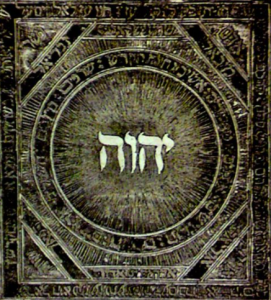
The Most Holy Name in a 1385 Sephardic
manuscript of the Tanakh.
f. Sir | Κύριε [kürie]: The word κύριος [kürios] is typically translated “lord” (or occasionally “master”). It was the most usual Greek rendering of אֲדֹנָי [‘Àdhonây], the word most often translated Lord, i.e., the one without small capitals, in Christian Old Testaments; in fact this word is indirectly responsible for the convention of using “LORD” to represent the Tetragrammaton in English: as the custom of not pronouncing the Tetragrammaton became more and more emphasized, substitutions for doing so when reading aloud from the Tanakh were devised, one of which was to replace it with אֲדֹנָי and, therefore, with κύριος if speaking Greek.4
A little unfortunately for Americans, κύριε—the vocative form of the noun, i.e. the form used in direct address—was also simply the equivalent of a polite “sir,” like the generic “m’lord” we vaguely associate with British English; hence, there isn’t a single word that neatly conveys both contextually-determined meanings without making the New Testament sound arbitrarily British. (Which is something we really like doing with the Roman Empire for some reason, but which probably doesn’t have a particularly sound theological backing.) It is striking that the woman does not initially address Jesus with κύριε, though she goes on to do so twice; one gets the impression that, as he shows through continued civility that he is not going to be cruel to her, she loses a certain defensive surliness she had adopted at first. (I personally think it’s also giving “St. Peter in Luke 5:1-11” vibes; see this post, especially textual notes d and h.)
g. the place where men ought to worship/the Place where it is necessary to worship | ὁ τόπος ὅπου προσκυνεῖν δεῖ [ho topos hopou proskünein dei]: My decision to capitalize here, while personal, is not arbitrary. One of the lesser-known titles for God in Judaism (lesser-known among Christians, I mean) is הַמָּקוֹם [ha-Mâqoum], “the Place.” The origin of this title is referred to Genesis 28:11—the passage where Jacob lies down to sleep in what will later be called Bethel, and has his dream of the ladder into heaven being traversed by angels. This is a natural allusion for the woman to make, since they are at Jacob’s Well, but it also ties this conversation back into the episode when Nathanael was introduced in chapter 1.
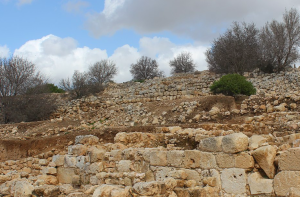
Ruins at Shiloh, the chief site of the
Tabernacle in the pre-monarchic Holy
Land. Photo by Deror Avi, used via
a CC BY-SA 4.0 license (source).
h. You worship what you do not know; we worship what we know, for salvation is from the Jews/You worship what you do not know—we worship what we know, because salvation is from the Jews | ὑμεῖς προσκυνεῖτε ὃ οὐκ οἴδατε, ἡμεῖς προσκυνοῦμεν ὃ οἴδαμεν, ὅτι ἡ σωτηρία ἐκ τῶν Ἰουδαίων ἐστίν [hümeis prosküneite ho ouk oidate, hēmeis proskünoumen ho oidamen, hoti hē sōtēria ek tōn Ioudaiōn]: Here, almost on the heels of the use of Ιουδαίος [Ioudaios] to mean “mainstream Jew [as opposed to a disciple of St. John the Baptist]” in chapter 3, we find it being contrasted positively with Samaritanism. This does also confirm that, as in the Synoptics, Jesus differentiates between Samaritans and Jews proper, on doctrinal and ritual grounds.
i. he will show us all things/he will explain everything to us | ἀναγγελεῖ ἡμῖν ἅπαντα [anangelei hēmin hapanta]: The verb here, ἀναγγέλλω [anangellō], has a base meaning of “to bring back word, declare [in detail].” It is of course related to ἄγγελος [angelos] “messenger.”
j. I who speak to you am he/I am, who am talking to you | Ἐγώ εἰμι, ὁ λαλῶν σοι [egō eimi, ho lalōn soi]: To my immense chagrin, it was only as I was writing this note for this post that the following dawned on me. I gave erroneous information in my intro to John: there aren’t three uses of “I AM” by Yeshua in this Gospel; there are four, and this is the first. The others are the three I had already listed in the Index/Outline—one occurs when he walks on the sea (ch. 6), one at the close of his homily during the Feast of Tabernacles (ch. 8), and one at his arrest (ch. 18). I’ve updated that post since.
This affords us another “retrograde inversion” of the episode with Nikodemos. There, although the Prysha approached with what he thought was readiness to hear, Yeshua told him that
what we know, we talk about, and what we have seen, we witness about, yet you all do not accept our witness. If I spoke to you about earthly things and you did not have faith, how should you have faith if I speak to you about heavenly things? And no one has gone up into heaven except him that came down from heaven, the Son of Man.
Yet in this case, a woman more or less “taken by surprise” understands well enough, and trusts simply enough, that she receives the divine disclosure Ἐγώ εἰμι, “I AM.” Which points us to a more remote source of echoes:
He was in the world, and the world came to be through him, yet the world did not know him. He came to his own, and his own people did not receive him. Such as did take him, he gave to them authority to become God’s children—to those that had faith in his name, who were not born from blood, nor from the flesh’s will, nor from a man’s will, but from God’s.
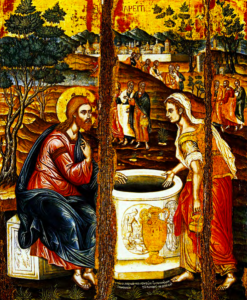
Samaritan Woman at the Well (1689),
by Emmanuel Tzanes.
k. There are yet four months, and then the harvest/It is four months yet, then harvest comes | Ἔτι τετράμηνός ἐστιν καὶ ὁ θερισμὸς ἔρχεται [eti tetramēnos estin kai ho therismos erchetai]: Okay, strap in: it’s liturgical calendar time, we’re getting wild up in here.
This establishes this episode as taking place four months before a harvest. Okay; which harvest? Even if we restrict ourselves to the ritually significant seven species of Canaan, the harvest times for all those together occupy more than half the year. A phrase in the next sentence, “the fields are white with harvest,” points us to the cereal crops, barley and wheat (the other five species are all fruits, which grow in vineyards or orchards, and anyway don’t turn white when ripe). The barley and wheat harvests occurred relatively closely together, the former in the month Nisan and the latter in the month of Sivan—very roughly equivalent to our April and June.
Now. Remember that the normal counting style in the ancient world is inclusive, and that the Hebrew calendar has a leap month, not a leap day, so that might be in play here; we don’t know. Counting backwards from Nisan, then, this would have taken place in the month of Tevet (not-exactly-January), or in Shevat (almost-February) if it were a leap year. Liturgically, these months are of very little significance: the last couple days of Chanukkah fall in the start of the former, and a minor holiday, Tu bi-Sh’vat or “the trees’ new year,” occurred in the latter, and that was about it. But what if we count backwards from Sivan instead? That lands us in either the month of Adar, or … the month of Adar—Adar is simply “had again” as the leap month! Adar I and Adar II are their formal titles. It so happens that a more significant festival than Tu bi-Sh’vat falls during Adar: פּוּרִים [Púrym], “Lots.” You may not think you know about this feast, but you know about it. It already came up in this post, in fact, though not quite directly. It’s the one with those little triangular cookies, hamantaschen? Which are named after a Biblical villain … yes, I’m talking about the feast commemorating the events of the book of Esther.
Royal banner of Cyrus the Great, first Shah of
the Achæmenid Empire, in which Esther is set
—artist’s conception, created by Wikimedia
contributor Sodacan.
To be clear: I don’t have firm evidence to offer that the harvest alluded to by Jesus is the wheat harvest in particular. It seems logical to me to make that assumption, because that draws this into John’s pattern of frequent liturgical allusions—which is valid enough speculation when advanced as speculation. But if someone tried to claim that as evidence that this took place around Purim, and then used John 4 taking place around Purim as evidence for that liturgical pattern in John, that would be some shameless circularity!
Having reminded ourselves of the difference between speculation and evidence, let’s proceed with the former. I find it intriguing that, just as this passage provides often-inverted parallels to Christ’s conversation with Nicodemus, it also exhibits parallels, both inverted and direct, with motifs in the book of Esther. (For simplicity’s sake, I’m going to use the traditional name Photine for the Samaritan woman of this passage.)
- Esther is a queen; Photine is a commoner.
- Esther is a Jew married to a Persian (a Gentile), from the Jewish community that remained in Babylon after the Exile; Photine is a Samaritan, descended from Israelites who were left in the Holy Land when the Exile began and were mingled with Gentiles.
- Esther is selected above all other candidates in the royal harem to become the Shah’s new chief consort; Photine (though we don’t know why) has been repeatedly divorced and is apparently now settling for being a guy’s side-piece.
- Esther fears that approaching the Shah unbidden will result in her execution; Christ out of nowhere offers Photine “living water” that “will become within [her] a fountain of water springing up to age-long life.”
- Esther addresses her petition to the Shah in the context of a lavish banquet; Photine speaks with Christ while his disciples are “offstage” purchasing basic travel-rations.
- Esther intercedes with her husband in her own people’s interest narrowly; Christ tells Photine that even though the Jews do have the right of the doctrinal dispute with the Samaritans, “the hour is coming when they will worship the Father neither on this mountain nor in Yrushalem.”
- Esther concludes with her and Mordecai writing about God’s deliverance and sending word to the Jews of every satrapy to celebrate Purim; the dialogue with Photine concludes with her so excited, she runs away to tell people in the town about him.
l. labor | τὸν κόπον [ton kopon]: In itself, this word is not that remarkable. However, it happens to be the base form of the adjective that describes Jesus in v. 6 when it says he is “labored (κεκοπιακὼς [kekopiakōs]) from traveling”; it also sounds similar to the Greek for “fruit,” καρπός [karpos]. This creates a kind of conceptual pun in the surrounding context, turning the Samaritans of Süchar into something like “low-hanging fruit” that, because of work he has done with a single person while resting from exhaustion, the Apostles have only to pluck.
Then the woman … went into the city and told people: “Come see a person who told me everything which I have done; isn’t he the Anointed One?” They came out of the city and began coming toward him. In the meanwhile, his students pressed him … Yeshua told them … “Don’t you say that ‘It is four months yet, then harvest comes’? Look, I tell you—lift up your eyes and behold the fields, that they are white with harvest; … I have sent you to harvest what you have not labored over; others labored, and you have come into [the produce of] their labor.” Many people from that city of the Samaritans had faith in him, because of the word of the woman … So when the Samaritans came to him, they pressed him to stay with them … And many more had faith because of his word.
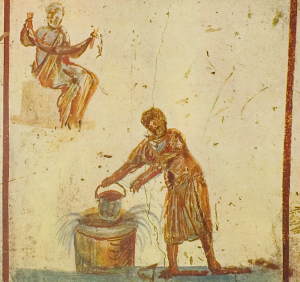
Roman painting (2nd c.) of Christ and the woman
of Sychar in the Catacomb of Callistus.
m. the Savior of the world | ὁ σωτὴρ τοῦ κόσμου [ho sōtēr tou kosmou]: Again we are presented with an echo of the story of Nikodemos, and one which resonates with stuff going all the way back to the prologue, where we heard that “the light appears in the darkness, and the darkness did not grasp it,” but that “Such as did take him, he gave to them authority to become God’s children”.
Additionally, like the woman’s allusion to “the Place” above, we have a faint echo once more of Nethanel bar-Tolmai’s first encounter with Yeshua: Nethanel calls him “the King of Yisra’el” back in 1:49, and one thing people sometimes miss about the word σωτήρ is, it was used as an imperial title. Augustus Cæsar brought an end to wars which had raged within the Roman sphere for nearly a century when he defeated Antony and Cleopatra at the Battle of Actium in 31 BC; that was about sixty years ago at this point, and the imperium had passed from Augustus to his stepson Tiberius (now in his early seventies), but the imperial office was still referred to as Σωτήρ, which can be rendered as “Savior” or “Healer,” depending on context.
Footnotes
1I.e. (as I am treating their order), John, Matthew, Mark, Luke, and Acts. With or without John placed first, I’m of the opinion that these five books are meant to be understood as the five books of the new law, corresponding to the New Covenant and its new Mediator.
2Admittedly, the first successor of Omri was his infamous son Ahab, and that reigning queen of Judah, Queen Athaliah, obtained the throne by usurping it from her own son. So maybe “immodestly successful” would have been more accurate.
3“A-AURORA BOREALIS. At THIS time of year. At THIS time of day, in this part of the country, LOCALIZED ENTIRELY within your KITCHEN.”
4Other alternatives, still in use among Jews, include simply allowing a brief pause when the Divine Name appears, and replacing it with הַשֵּׁם [ha-Shêm], which literally means “the Name.”










 Ad-Free & Subscriber Log-In