

You can find my two-part introduction to the Gospel of John at these two links, and my index/outline for it here; for the previous installment on John 2:13-22, go here.
The Witness of the Baptist (John 3:22-4:3)
Though turning from the religious establishment in Yrushalem to its millenarian fringe in the person of the Baptist, even so, we here continue the series of “statements from witnesses” that this part of John’s Gospel consists in. Intriguingly, we find another narrative curveball for the Christian reader who is already acquainted with the other Gospels. Last week, with Nikodemos, we saw the name of a saint, whom we would presume to be an ally, but were at the same time reminded that he was a Prysha, whom we might presume to be an enemy—yet really, we did not get a clear instance of either one. Likewise, we hear see the name of Yochanan the Immerser, which primes us to expect support for Yeshua’s fledgling ministry (especially after the ringing endorsements already given by him in 1:29-36), but when we come to the text itself, we discover what appears to be an unexplained episode of jealousy on the part of Yochanan’s disciples. The darkness and the light in the Fourth Gospel may not themselves be confused, but the human beings in it exemplify something more like Aleksandr Solzhenitsyn’s famous saying from The Gulag Archipelago, that “the line dividing good and evil cuts through the heart of every human being.”
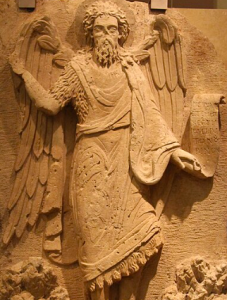
Limestone relief (17th c.) of the Baptist from
Greece. Photo by Tilemahos Efthimiadis,
used via a CC BY-SA 2.0 license (source).
One textual note (a) and the majority of a second (f) are of purely academic interest here, rather than being theologically or devotionally pertinent to the text. These, like lists and quotes, have been placed in small type to save space.
John 3:22-4:3, RSV-CE
After this Jesus and his disciples went into the land of Judea; there he remaineda with them and baptized. John also was baptizing at Aenon near Salim,b because there was much water there; and people came and were baptized. For John had not yet been put in prison.c
Now a discussiond arose between John’s disciples and a Jewe over purifying. And they came to John, and said to him, “Rabbi, he who was with you beyond the Jordan, to whom you bore witness, here he is, baptizing, and all are going to him.” John answered, “No one can receive anything except what is given him from heaven. You yourselves bear me witness, that I said, I am not the Christ, but I have been sent before him.f He who has the bride is the bridegroom; the friend of the bridegroom, who stands and hears him, rejoices greatly at the bridegroom’s voice; therefore this joy of mine is now full. He must increase, but I must decrease.”g
hHe who comes from above is above all; he who is of the earth belongs to the earth, and of the earth he speaks; he who comes from heaven is above all. He bears witness to what he has seen and heard, yet no one receives his testimony; he who receives his testimony sets his seal to this, that God is true. For he whom God has sent utters the words of God, for it is not by measure that he gives the Spirit;i the Father loves the Son, and has given all things into his hand. He who believes in the Son has eternal life; he who does not obeyj the Son shall not see life, but the wrath of God rests upon him.
Now when the Lord knew that the Pharisees had heard that Jesus was making and baptizing more disciples than John (although Jesus himself did not baptize, but only his disciples), he leftk Judea and departed again to Galilee.
John 3:22-4:3, my translation
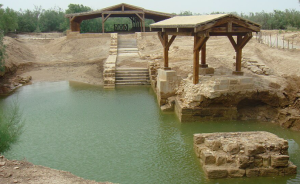
Al-Maghtas, purported site of Christ’s baptism.
Photo by the late Wikimedia contributor
Producer, used via a CC BY 2.5 license (source).
After these things, Yeshua and his students went into the land of Judea, and there he whiled away timea with them and immersed [people]. Yochanan was also there immersing, at Eynan near Saleim,b because there was a lot of water there, and [people] arrived there and were immersed; for Yochanan had not yet been thrown in jail.c
Then there came to be a debated from Yochanan’s students with a Jewe about cleansing [rites]. And they came to Yochanan and told him: “Rabbi, he who was with you across the Yarden, about whom you have witnessed—look, he is immersing [people] and everyone is going to him.”
In response, Yochanan said, “No one can receive nothing, unless it is given to him from heaven. You yourselves witness to me that I said, ‘I am not the Anointed One,’ but that ‘I am sent in front of him.’f He who has the bride is the bridegroom; the bridegroom’s friend, who stands by and hears him, is overjoyed by the bridegroom’s voice. This, then—my joy—is fulfilled. It is necessary for that man to increase, but for me to lessen.g hHe that comes from the top is over all. The one that is from the land is from the land and speaks from the land; the one that comes from heaven is over all; what he has seen and heard, he bears witness about this, and no one receives his witness. He who receives his witness, he sealed that God is true. For the one whom God sent speaks the words of God, for he does not give the Spirit by measure.i The Father loves the Son, and he has given everything into his hand. The one who has faith in the Son has age-long life; yet he who disobeysj the Son will not see life, but the wrath of God stays on him.”
Then, when Yeshua knew that the Pryshaya heard that Yeshua is making and immersing more students than Yochanan (even though Yeshua himself did not immerse, but his students did), he quitk Judea and went back into the Galilee.
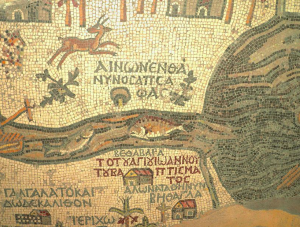
Part of the Madaba Map (6th c.) showing Ænon
on the left bank of the Jordan, just north of
the Dead Sea. Photo by Disdero (?), used via
a CC BY-SA 2.5 license (source).
Textual Notes
a. remained/whiled away time | διέτριβεν [dietriben]: For fun, I wanted to take note of the verb here, διατρίβω [diatribō]. It was applied idiomatically to time; its original meaning was “to rub through,” and was related to a word meaning “path, track, rut.” It comes from an Indo-European root, *terh1, meaning “to rub” and/or “to drill, pierce.” This same root bore three or four flowers in English that blossom to this day. Whether the total comes to four or three depends on whether you’re willing to regard tharm—a word for the intestines which descends via the Middle English þarm—as being “an English word to this day,” as I gather it’s more properly a Scots word, maybe? (The other three descendants of *terh1 in modern English are thrash, thresh, and thread.)
b. Aenon near Salim/Eynan near Saleim | Αἰνὼν ἐγγὺς τοῦ Σαλείμ [Ainōn engüs tou Saleim]: The name of Eynan seems to be related to עַיִן [3ayin], which is both the Hebrew word for “eye” and the name of ע, the sixteenth letter of the Assyrian script (now used for Aramaic, Hebrew, and Yiddish). According to Strong’s, עַיִן was also a standard term for a spring in Hebrew, in much the same way we can speak of the mouth of a river or an arm of a mountain chain. Given the obviously “not being very specific this morning, are we” nature of a name like this, there may have been several cities named—well, basically named Springfield! so the phrase “near Saleim” introduced some needed clarity … to its original audience, anyway (I assume). To modern scholarship’s chagrin, Saleim is also not a unique name, and is itself rather tricky to parse. The only theory I found was that it comes from σάλος [salos]—which isn’t impossible but would be odd, since this would seem to imply it was mashed together from Greek and Hebrew elements without clear meaning in either language. The point is, the exact location of the ancient “Eynan near Saleim” can’t be settled at present, though there are credible theories. These include the modern ‘Ainun, a village in the West Bank, roughly halfway between the Sea of Galilee and the Dead Sea; this appears to align, very roughly, with the information given by Eusebius in his early fourth-century Onomasticon. It’s also possible that it lay on the far bank of the Jordan, opposite Jericho, and thus near the point where the Jordan reaches the Dead Sea; this seems to be supported by the Madaba Map, a church mosaic created in the 500s, and perhaps agrees better with the tradition that the modern Al-Maghtas was the site of Christ’s baptism.
c. For John had not yet been put in prison/for Yochanan had not yet been thrown in jail | οὔπω γὰρ ἦν βεβλημένος εἰς τὴν φυλακὴν ὁ Ἰωάννης [oupō gar ēn beblēmenos eis tēn fülakēn ho Iōannēs]: A little curiously, given his especial prominence in this Gospel, this is John’s only allusion to the imprisonment of the Baptist. His execution is never openly discussed: the evangelist may be hinting at it in 5:32-35, which refers to the Baptist in the past tense, but he draws no closer than this. (The Synoptists’ principal accounts are in Matthew 14:1-12 and Mark 6:14-29; Luke, conspicuously, omits any depiction of the saint’s death, but refers to it in 9:7-9.)
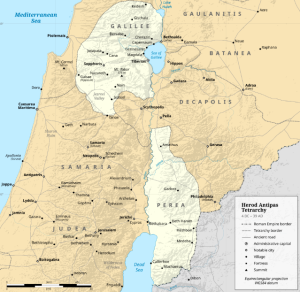
The realm of Herod Antipas, the Herod most
often meant in the New Testament (though not
in Matthew 2). Map by DEGA MD, used via
a CC BY-SA 4.0 license (source).
Here we also find one of the seeming discrepancies between Johannine chronology and that of the Synoptics. Matthew and Mark both indicate that Jesus’ public ministry began only once the Baptist had been imprisoned, whereas this appears to imply that Jesus inaugurated his ministry while St. John the Baptist was still at large (armed and dangerous … -ly telling people not to marry their sisters-in-law). Then again, it is intriguing that near the close of our text, the author makes a point of the fact that Jesus was not personally performing baptisms, even though they were clearly taking place under his ægis. Given the absence of the temptation from this Gospel, and the reasons we have to think that its arrangement is partly thematic rather than strictly chronological throughout, it is hard to say whether this took place before Christ’s ministry formally opened—which Matthew tells us took place in Capernaum—or if there was a (presumably short) period of overlap between the Baptist’s public ministry and his.
d. a discussion/a debate | ζήτησις [zētēsis]: This reminded me irresistibly of a passage from Notes From the Internet Apocalypse, a 2014 novel by Wayne Gladstone (a Jewish author, which will be relevant in a moment here). In its fifth chapter, the self-portrait central character pays a visit what people used to inanely call the “Ground Zero Mosque” in New York, where he strikes up a conversation with one Khalil, an Egyptian Muslim in the city on business. The joke it tells is very old, yet none the worse for that, and I find his telling of it incredibly charming.
“There’s a distrust I did not see sixteen years ago” he said. “Sure, I was a foreigner. … Contempt, racism, even hatred. But there was no fear. Now I just don’t understand.”
“Well, you do understand though, right?” I said. “It was no small thing that happened.”
“Please. I apologize. I’m not minimizing 9/11. But had I stayed in New York, I could very well have been working in the Towers that day. I would certainly have been downtown. And now all Muslims are always the first against the wall.”
Okay. Now we’re getting somewhere, I thought. … “I don’t disagree, Khalil, but given the animus of the Muslim world against America and the history right here in New York, do you really have a right to be a bigot to people who are nervous about a solitary Muslim man crunching numbers five blocks from Ground Zero?”
A slow smile spread across Khalil’s face. He was remembering someone, and it brought a happiness … “You’re a Jew,” he said. “Yes?”
“Why so sure?”
“Only a Jew would be open-minded enough to come to a Muslim community center, while still opinionated enough to risk offending the people inside.”1
In short, and like I said it is an old joke: Jews Love to Argue. I draw attention to this partly just because I find it weirdly heartwarming—as in, it’s weird to me that I find this heartwarming, but I do—and partly with last week’s theological postscript about the Pryshaya in mind. But I also bring it up because it put me in mind of a passage from another excellent book:
No pot—so far—has asked questions of the potter in a voice the potter can understand; when it does, it will be time enough to compare pots to men. The criticism is not aimed at St. Paul. But [this text from Paul] has been used too often by the pious to encourage them to say, in love or in laziness, “Our little minds were never meant …” Fortunately there is the book of Job to make it clear that our little minds were meant. A great curiosity ought to exist concerning divine things. Man was intended to argue with God.
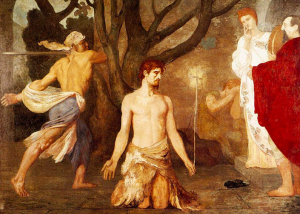
The Beheading of St. John the Baptist
(c. 1869), by Pierre Puvis de Chavannes.
The three friends who have been assuring Job of his sinfulness have their reward. “Ye have not spoken of me the thing that is right as my servant Job hath.” Job is to sacrifice and intercede for them, “lest I deal with you after your folly.” The pretense that we must not ask God what he thinks he is doing (and is therefore doing) is swept away. The Lord demands that his people shall demand an explanation from him. Whether they understand it or like it when they get it is another matter, but demand it they must and shall.
—Charles Williams, He Came Down From Heaven, Ch. III: The Mystery of Pardon and the Paradox of Vanity3
“The Lord demands that his people shall demand an explanation from him.” Not only do I consider this thoroughly in line with Scripture: I believe Scripture teaches us this lesson—or at least that it would, if we read it a little more shrewdly. Almost any Jew could have told us that, if we’d listen even a little bit to Jewish sources about the Jewish collection of documents we know as the Old Testament. A classic and justly famous example occurs in Exodus 32, which we brushed up against in note f from the post about the wedding of Cana. When I was a tweenage Calvinist,4 this passage was marshaled chiefly into arguments about the immutability of the Deity; which in retrospect, I’ll admit, feels … boorish? Anyway, Moshe is up on Mount Sinai and the Israelites have gone and gilt themselves a Calf to worship, when the Lord their God brings this to Moshe’s attention.
The LORD said unto Moses, “I have seen this people, and, behold, it is a stiff-necked people: now therefore let me alone, that my wrath may wax hot against them, and that I may consume them: and I will make of thee a great nation.”
And Moses besought the LORD his God, and said, LORD, why doth thy wrath wax hot against thy people, which thou hast brought forth out of the land of Egypt with great power, and with a mighty hand? Wherefore should the Egyptians speak, and say, For mischief did he bring them out, to slay them in the mountains, and to consume them from the face of the earth? Turn from thy fierce wrath, and repent of this evil against thy people. Remember Abraham, Isaac, and Israel, thy servants, to whom thou swarest by thine own self, and saidst unto them, I will multiply your seed as the stars of heaven, and all this land that I have spoken of will I give unto your seed, and they shall inherit it for ever.” And the LORD repented of the evil which he thought to do unto his people.
—Exodus 32:9-14
If I understand correctly, the standard Jewish interpretation here does, strictly speaking, agree with the concern of “classical theism”5 that this text is not saying God can be changed by outside agents—which is a completely normal thing to be worried about, so, good job, classical theists. But the point of the text is Moses’ intercession for the Israelites; and the usual rabbinic idea (again, to my understanding) is that prompting Moses to intercede is why God addressed the prophet this way in the first place.
If your reaction at this juncture is Great, but what does this have to do with John chapter 3?, the answer is Not much that I know of. But I think it is worth taking note of lessons that turn out to be as wide-ranging as “Why does God tell us to pray?” for future reference whenever they chance to come up. God tends to plant Easter eggs in our lives: things (including knowledge) that will be useful later, or to others, in ways we cannot foresee.
e. a Jew | Ἰουδαίου [Ioudaiou]: I outlined the idea I’m about to discuss a couple of months ago, in note b of this post. However, on reflection, I feel my critique in that post was wide of the mark. I stand by the statement that it is not proven; it’s not. But I think it’s credible, and that, I must eat my words about.
Jews are an ethnoreligious group.6 As that term suggests, these are ethnic groups (i.e., defined by shared descent and culture) which have become so closely entwined with a given religion that the two have in some sense fused. This can lead to some extremely complex answers to superficially simple questions, because—as we see with every religion—people don’t always stay the same religion their whole lives, nor in many cases can religions be trusted to stick to one people for their entire lives.
The term Ἰουδαῖος [Ioudaios] is nearly always rendered “Jew” in English, which is perfectly correct; the term ultimately descends from יְהוּדָה [Y’hûdhâh], the Hebrew name of Israel’s fourth son. However, the complexities that inhere in this word aren’t necessarily clear at a glance. Ἰουδαῖος need not mean “Jew as opposed to Gentile.” It obviously could. But, depending upon context, I think it’s probable that Ἰουδαῖος could have borne any of five particular meanings—two primarily ethnic and historical, two primarily religious, and one primarily civic and cultural.
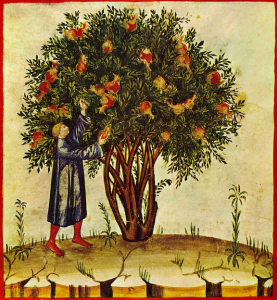
Illustration (late 14th c.) of a pomegranate
tree from an Italian manuscript.
- Of “Judahite” ancestry (narrow sense). A member of the Tribe of Judah as distinguished from some other tribe. (In this highly restricted sense, even the high priest would technically not have counted as a Ἰουδαῖος.) The salient distinction here is between this one tribe and the other eleven.
- Of “Judahite” ancestry (broad sense). I.e., descended from the people of the southern Kingdom of Judah, as opposed to being descended from the northern Kingdom of Israel. (It is in this sense that Benjamites and Levites, as well as Judahites, were Ἰουδαῖοι [Ioudaioi].) The salient distinction is between those who, centuries ago, clung to the House of David and the Temple of Solomon, versus those who abandoned both—the Samaritans, for instance.7
- A small-o orthodox Jew.8 As opposed to any sort of heterodoxy; Samaritans would have been the primary “targets” of this distinction, but there were others, like the supporters of the Temple of Onias in Egypt.9 The salient distinction here is between mainstream Judaism and the theological “fringe.”
- A “Judaist.” One who practices Judaism. This almost always means one who is Jewish by both ethnicity and faith, but converts to Judaism are also known in the first century. The salient distinction is between the Judaic faith and the paganisms of the surrounding goyyim.
- A Jew from the province of Judea. As distinct from a Jew who came from the Galilee or Idumea10 (both outlying regions acquired by the Hasmoneans relatively recently), or from a Hellenist, i.e. a Jew of the Greek-speaking disapora. The salient distinction in this case is between more respectable Jews who live in or near Jerusalem versus Jews from the outskirts or from abroad, who evidently spoke with distinctive accents, either foreign or regional11 (if they spoke Aramaic at all, that is).
Obviously these categories can overlap; indeed, some of them do so automatically: any Jew in sense 1 would ipso facto fit under sense 2, and Jews in sense 3 must also be Jews in sense 4. Most people who appear in the Gospels would have been Ἰουδαῖοι [Ioudaioi] under 2, 3, and 4. A southern Ἰουδαῖος in sense 5 might be contrasted with a Γαλιλαῖος [Galilaios] (a Galilean); a practicing Ἰουδαῖος in sense 4 might be contrasted with an ἐθνικός [ethnikos] (a Gentile); a doctrinally meticulous Ἰουδαῖος in sense 3 might be contrasted with a Σαμαρείτης [Samareitēs] (a Samaritan), etc. Still, the most frequent and sharpest distinction would always be that made between the Ἰουδαῖος and the ἐθνικός.
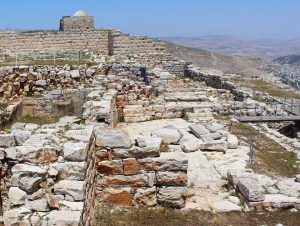
Ruins of a Samaritan settlement on Mount
Gerizim. Photo by Deror Avi, used via
a CC BY-SA 3.0 license (source).
The reason I was initially skeptical about the possible complexities here was, basically, that it seemed like a suspiciously convenient “out,” with respect to the question of antisemitism in the New Testament. Oh, the New Testament isn’t antisemitic because every time it says “the Jews” in a way that sounds antisemitic, it just means “Judeans,” so that’s fine? Sure, pal. And don’t get me wrong, I’m not eager to charge the New Testament with antisemitism—if anything, I earnestly want to clear it of such a charge. But for that exact reason, I don’t like cheap rebuttals. Cheap rebuttals make the accusation seem more credible, not less; I want (if possible) to exonerate it, not have it procedurally acquitted on mere lack of evidence! And my suspicions only seemed to be reinforced by Jesus using the term in an obviously theological sense (our sense 3 in the list above) in John 4:22.
But I’d forgotten about today’s passage when I remarked on this interpretation three months ago. Look back at 3:25. The disciples of the Baptist, like the whole “cast” thus far, are Jews. So what could be meant by the statement that the disciples of the Baptist got into an argument with “a Jew”? All concerned are clearly Jews in sense 4, or there’d be nothing in common for them to argue about. The contrast can only be doctrinal, at least in the broad sense whereby “doctrine” includes ritual; indeed, we’d likely describe a dispute of this kind in the Catholic Church today as a difference of rites (as in the Coptic rite, the Greek rite, the Latin rite, etc).
f. You yourselves bear me witness, that I said, I am not the Christ, but I have been sent before him/You yourselves witness to me that I said, ‘I am not the Anointed One,’ but that ‘I am sent in front of him’ | αὐτοὶ ὑμεῖς μοι μαρτυρεῖτε ὅτι εἶπον· Οὐκ εἰμὶ ἐγὼ ὁ χριστός, ἀλλ’ ὅτι Ἀπεσταλμένος εἰμὶ ἔμπροσθεν ἐκείνου [autoi hümeis moi martüreite hoti eipon: Ouk eimi egō ho Christos, all’ hoti Apestalmenos eimi emprosthen ekeinou]: Curiously, despite the Baptist’s avowed confidence in and endorsement of Yeshua, it’s clear from both the canonical Gospels and the book of Acts that his disciples remained a group distinct (or at the very least, distinguishable) from those of Yeshua, both before and after their own prophet’s execution, as well as the Resurrection. Why this should be so is difficult to say; one would have expected endorsement to result in fusion.

Drabsha (“banner”) of Mandæism at a
Mandæan house of worship in Sydney, Australia.
Photo by Wikimedia contributor Akamanda, used
via a CC BY-SA 4.0 license (source).
At least one modern group besides Christianity also claims to have roots in the following of St. John the Baptist. That group is the Mandæan religion; and for once, I will allow people to call something “a modern form of Gnosticism,” because it does in fact adhere to beliefs that were familiar in Gnostic circles as those were in their heyday (the second and third centuries)—they are often called the sole surviving Gnostic religion.12 (In some older literature they were referred to as “Christians of St. John,” which was quite the misnomer, as we are about to see.)
Now, Mandæism is an esoteric faith, so some of its beliefs and rituals are restricted to initiates; moreover, I am far from being an expert on them. However, I gather their exoteric teachings include monotheism, the existence of a host of angel-like beings, the immortality of the soul, and the ascent of the soul after death through the planetary spheres, which are held to constitute or include a type of Purgatory. Mandæans consider themselves the descendants of Adam, Seth, Noah, and Shem, and revere Yahya (St. John the Baptist) as the greatest of all prophets. Despite all this, it is hard to classify them as an Abrahamic religion: they do not recognize Abraham, Moses, or Jesus in any role, and indeed, they regard Jesus in particular as an apostate from their own faith. Ritually, they repudiate circumcision and practice frequent baptisms. Quite confusingly, the emblem of their faith—known in Mandaic Aramaic, their liturgical language, as the drabsha—has the superficial appearance of a white-mantled cross! (The two can be distinguished by the fact that the white draping is always required on the drabsha, and by the seven sprigs of myrtle that must adorn its top.) My personal guess is that the Mandæns are derived from the Essenes, which would seem to economically explain both their similarities to Judaism and Christianity and their divergences from both, and dovetails very nicely with their attitude to John the Baptist.
g. He must increase, but I must decrease/It is necessary for that man to increase, but for me to lessen | ἐκεῖνον δεῖ αὐξάνειν, ἐμὲ δὲ ἐλαττοῦσθαι [ekeinon dei auxanein, eme de elattousthai]: This is a funny sort of case: last week, I was lamenting the fact that translators often iron out similarities of wording from one spot to another, thus eliminating certain rhetorical aspects of the text, but here, most translators introduce a verbal parallel (“increase-decrease”) that is not present in the Greek!
h. [—]: As with the mysterious decision about vv. 16-21 we touched on last week, why aren’t vv. 31-35 attributed to the Baptist by most interpreters? Again, there seems no particular reason to assume John the Baptist could not say something of this nature, though the text as we have it is perhaps filtered through a Johannine idiom.
i. for it is not by measure that he gives the Spirit/for he does not give the Spirit by measure | οὐ γὰρ ἐκ μέτρου δίδωσιν τὸ πνεῦμα [ou gar ek metrou didōsin to pneuma]: This caught my eye. Μέτρον [metron], “measure” (hence meter), is related to the word μετρητής [metrētēs], “measurement”—the same word used a few verses back in chapter 2, describing the stone jugs that would each hold “two or three measurements” of water. So I’m now kicking myself that in my post on the miracle at Cana (see textual note g), I decided to use rundlets because “measurements” was, my words, “amazingly unsatisfying”! Serves me right for ignoring my own principles of translation.
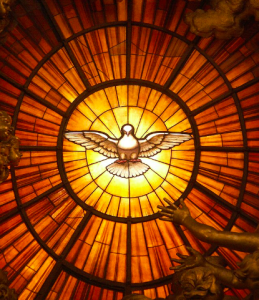
Depiction (c. 1660) of the Holy Ghost from
St. Peter’s Basilica in Rome. Photo by
Dnalor 01, used via a CC BY-SA 3.0 license
(stop).
j. does not obey/disobeys | ἀπειθῶν [apeithōn]: Interestingly, the Greek verb usually translated “to obey” (πείθομαι [peithomai]) does not really mean that, or at least, it didn’t originally. The -μαι ending on the dictionary form there might make us guess that it is a deponent verb, one of those active verbs that just has a passive-voice form for some reason; in truth, that is a genuine passive, corresponding to the active πείθω [peithō], “to persuade, convince.” To obey was, linguistically, to be persuaded.
k. left/quit | ἀφῆκεν [afēken]: Ah, we meet again: ἀφίημι [afiēmi], my old arch-nemesis. This verb has such a ridiculously long list of possible meanings, I don’t believe anyone could hope to render it by just one in English; it’s almost as bad as our “to do” (and no, of course ἀφίημι doesn’t mean “to do,” that would be crazy). To be fair, it is, conceptually, extremely wide-ranging: it’s compounded out of ἀπό [apo], the preposition mainly meaning “from, away from,” plus the verb ἵημι [hiēmi], “to release, let go of; to say; to throw, cast, hurl.” (You would think Ancient Greek was adequately supplied with verbs that can bear the meaning “to say,” but of course you would be wrong.)
Given that practically any … motion, really, can be seen from some point of view or other as casting something away, or being cast away from something, well, you see the problem! But then they also gave ἀφίημι every metaphorical meaning under the sun, from “divorce” to “forgive” to “send as a representative” to “manumit,” and y’all, I give up. Hitherto, I’ve been able to cram most of the things ἀφίημι has meant in passages I’ve translated under either emit or remit, which at least have a genuine etymological relationship, however tenuous; but at this point, yes, we are in fact reduced to “using quit because it rhymes with the other two and that’s the nearest thing to verbal consistency I can extract from this.”
Footnotes
1Notes From the Internet Apocalypse, pp. 68-69 (nice2), from Thomas Dunne Books (which is an imprint of St. Martin’s Press, which is a derivative of Macmillan Publishers, which is,,, and so on back to the invention of hieroglyphics). I’ve taken the liberty of omitting some of the ellipses that should really be here, and also of adjusting the wording of the last sentence in the fourth paragraph: my copy in fact reads “to be a bigot to be nervous” rather than “to be a bigot to people who are nervous.” I take the intended meaning to have been the latter; however, if I have misunderstood and, by some strange turn of fate, Mr. Gladstone happens to read this, I apologize and solicit his correction of my emendation!
2I know we’re here to talk about Scripture. But look, Gladstone’s an alumnus of Cracked.com from way back, like “when it was good” kind of way back: I can’t just not say “nice” under these circumstances. It’d be bad form.
3I have left out a few ellipses here, because the one I left in is Williams’ own, and I did not want to rob it of its proper effect.
4I Was a Tweenage Calvinist—now that is a book title.
5If you’re not acquainted with the expression “classical theism,” it theoretically denotes a set of views about God that can be reached simply through reasoning. (It also and in practice says Yes, I am a Christian, and yes, I am doing apologetics, but I’m trying very hard to argue from reason with no fallacious appeal to religious authority. Not that that’s a bad thing to say—just so you’re aware of the fact.)
6I can’t say why, but for some reason the Near East seems to abound in these: you’ve got your Alawites, Assyrians, Druze, Jews, Mandæns, Maronites, Samaritans, and Yazidis, to name just eight that all hail from the Fertile Crescent.
7To me, the claim that Samaritan Judaism is not a form of, uh, Judaism (which is a normal view among Jews) seems like it must be at least partly a feature of the relation between the names of “Judaism” and “Judah”: the surviving Samaritan population of a few hundred people, while they profess to preserve ancient Israelite religion in its proper form and possess their own version of the Torah, claim descent not from Judah but from Ephraim.
8I specify “small-o” because, naturally, the full panoply of beliefs and practices proper to capital-o Orthodox Judaism—the Talmud, Rashi, Maimonides, the Zohar, Luria, etc.—did not yet exist; even the Masoretic Text still lay in the future in the first century.
9This “Temple of Onias” stood in Heliopolis, one of the oldest cities in Egypt, near the base of the Nile Delta. It had been founded by a priest of genuine Zadokite lineage, probably in the early second century BC; for this reason, and because it did not allow any syncretic or idolatrous practices, this temple was considered illegitimate but not blasphemous by the Sanhedrin. Like the Temple in Jerusalem, however, the Temple of Onias was destroyed during the First Jewish War (to prevent its becoming a possible rallying point for irredentist Jews).
10In particular, Idumea was the Hellenized name for Edom (from אֱדוֹם [‘èdhoum], “red”), a kingdom stated in the Bible to be descended from the family of Esau, Jacob’s twin brother. Its territory lay on either side of what we now call the Wadi Arabah—essentially a southward continuation of the Jordan Valley, itself the surface manifestation of a tectonic rift known as the Dead Sea Transform.
11The difference I’m getting at in distinguishing between foreign and regional accents is the difference between someone speaking with a foreign accent (French, Russian, etc.) and someone speaking dialectically within English (e.g. with a “Southern twang” or an “Irish brogue”).
12For those keen on demography: there are about a hundred thousand Mandæans in the world. Until 2003, when US military action disrupted all levels of society there, almost the entire Mandæan population lived in southern Iraq, and had done almost since their founding, which they date to the ministry of John the Baptist, a date which at least some scholars consider possible. Tens of thousands have since fled to Europe, North America, or Oceania; most now live in Australia, Germany, the Netherlands, Sweden, or the US.












 Ad-Free & Subscriber Log-In