

Look around your parish. Nice place or needs upkeep? Who takes care of the church and grounds? You assume there’s staff for that. Yet, who is the manager who makes it all function properly? Well, the parish pastor, of course. My question is, though, how does he cope? Doesn’t temporal maintenance interfere with spiritual maintenance?
In my travels, I have come across a couple of situations that made me ask that question. My husband and I attended Mass in Cheyenne, Wyoming, several years ago. The first thing we noticed was that the parking lot looked newly resurfaced, and the entire parish complex appeared well-maintained.
As the pastor revealed in his homily, the parish had just been through about ten years of fix-and-build projects. It was all coming to an end, though, and he said that absolutely, positively, enough was enough — he was not going to talk about money from the pulpit anymore! Instead, he was going to concentrate on Catholic teaching.
The pastor went on to make a very good point about parish life that I think will strike home with many a Catholic priest or parishioner: We can get so caught up in the practical demands of building maintenance that we forget the real reason for the parish: spiritual maintenance.
Church Buildings and Grounds
A church is the place where we gather to worship. We could hold services in any open space, but the vagaries of nature cause us to seek indoor shelter. Thus we erect a building, but then we have to maintain it, and wouldn’t it be nice if we had a parish hall for social functions, and we have to have a school, of course, and then the KofC wants their own hall, and you’ve got to have a playground, and. . . .
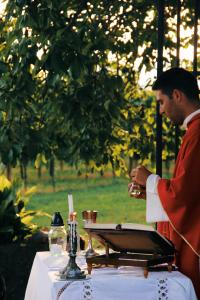
Remember that we just wanted a place to worship? When confronted with the painting, plastering, repairing, resurfacing, etc., over and over again, suddenly open-air services in a meadow seem like a much better idea. Oh, but that might get a little chilly in Cheyenne or cause heatstroke in Phoenix. Okay, back to needing a building, but how do you keep the spiritual purpose of the church to the fore?
For that parish in Cheyenne, the pastor announced that they had come to the end of all major construction projects, at least for the foreseeable future. There would be no more capital campaigns and no more building committees. He acknowledged that people in the parish were tapped out and worn out, so it was time to put all that aside and concentrate on spiritual renewal — on fortifying the soul, not the infrastructure.
A similar example of the demands of physical maintenance occurred when we visited a parish in Las Cruces, New Mexico. The relatively small church had a packed house at the 9:30 English Mass we attended, but there were four other Sunday Masses; two in Spanish. With two priests, a deacon, and five Sunday Masses, it must be a busy place.
At the end of Mass, the priest announced that, despite some complaints to the contrary, the parish cemetery was being properly maintained. He asked for patience with some of the erosion problems they were experiencing because of recent heavy and continuing rains.
The Pastor’s Job
How do parish priests do it all? They are trained to say Mass, hear confessions, prepare parishioners for the sacraments and administer those sacraments, provide counseling, lead adoration services, conduct funerals, and so on.
Besides that, they have to be a Jack of All Trades overseeing fundraisers and various other events (including bingo!), serve as advisor to several parish organizations, teach classes, sit in on endless committee meetings, worry over the budget, listen to complaints, do their bit for the diocese, and supervise the school (if there is one), all the while developing relationships with their fellow priests, the deacons, the principal and teachers at the school, the parish staff, and a whole herd of parishioners!
It’s monumental, but expected nonetheless. I once belonged to a parish that had 4600 families. The church compound covered most of a city block and included the church, school, playground, offices, parish hall, the St. Vincent de Paul and KofC buildings, several other secondary buildings, and the rectory. The pastor was, in effect, running a small city. Is that what he signed up for?
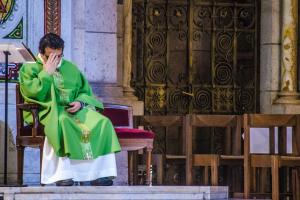
Fortunately, he had two other priests in residence, but one was also a hospital chaplain. Then, on top of regular parish work, they had large programs to assist their many Hispanic members with immigration issues and catching up on neglected sacramental training and getting marriages blessed.
Much of this is truly pastoral work related to the faith, but much is also administration for which, I suspect, many a pastor wishes an MBA had been included with ordination. I mean, really, did he spend all those years in seminary studying theology to end up explaining cemetery maintenance?
Perhaps he has a maintenance supervisor and a cemetery board to handle the details, but being a pastor means the buck stops on his desk, and the poor guy is definitely the one who gets an earful from unhappy parishioners and then has to go find out the causes and solutions to the problems.
In 2021, Catholic Digest published an article about a Chicago police chaplain that touched on this subject. Describing a priest who started out “energized” by so much of parish ministry and had “never imagined anything but parish life,” the priest “ultimately found himself questioning his role. He didn’t become a priest, he admitted, to deal with leaky roofs, teacher contracts, or disagreements about use of the church hall.”Finding Balance
Parish priests have a very hard job. Parishioners need to curb their complaints and practice saying, “How can I help, Father?” We need to recognize the extent of the demands on the pastor, be grateful for his dedication, and do what we can to increase his time as our spiritual guide.
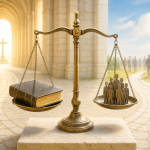
As with everything in life, there is a need for balance in parish functions. We cannot ignore the practical demands of our necessary physical structure, but even more importantly, we cannot ignore the demands of maintaining a beautifully built spiritual life. There are many Catholics around the world, perhaps the majority even, who worship in not much more than a hut, but their faith is made of solid timbers. Perhaps then, if we want a nice building, we should make a shining temple of our souls.














 Ad-Free & Subscriber Log-In