

The bite of the apple tastes serious
Five diverse graduate students, each a specialist in fields ranging from physics to Greek Classics, arrive at the “Vault,” a TechGenie Media innovation lab. Their mission: a multidisciplinary quest to solve a major global problem. Their mentor, Professor Torn, immediately challenges their “invincibility,” arguing that innovation without spiritual wisdom is a fast track to failure. He posits that humans are not “lumber” to be shaped, but complex beings requiring the vision of a Creator to become true “co-creators.”
The group selects a daunting target: Ending economic unemployment and establishing living wages. The tension escalates on the ride home when Loki, their cynical bus driver, condemns them as “born sinners” destined for failure. While the group feels the sting of his demoralization, they leave the bus with an uneasy, demoralizing feeling.
The Insight: In the “Workshop of Life,” your Attitude is that small signal that controls you. Loki’s goal is to fill your “circuit” with the static of condemnation and depravity, which effectively shuts down your power. When you shift your view from being a “broken machine” (The Courtroom) to an “apprentice in training” (The Workshop), you clear the signal. This internal shift is the “small thing” that allows you to begin controlling the “large power” of societal change.
The Action: Today, identify one “Loki” in your life—a voice, a news source, or an internal thought—that is telling you that a problem is too big to solve or that people are too “depraved” to change. Look at a project you are currently working on. Are you waiting for it to be “perfect” (Eden) before you start? Or are you willing to take your “flawed tool” out into the reality of the swamp to see where it needs reinforcement? Embrace the bite—it tells you exactly where your blueprint is weak.
The Task: Instead of arguing with the noise, look for the Blueprint.
The Step: Find one small, evidence-based “Success Signal” in your community—a local charity that works, a neighbor helping a neighbor, or a small business staying afloat. Acknowledge that small success as proof that the “System” can still be steered. Use that one positive data point to “gate” your energy toward solving a problem rather than just lamenting it.
Themes: Experiential Knowing, Creative Agency, and the Psychology of Grace.
The Three Trees in the Bible: The Tree of Life, The Tree of Good and Evil, The “tree” of Christ: the Cross
The song, Three Trees, that I created to accompany this series, on YouTube and soon to be on in distribution on music channels.
Chapter 2: The Stress Test
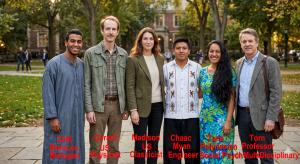
The five graduate students piled off the bus into the remote campus building where TechGenie Media sponsored a multidisciplinary Innovation lab. This independent study offered a unique path: directed research with an experienced multidisciplinary director, preparing for doctorate level work.
The building was a relic of the late 1800s, a Gothic revival of dark limestone that rose from the Missouri soil like a stone bulwark against the ashes of time. To the local townspeople, it was “The Vault;” to the university, it was a high-stakes experiment. Only students with master’s degrees—those who had already proven they could survive the academic “nursery”—were allowed within its heavy oak doors.
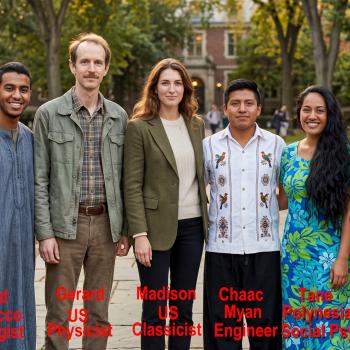
Most had only just met at the orientation dinner, a night of cautious networking where they learned that “diversity” was more than a buzzword here; it was a structural requirement. Diverse interests, diverse studies, diverse geography, all typified the five people who had been so interested in everything they had difficulty choosing a major in college.
“Have a fruitless day!” yelled Loki, the bus driver as they piled off the bus. He hung out the window, his eyes twinkling with a mischief that bordered on malice. “You’ll never accomplish anything until you get right with God. You’re just building sandcastles in a hurricane!”
Some of the students turned and made rude gestures while smiling. This was their first experience with Loki, and they took his cynicism as a badge of honor.
“We’re going to solve world problems, you wait and see,” yelled Madison. She stood tall, her brown hair flowing, her Roman heritage evident in her sharp profile and the way she carried like a shield her leather-bound copy of Yale Classics – Ancient Greek Literature (Anthology). “My aunt’s social security couldn’t keep up with inflation and she just got evicted! You tell me God doesn’t want that fixed!”
“Easy. Ignore him.” Zaid said, his voice carrying the warmth of the Moroccan sun to which his dark skin and black hair were immune. Next to Madison, he was a bit short. He adjusted his satchel, which smelled faintly of damp earth and peppermint. “He’s just a Sirocco, the desert wind—lots of hot air, but no rain. We have fun work to do.”
Gerard laughed, the sound as dry as a blackboard eraser. Tall, thin, a mustache, and already balding, he was someone you could imagine writing physics formulas on a tall chalkboard, or scrawling them on a tablet on a podium. “Madison, where did democracy and great thinking get the ancient Greeks? Alexander the Great terminated it. We struggle, but we can’t change the idiots that conquer our politics. The degenerates, moving backward through time, always get back in.”
“Maybe your physics goes backward, Gerard, but the Mayan Calendar only goes forward in cycles. Run the course then begin again,” Chaac said softly. He walked with a measured pace, his eyes always scanning the horizon as if looking for a shift in the clouds. In stature, he was substantially shorter than Zain at 5’ 4”, typical of Mayan men. “Maybe we never learn. Maybe we have to repeat to learn. Maybe a new group comes each time.”
“You’re named after the Mayan god of rain, Chaac. Don’t rain on my physics,” Gerard shot back, though a smirk played on his lips. Chaac laughed at the playful banter. He wasn’t about to be drawn into a serious rivalry.
They entered through the double wood doors, leaving the humid Missouri morning for the cool, floating-dust speckled air of the foyer lit it up by the afternoon sun. The interior was a labyrinth of brass fixtures and polished mahogany. They bypassed the modern labs with their humming servers and glowing screens, led instead to a sanctum that felt older than the university itself.
“I view it from the lens of social psychology,” Tane mused, her Polynesian lilt turning the sentence into a song. She was the same height as Chaac, but with flowing black hair. “In the islands, the sky and water are most of the earth—we never know the depth of knowledge, so family is the only anchor. Relationships are everything.”
A sign on a bright yellow tripod pointed to another darkly stained oak door which led them into a classroom.
“Someone’s going to stumble over that sign,” Gerard said. “I’ve seen it happen.”
Unlike the sterile labs upstairs, this room featured a circle of comfortable swivel chairs around a plain, massive chalkboard that still bore the faint white ghosts of previous equations. Zaid sat in one and immediately began to spin, his boots scuffing the floorboards.
Professor Torn didn’t stand behind the lectern; he leaned against it, his posture reflecting a man comfortable with the weight of the world. He wore a tweed jacket that had seen decades of field work, and his hands—stained with both ink and garden soil—were restless. His name was a source of student legend; some said it meant he was “torn” between the physical and the spiritual, others said it referred to his method of tearing down a student’s “Attitudes” to find their “Rationality.”
His eyes were light green, piercing, as if he were looking at the “blueprint” of the person rather than the exterior.
The man they knew as the professor studied each as they entered and sat. He waited for Zaid to finish his third rotation in the swivel chair, smiling to himself, before he spoke. He watched them—the fire of youth in their eyes, that dangerous mix of high intelligence and the belief that they were invincible, and he smiled, knowing the “milling” they were about to endure might just break some of them.
“You spoke last night of ‘solving problems’ and ‘replacing worn out systems,'” Torn began, his voice a low baritone that seemed to vibrate the very floorboards. “Here we are, coddled in academia, the proverbial Garden of Eden, innocent, idealistic, nibbling on that tree of knowledge, thinking you know the answers and anxious to get out there and be creative. My job isn’t to profess anything to you—you’ve learned the academics extremely well or you wouldn’t be here. My job is to meet you where you are and pull back the curtain on the reality you the level you can work with, not by more knowledge but by actually doing it. Not many can hack it. Reality is a royal pain in the arse. It’s unscripted, uncooperative, and every time you think you’ve engineered a perfect answer, some monster jumps out of the swampand bites you in the butt.”
He looked around again at them. “Look at us. Are we arrogant children playing with the fire of the gods?” His piercing eyes looked into the souls of each of them. “Do we believe we can engineer a paradise when we ourselves are flawed tools.”
He picked up a piece of chalk and drew a single, jagged line down the center of the board.
“The human material you wish to work with is not ‘lumber’ to be shaped,” he asserted like this was a major filament of the universe that couldn’t be cut or nailed. “We have to understand that we are here to learn that without spiritual wisdom, our ‘Innovation’ may be merely a faster way to reach the bottom of the well. If we become co-creators we need the vision of the creator.”
He looked at each one of them as he spoke. “Who of us dares to step into that gigantic role?” Again his eyes searched their souls. “Who of us has the wisdom of the ages? Who of us is wise enough to assert his will on the world?” He let that sink in for an uncomfortable amount of time.
Finally Gerard broke the silence. “I think he’s echoing Loki,” Gerard nervously said to the group.
Torn smiled knowingly and sat down in a chair with them. “Loki is half-truths. He will try to get you to drop all of this. I want us always to keep in mind the gravity of our tasks. In this lab it stops being theoretical and we’re messing in the lives of real people. This isn’t a frivolous thing to do. We have to look at the “burden” we place on society.
“When we decide which human problem to tackle, we may find ourselves delving into the myths all around the world, Madison, to find the kernel of truth the Greek philosophers struggled to find.
“We may find that physics, Gerard, is only one tool in a toolbox of human invention that includes so many other tools, like Tane who views the mystery of the universe with awe that not just one tool can ply.
“And then Chaac, our engineer who sees the cycles of creation over and over in the Mayan calendar and in plants and animals. What does that tell us? What are the implications for our quest to solve a great problem?”
You have the basic tools. You all know the “Five Whys.” You’ll use them. And Human Centered Design. And of course Multi-Criteria Decision Analysis (MCDA). But you’re moving toward doctorate level research. You’ll be using “Triangulation” which is proving a theory is sound from every possible angle of reality. And this may be a shock, but Grounded Theory in the spiritual and psychological side of the research.
“You’ll also look at Analyzing the “Signs” and “Language” used in public policy (such as why do we call it “Entitlements” vs. “Stewardship.” Just as importantly you’ll look at Scalability, Operational Efficiency, and Value Propositions. That is, the road to implementation.
“In short, you’ll identify everyone with “skin in the game” such as the city, the politicians, the billionaires building monoliths, the impact on local small businesses, and even the homeless living in the streets. And finally, change management, which you will find in Dorian Cole’s book Unleash Movements that Matter: Break through barriers to change.
Torn paused and looked pointedly at each one of them again before raising the question of the hour and the century, “What earth-shattering problem shall we solve?”
“Global warming!” Tane shot out immediately. “It’s drowning our islands.”
“It’s killing central America,” Chaac said. “El Salvadore keeps getting hit hard. Unemploment is high, and very high among the youth, so they join gangs. This is why they keep fleeing to the US. But the US is the second largest polluting country in the world, so it’s creating the very problem that’s driving people to come here.”
“Very good analysis,” Torn said. “Anyone else?”
“Growing food in the Sahara desert,” Zaid said. “I want to make that happen. Morocco borders the Sahara.”
“Economics and unemployment,” Madison said. “It’s a global problem that keeps food out of the mouths of babes and even in the US 3.5 million people lose their jobs and homes every year. I don’t go to church much, but these are the people in the pews whose jobs were outsourced, the elderly woman whose property taxes outpaced her social security, and the family whose medical debt triggered an eviction. It happened to one of my friends. And my mother talks about how people are struggling to keep their homes.”
“Yeah, yeah,” Zaid agreed. “That’s very practical.”
“It’s a major problem in Mexico and mid-America,” Chaac said. “It’s hard to grow food with the climate changing, and we stay very poor because our economic system has no props.”v
Gerard looked down at the floor.
“What’s the problem, Gerard?” Torn asked.
“I’m kind of left out. I don’t see physics applying to either of these problems.”
“You’re going to be pleasantly surprised.” Torn turned his focus back to the group. “So, is it economic unemployment and living wages?”
The group nodded affirmation.
“Worthy cause. This is an enormous problem. Do you think we can solve it?” Torn asked.
The group looked doubtful.
“Maybe some corner of it,” Madison said.
“Then let’s turn to physics.” He smiled at Gerard.
“Gerard, can you tell us something in physics that has a small amount of power, but it controls a much bigger process?”
Gerard thought for a moment. “Okay, amplifiers take millionths of a volt signals from the air and amplify them into large signals for things TVs that display big, colorful images with large sound.”
“Good, but amplifiers have a large voltage supplying them. Sometimes we can use that.”
“Go home and think about this.” He handed them a copy of Dorian Scott Cole’s book, “Unleash Movements that Matter: Break through barriers to change,” that shows how people without power changed society.
The group got back on the bus to take them to the main campus. Loki smiled at each one with a clever, mischievous glint in his eye. As they settled in, the engine roared to life and he accelerated quickly out of the parking lot into the four-thirty going home traffic.
“Think you’re smart, don’t you.”
“If we weren’t smart, we wouldn’t be in this group,” Chaac said.
“I suppose you’re looking down on us because you’re uneducated and you fear us,” Madison said. “Well, you have nothing to fear. We’re on your side.”
“I’m on God’s side, so what have I to fear? Huh? The only people who are smart are those who have chosen Jesus Christ as their savior. The rest are going straight to Hell. You were born condemned because of Adam and Original Sin.”
“You! You! You don’t know what you’re talking about. We’re good people! You’re spouting nonsense. I’ll find where your version of God went wrong, Loki. Because the God I hear about is a creator, not a destroyer.”
“Prove it. Dig into the scriptures.”
“I will! Just to show you. I can read and analyze two books a day. I’ll put this craziness to rest. Zaid, you do it, too?”
“The Koran has a lot of Jesus in it. I don’t have time for this. We have our assignment.”
“The wheel of time moves forward and we all learn one way or another,” said Chaac.
“Stupid stuff,” Gerard piped up. “Life is all physics. Action-reaction.”
“You’re actions burn you in Hell,” Loki replied.
“What do the rest of you think?” Gerard asked. “You’re all different heritages.”
The group mused on that as they traveled. Loki hurt their feelings. They felt up when they had left, now Loki was bringing them down. They had to battle Loki.
As Madison was leaving the bus she said to the group, “He thinks we’re broken machines. Tomorrow, let’s show him the blueprint.”
Chaac said, “The rain falls on the just and the unjust, Gerard. Loki is just a cloud.”
________________________________________________
TechGenie Media is my company which I used because it represents my multidisciplinary approach to research to find answers to very difficult questions.
Our answer is God. God’s answer is us. Together we make the world better.
Author’s Website with life and spiritual resources: Dorian Scott Cole .com
Recent website articles
- Theology of Catastrophe: a dissertaton style paper on why catastrophes happen.
- Ekklesia: a new format for a Jesus Gathering.
- Systematic Theology for the 21st Century
- Major Decision Matrix











 Ad-Free & Subscriber Log-In