

The closed loop of the exile
The students’ quest for systemic change hits a wall—literally—when they stop to talk to a man on the street. Expecting a simple encounter, they are instead confronted by the brutal reality of “The Closed Loop”: a systemic trap where the sheer act of surviving (finding food, walking miles on broken soles, managing untreated depression) consumes 100% of a person’s energy. There is nothing left for “growth.”
The group’s internal defenses fracture. Gerard sees the physics of resistance; Tane sees the structural violence of the code; Chaac sees the need for independent organization; and Madison sees the return of the “Masterless Man” in a modern feudal system. They realize they aren’t just looking at unemployment—they are witnessing the literal “exile” from society.
The Insight: Society often treats the impoverished not as citizens in exile, but as “bugs in the code” to be cleared. When we label someone as “useless,” we effectively justify their exclusion, allowing the “system” to ignore the fact that the closed loop is a man-made failure, not a natural disaster. Exile is a choice the system makes about who belongs.
The Action: When you see someone in the “exile” of the streets, resist the urge to look away or to immediately jump to a “solution.” Instead, acknowledge the “closed loop.” Recognize that the barrier isn’t just the lack of a job—it’s the lack of the “structure” (the phone, the bath, the address) that allows a person to participate in the social contract at all.
The Task: Practice “witnessing.” Instead of averting your eyes, offer the dignity of a recognition. Realize that every “exile” you see is a data point in a systemic failure that you are now tasked to help “reboot.”
Themes: Systemic Friction, The Modern Feudalism, and the Dignity of Witnessing.
The Three Trees in the Bible: The Tree of Life, The Tree of Good and Evil, The “tree” of Christ: the Cross
The song, Three Trees, that I created to accompany this series, on YouTube and other music distribution services.
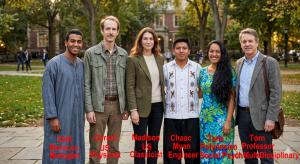
Chapter 4 Quest: The Friction of the Street
Loki jeered the group as they pulled away after loading. “Gonna’ save the world today?” He laughed. He looked at them with mischief in his eyes. “They don’t want your help; they want you to leave. It makes them feel better to pretend you’re ‘useless,’ doesn’t it?”
The group ignored him.
”You know the spot we saw the man with dilapidated shoes?” Gerald asked Loki. “We want to stop there.”
Loki laughed. “Got a savior complex? Think you’re doing God’s work? You don’t have the power.”
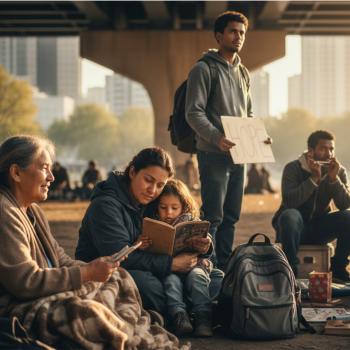
The bus stopped at the spot they had seen the man with holes in his shoes, and the five launched onto the cracked pavement as if on a mission. Gerard spotted him immediately. He was sitting on a milk crate, leaning against the cold brick of a closed storefront from the late 1800s. As they drew closed the smell of urine flooded their noses. His shoes were barely held together with duct tape and hope.
Gerard didn’t hesitate. He pulled the extra running shoes from his bag and walked over. The others followed, a mix of apprehension and curiosity on their faces.
“Hey,” Gerard said, kneeling down. “I saw you earlier. You need better shoes.”
The man, startled awake, looked up, his eyes hollow but intelligent. He didn’t respond to him immediately. He just stared at the shoes, then at Gerard’s feet. “Running shoes,” he muttered. “Those look fast.”
“They’re yours,” Gerard said, sliding them onto the pavement.
The man started to unlace his ragged shoes, his hands shaking. “I’m sorry,” he said, his voice raspy. “I’m not… I’m not usually like this. I’m just busy. People don’t understand, they think I’m lazy. But I’m busy all day. Sorting through dumpsters for food and clothes, walking the route, finding a spot to sleep before dark.”
”We’re not here to critique you,” Tane said. “We just want to understand, and help if we can.”
”Help is just a dream, and I prefer not to dream or have any hope because all experience says it won’t come. Just look around. These people have been here for years. You caught me off-guard or I would have avoided you.”
”Why are you out here like this?” Madison asked.
”You sure you want to here this?” He asked, expecting them to flee, giving up at the enormity of the problem.
They all nodded affirmative.
”A couple of years ago, my company laid me off. I was expecting it. You’re better able to get a job while you’re employed, so I filled out job applications doing what I do all over the area. But the area is saturated with people who do what I do and those jobs are going away. I tried applying for every kind of job that might take me. I looked at moving, but there just isn’t any need for me. I lost the house. My wife took the kids to her mom’s. I sold my car to get along for a while. Still nothing. So here I am. Useless. A reject.”
”Why didn’t you go to your wife?” Chaac asked.
”What kind of man can’t support his family? I’m… I’m…” He bowed his head averting his eyes. “I’m ashamed. I’m filled with shame. No one wants to hire a man like me, especially one that looks like me.”
”Are you still applying for jobs?” Zaid asked.
The man laughed. “Look at me! I got no phone, no physical address, I can’t take a bath, I have no clean or presentable clothes, no transportation, no haircut I just chop at my hair in a gas station restroom.” The lines almost sounded rehearsed from telling his story so often, but they had the ring of truth to them. “I have no ability to send resumes and make applications, and I have no time because I’m kind of busy all day grubbing through garbage containers for food and worn-out shoes and walking to them with my soles worn through, and the limping because the bottom of my foot is raw and it really slows me down. If I show up to an interview like this, they just call the police. Not to mention I have horrible depression that stops me cold because society doesn’t care about people like me—they just want me to go away. So I’m gone. I’m here on a sidewalk and nobody sees me here.”
Zaid looked down, his face pale. “We were just talking about how to solve unemployment,” he whispered. “This feels… impossible.”
Gerard tried to touch him on the shoulder to comfort him, but he flinched away, never allowing “good” people to be near what he knew was undesirable. “We won’t forget you’re here.”
“Thanks for the shoes, man. Now you can say you did your part.” He closed his eyes.
As they walked the remaining blocks to the Vault, the silence was heavy.
“It’s a physics problem,” Gerard said finally, his eyes fixed on the sidewalk. “You’re talking about massive resistance. The system is designed to keep him in a closed loop. He’s spending 100% of his energy just on survival—entropy—leaving zero energy for work, let alone growth. He can’t move because the ‘friction’ of his environment is higher than the force he can generate.”
“It’s not just friction, Gerard,” Tane argued, her voice sharp. “It’s structural. The system doesn’t want to ‘solve’ him. It wants to ‘clear’ him. He’s a bug in the code of the economy. Society doesn’t want him to work; it just wants him to disappear so it doesn’t have to look at its own failure.”
Chaac shook his head. “We keep talking about ‘the system’ like it’s a god we have to appease. If we wait for the system to change, he dies. If I had a warehouse, a shower, and a phone, I’d hire five guys like him tomorrow. We could organize. We could trade labor for access. In my country we do this all the time.”
Madison stopped, looking back at the bustling, indifferent crowd. “It’s the feudal system, Chaac. We think we’re modern, but we’ve just swapped Lords. In the old days, if you were a serf and you lost your place on the land, you were a ‘master-less man.’ You became a victim of the surrounding pirates in the open countryside. That’s what he is. He’s been cast out of the Lord’s protectorate. He has no rights, no protection, and no place. We aren’t looking at ‘unemployment.’ We’re looking at exile.”
”What can we do to help? I mean really help?” Gerard asked.
Tane stood in front of them and stopped them all. “This seems just like people who go through a crisis. It’s a long series of problems. Everyone needs structure in their lives and a sense of purpose that accomplishes something. Structure is what keeps us afloat even in our down moments. When we lose our daily routines, our minds become clouded and our environments become chaotic. His only structure is looking for food and a place to defecate and sleep. And when we are overwhelmed by the “big” problems, our executive function shuts down. We stop doing the little things like taking care of ourselves. And when we fail to do the little things, the guilt takes up even more room in our heads, creating a downward spiral. We have to olve those things.” The pain in her face said it all.
They had entered a slightly better area where shops were open and there had beeen some sidewalk beautification. It was hard to believe the deteriorated area where the homeless camped on the sidwalk was so close yet so invisible.
The group looked at her for a while, digesting this. Chaak sank against a wall on the sidewalk and held his head. Madison and Gerard sat feet apart on a garden wall on the sidewalk. Zaid crouched down and leaned against the wall with Chaak. Tane stood there looking at them expectantly like a solution was suddenly going to boil up out of them.
”I thought it was just a physics problem,” Gerard said. But it’s an “I don’t want you in my backyard” social problem, and an economic system problem, and a psychological problem, and maybe more. I don’t know if we can solve this. It’s overwhelming. Maybe we bit off too much.”
”That’s what Loki wants us to think,” Zaid said. “But maybe we’re better than this.”
They reached the massive doors of the Vault. The weight of the encounter clung to them. They walked inside, where the air was warmer, the lights were amber, and Professor Torn was waiting at the chalkboard.
They mused about it a while longer while Torn listened.
“You’ve seen the face of the problem,” Torn said, not looking away from his notes. “Now,” he turned, his chalk leaving a sharp, white mark on the board. “Let’s discuss the first ‘Exile.’ Let’s discuss Adam and Eve.”
________________________________________________
Our answer is God. God’s answer is us. Together we make the world better.
Author’s Website with life and spiritual resources: Dorian Scott Cole .com
Recent website articles
- Theology of Catastrophe: a dissertaton style paper on why catastrophes happen.
- Ekklesia: a new format for a Jesus Gathering.
- Systematic Theology for the 21st Century
- Major Decision Matrix











 Ad-Free & Subscriber Log-In