

• The legendary Bollywood “playback singer” Asha Bhoslie, has died at age 92.
Like many Americans, I have only a slight, passing familiarity with the Bollywood musicals for which Bhoslie recorded 12,000 songs — mostly lip-synched on screen by other actresses. But I know here name because of Cornershop’s delightful 1997 hit “Brimful of Asha.”
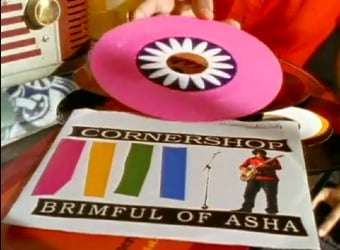 That song was about a very specific, very particular memory of something far outside of my experience, but the song still works for me — and for many people like me who had no such fond memories of growing up listening to Asha Bhoslie’s voice — because it captured and communicated the feeling of that (plus, it has a ridiculously catchy hook).
Since I recently wrote about my dislike of the Five for Fighting song “Slice,” I started thinking about the difference between that song about an old song and Cornershop’s, and other songs about old songs that I do like.
For example, I love Wussy’s “Teenage Wasteland.” Like “Brimful,” it involves memory and something like nostalgia, but it’s not, like “Slice,” only interested in savoring and wallowing in that nostalgia. “Do you remember the moment you finally did something about it?” Lisa Walker sings, and you don’t have to have been a kid stuck in a small midwestern town hearing “Baba O’Riley” for the first time to understand what she’s getting at.
I suppose one thing that Wussy and Cornershop offer here — the thing that isn’t found in that Five for Fighting song — might be described as gratitude. And while I’m not exactly sure of what I mean by this, and I haven’t ever thought about these things in these terms before, I’m starting to think that nostalgia and gratitude may be opposites — one of which is good for you and one of which is not.
• “Pastor who wrote book on biblical marriage arrested for alleged bigamy.” Hemant Mehta highlights this man’s hypocrisy, but also notes that, after all, this pastor was in a position to know twice as much about marriage as most husbands. Why take advice on quitting smoking from someone who’s only done it once when you could seek the advice of someone who’s done it dozens of times?
One could also make a very strong case that having multiple wives is, in fact, very much a form of “biblical marriage.”
• “They’re Trying to Get Jimmy Kimmel Fired Again.”
The joke they’re upset about this time was very much a Leno joke. And also a Carson joke. And probably also a Jack Paar joke.
Kimmel described Melania Trump as having “a glow like an expectant widow.” It was, he explained, “A very light roast joke about the fact that he’s almost 80 and she’s younger than I am.”
This is an old joke — older than late-night comedy itself. It is a joke that has been told for as long as there have been old rich men who marry much, much younger women. Jay Leno told this joke dozens of times — mostly about Anna Nicole Smith and her elderly millionaire husband. Johnny Carson told this joke dozens of times — often about his friend and sidekick, Ed McMahon. Comedians from the Catskills era of comedy — Milton Berle, Henny Youngman — told versions of this same joke.
Two 80-year-old men are ogling the first guy’s beautiful, 40-year-old wife.
“How did you ever get her to marry you?” his friend asks.
“I lied about my age.”
“You told her you were 70?”
“I told her I was 95.”
Pretty much every comedian who ever approached a microphone has told some version of this joke. (Well, except for Seinfeld, for some reason.) But it’s older than microphones. Vaudeville comics told this joke. Jane Austen milked this joke for all it was worth.
Donald Trump is a rich guy who is almost 80 years old. His third wife is several decades younger than he is. The old jokes fit. People are going to make those jokes about him and about his marriage because there’s always something creepy and transactional about such arrangements and finding ways to laugh at the discomfort is a natural reflex. Heck, people make this same joke about Robert Deniro and people like Deniro.
• Roger E. Olson is a conservative white evangelical theologian who has been blogging for Patheos’ “evangelical channel” for as long as it has existed. His theology and politics are generally conservative and his demeanor and temperament are generally conservative.
But Dr. Olson is now 74 years old and enjoying his freedom as a mostly, but not entirely, retired emeritus professor. He has stopped worrying about not saying what he thinks because of how it might affect his career and/or his future employment. In other words — words of the sort Olson himself would never use — he’s all out of f–ks to give. And so his blog is getting spicier and more interesting.
Olson kind of dipped his toe into these waters late last month with this post: “Why an Evangelical Theologian Says Capitalism Is Sin.”
CAPITALISM IS SIN. It is a sinful economic system. It will not exist in the completed Kingdom of God to come. God may allow it, but it cannot conform to his perfect will.
And then he seems to have figured as long as he was in, and in for good, he might as well go the whole hog, announcing his intentions in a post titled “Memories and Secrets of Evangelicalism“:
Here I begin a series telling my memories of American evangelicalism and what happened in it and to it. Here I am and will be talking about the Evangelical Movement that was born in the early 1940s with the founding of the National Association of Evangelicals and given impetus in the 1950s by the founding of the magazine Christianity Today. I was brought up in that movement. And worked within it as long as it lasted.
I have studied the history of the movement in depth. I knew most of its leading historians. I taught theology within it and served as a contributing editor of Christianity Today. I also served as senior editor of a leading evangelical scholarly journal called Christian Scholar’s Review. I attended meetings of that journal’s editorial board which consisted of representatives of its supporting evangelical colleges and universities, about fifty of them.
My uncle, president of our evangelical-Pentecostal denomination, served on the national board of the NAE and shared many stories about it with me. From the time I was a teenage I knew we were evangelicals, not fundamentalists.
Part of this is Olson’s first-person witness testimony offered as a contribution to the ongoing historiographical and boundary-drawing arguments over late-20th-century white evangelicalism. That testimony is offered as evidence, but also as counter-evidence — there’s a strong undercurrent here of Don’t tell me I don’t understand this — I was there.
Olson is spilling the tea. He has been an insider in American white evangelicalism and he is now sharing his insider’s perspective — particularly on those points on which he feels the official story has been less than honest. Hence a few of his other recent posts — “Evangelicalism: Duplicity and Dissimulation?” and “Evangelicalism A Closed Club?”
The points of contention here may seem minor — like the bad-faith conflation of “open theology” with “process theology.” But his subject is not the difference between such schools of thought, or why he regards the one as closer to the center of evangelicalism than the other. His subject is the bad faith — the deliberate and dishonest distortion of others’ views by gatekeepers in pursuit of power.
Olson here understands what so much of the “evangelical historiography” debate and the “evangelical definition wars” fails to understand: taking bad-faith claims from bad-faith actors at face value is no way to pursue the truth.
This is also something that 90% or so of “political journalism” fails to understand.










 Ad-Free & Subscriber Log-In