

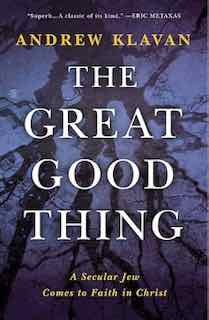
Book Review: The Great Good Thing: A Secular Jew Comes to Faith in Christ by Andrew Klavan
Best selling author Andrew Klavan was what he describes as a “secular Jew.” Then, he began praying.
He didn’t aim his prayer at any God or being in particular. He just began to discuss what was on his mind in prayer.
The surprise — to him, but not so much to those of us who have experienced the same thing — is that there was an immediate answer.
Klavan’s book describes the slow and gradual relationship with God that he built by the simple method of praying to this unknown Being. By the time he realized that he had been speaking with Jesus, the deal was done.
This is a candid and honest book, in which Klavan deals with all sorts of issues that people encounter in their walk with Christ. I was especially interested in how he thought through the violence and cruelty of anti-semitism and the senseless slaughter of the Holocaust. It mattered to me a lot because, while I am not Jewish, I have the same questions about the same events.
As a woman, I also deal daily with the misogyny that Christian leaders peddle in the name of Christ. I have been deeply wounded by it. I struggle with the indifference to violence and cruelty against women, even to the point of supporting rapists for high office.
So, Klavan’s thoughtful and honest consideration of what Jews have suffered at the hands of Christians was meaningful to me on many levels.
The book itself is more memoir than conversion story. In fact, I think it has too much depth and honesty to fit into the category of conversion story. I read a review on Amazon which described The Great Good Thing as something akin to The Confessions of St Augustine.
Personally, I don’t think so. Augustine was a lot less honest in his confession than Klavan, and the “sin” he talked about was trivial.
Klavan is open about his own life, and he also deals with the nightmare of Western civilization, which is the industrialized mass murder of millions of innocent people by the Nazis. He talks about the Holocaust from the viewpoint of a Jew who has developed a personal relationship with Jesus Christ.
While I know he is only speaking for himself, the fact that he doesn’t back away from this or try to dismiss it with verbal pablum, gives resonance to everything else he is saying. Honesty counts for a lot.
People who do monstrous things are destroyed themselves by what they do. But people who have horrible things done to them carry a burden of almost equal destructiveness.
How do you find spiritual life after atrocity? How do you recreate a moral world once the reality of what we are capable of doing to one another is fully exposed? How do you square the circle of a loving God in a world where such evil can flourish?
Klavan doesn’t answer those questions. But he does acknowledge their reality.
His book opens the door to discussion about such things without the meaningless gibberish of psycho-babble or opaque dismissiveness of pious and formulaic sloganeering. He doesn’t come up with a universal answer. But he wasn’t trying to do that.
He was trying to find an answer for himself. In the end, he dealt with it in a way that worked for him without lying to himself or to his reader.
The most interesting thing about the book is how he came to Christ. As I said, he found Jesus in the simplest way possible: by talking to Him in prayer.
That’s close to my own conversion experience. The difference is that with me it was immediate and overwhelming, while with Klavan it was slow and thoughtful.
He worked his way through his many questions as part of the conversion process itself. I converted in a moment, and then dealt with the questions afterwards. But both of us encountered Christ on our own, without church or clergy or even an earnest friend to facilitate the process.
I recommend The Great Good Thing: A Secular Jew Comes to Faith in Christ. I think it’s well worth the read.












 Ad-Free & Subscriber Log-In