

It is impossible to overstate how important Sandra van Rompaey’s book Mandaean Symbolic Art is. It is common to quote Ecclesiastes to the effect that the making of books there is no end. Mandaean Symbolic Art is the rare and precious instance of a kind of book that has never been written before. Let me be unambiguously clear on this, as the author of a rather distinctive book, inasmuch as many said that writing a biography of John the Baptist was impossible. There had nonetheless been many academic books about John the Baptist, and many fictionalized lives of John the Baptist. In stark contrast, there has never been any sort of study of Mandaean art as such, much less a serious academic one. As someone who hopes and advocates for scholars to stop neglecting the Mandaeans and their texts, the publication of this book is simply thrilling.
Based on her PhD thesis on the subject at La Trobe University, Mandaean Symbolic Art is a beautiful book, one of the rare books that more than merits the high price tag on so many academic books from European academic presses such as Brepols. There are so many photos of Mandaean scrolls with their unique artwork, as well as other scenes from Mandaean life, that this solid academic book can double as a coffee table book. Even the tiny glimpse inside provided by Brepols, the volume’s publisher, will surely be enough to make clear why I have described the book in that way, as well as why I am so excited by its publication and why this subject is long overdue for academic attention.
I first met the author in 2013 at the ARAM conference on the Mandaeans, which was my own very first foray into this area that would become a major research focus of mine (unbeknownst to me at the time). It was already clear to me then (once I realized that a nearly comprehensive gathering of all scholars who work on the Mandaeans in any time and from any angle could fit in a small seminar room) that van Rompaey was the only scholar of the visual arts giving attention to the very distinctive artwork in a number of Mandaean scrolls. That there would eventually be a book was hinted at then. I have thus been in eager anticipation of this book’s appearance for more than a decade. If in one sense a study like this was long overdue, van Rompaey’s book was well worth the wait.

Right from the outset, van Rompaey emphasizes why the Mandaean illustrated (or if you prefer to use the terminology of the Christian tradition, illuminated) manuscripts are important. She writes, “the iconography of Mandaean art, reveals a body of art encompassing nine manuscripts that is stylistically coherent and unique in its method of representing key elements of Gnostic thought” (p.11). The interplay of text and image in these manuscripts is crucial to the meaning of both, and in turn clarifies things in other Mandaean texts. Striking parallels and points of comparison are noted already in the preface between the art in these manuscripts and some of the artwork (fascinating in its own right) at Dura-Europos (p.12). The author describes the characteristic features of the illustrations in the scrolls, making clear why “criteria derived from the European aesthetic tradition are of little help in interpreting such work” (p.19). The symbolism of the artwork is very deliberately both esoteric and meaningful. The manuscripts under discussion include many that are unpublished. As an aside, I saw (early in my work on Mandaean literature) a copy of one of E. S. Drower’s editions of a Mandaean text listed for sale on Amazon from a used bookseller. When it arrived, I discovered that it was not the translation in book form but the facsimile of the two scrolls themselves (The Greater First World and The Lesser First World). This tube is one of my cherished possessions and I delight in showing it to fellow academics as well as students when an appropriate moment arises. I have also had the opportunity to see a full-sized scroll of Diwan Abatur in person in the Bodleian Library in Oxford as well as the home of the Mubaraki family in Australia.
Among the many things never undertaken prior to van Rompaey’s book is a comparison of the slight but in her view significant differences between the illustrations in different manuscripts of the Diwan Abatur, arguably the most famous Mandaean illustrated scroll (p.22). The book also tackles for the first time the relationship between the figures in the scrolls and those depicted in Mandaean incantation bowls. In the process of comparing illustrations in the scrolls to not only Mandaean texts but current and recent Mandaean practice, it became clear both how impressive is the continuity while the differences are also significant and worthy of close investigation by scholars.
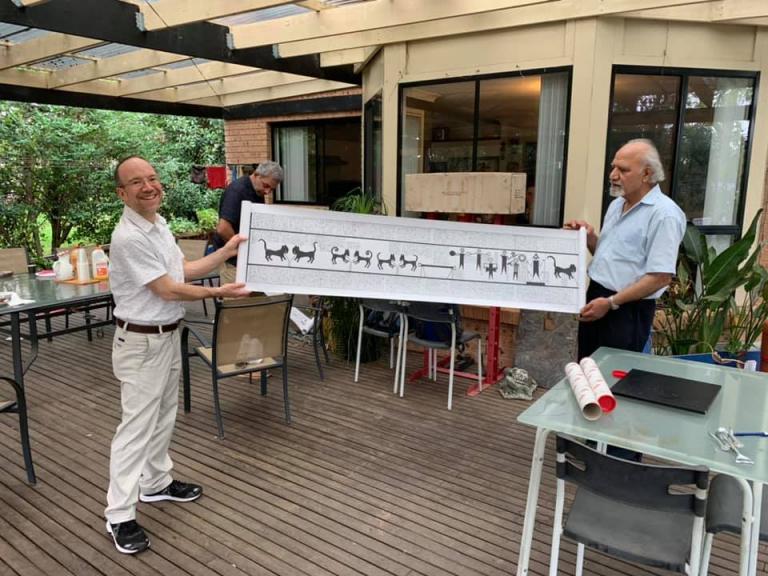
If you have the budget and are interested in this topic then get a copy. Otherwise, do what European academic publishers’ pricing model expects you to do: recommend it to your library, have them purchase it, and then borrow it from there.
I shared above my photo of visiting with the Mubaraki family and seeing their scroll. Here is a photo I took of myself showing my facsimile of a Mandaean scroll to students in my class. They were fascinated but also clearly not used to dealing with this unusual show and tell scenario.

In case you’re wondering why I blogged about this twice, the answer is that I apparently started a review of van Rompaey’s book and then forgot about it and started another one!
Here are a couple of other relevant posts.
















 Ad-Free & Subscriber Log-In