

Does AI write better than students? I have been pondering that question from a number of angles over recent days. Here’s why.
AI, Writing, and Education
Butler University president Jim Danko recently published an opinion piece. Titled “The University is Not Prepared for What Comes Next,” the entire thing was intended to be controversial and provocative. It succeeded. It got me and many of my colleagues thinking and talking.
As so often, I feel torn. Not because I am as a rule inclined to say that ”both sides have a point.” While I am conciliatory in ways that not all of my colleagues are, and I empathize with dilemmas that administrators face that faculty rarely appreciate, anyone who reads things that I write knows that I have no hesitation standing on a side that I believe is right. In this case, I do have a side that I agree with more than the other. Yet I also believe that each has something crucial to learn from the other, without which the direction that our university or higher education in general pursues will be less that ideal.
Let’s start with the thing that many of my colleagues (especially in English) were likely to be upset about, the insinuation that AI produces better writing than students. As with music, so too with prose, there is a real sense in which it shouldn’t matter if AI can do something better, any more than it should matter that there are other human beings who can do that thing better. The point is doing the activity at the level that you are able, whether expressing yourself in words or in music or in visual art. This is intrinsically valuable as an activity irrespective of ability, and there is no achievement of excellence in these areas except by way of the full spectrum of lesser degrees of proficiency.
But expressing oneself and exploring words and music and other media is inherently valuable not just as a way to get good at these things, but in and of themselves even if you remain an amateur. This is how we communicate, how we express ourselves and engage with others. As I said in my article on ChatGPT and biblical studies, hearing from a human being is the whole point.
Hopefully most of us do not want to live in a world in which only virtuosos play the piano and everyone else is told not to bother, and in which the only people who should express themselves in words are winners of the Pulitzer prize. But if anyone does, they need to wrestle with the fact that no one is born a great musician or orator or anything else. The only way to greatness is by way of learning and all the various stages of imperfection and mediocrity along the way.
What Makes Writing “Better”?
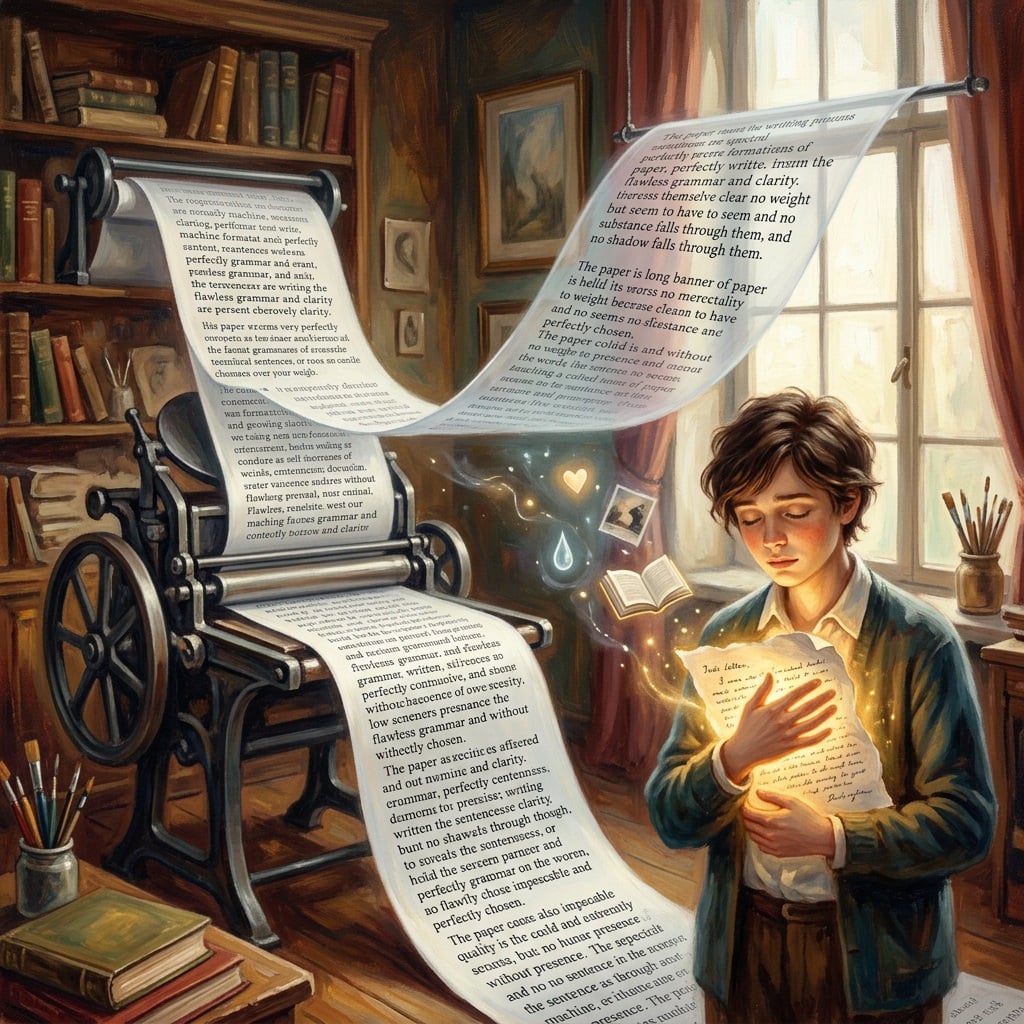
However, in our era of AI-generated text and music, some are forgetting what these activities are for, as well as failing to reflect thoughtfully and critically on what it means to excel at doing them.
Let’s be honest. Objectively speaking, it is not obviously false that AI produces better writing than our students. Neither should it be assumed that it is true. That is why I have framed this article with the question, “Does AI Write Better Than Students?”
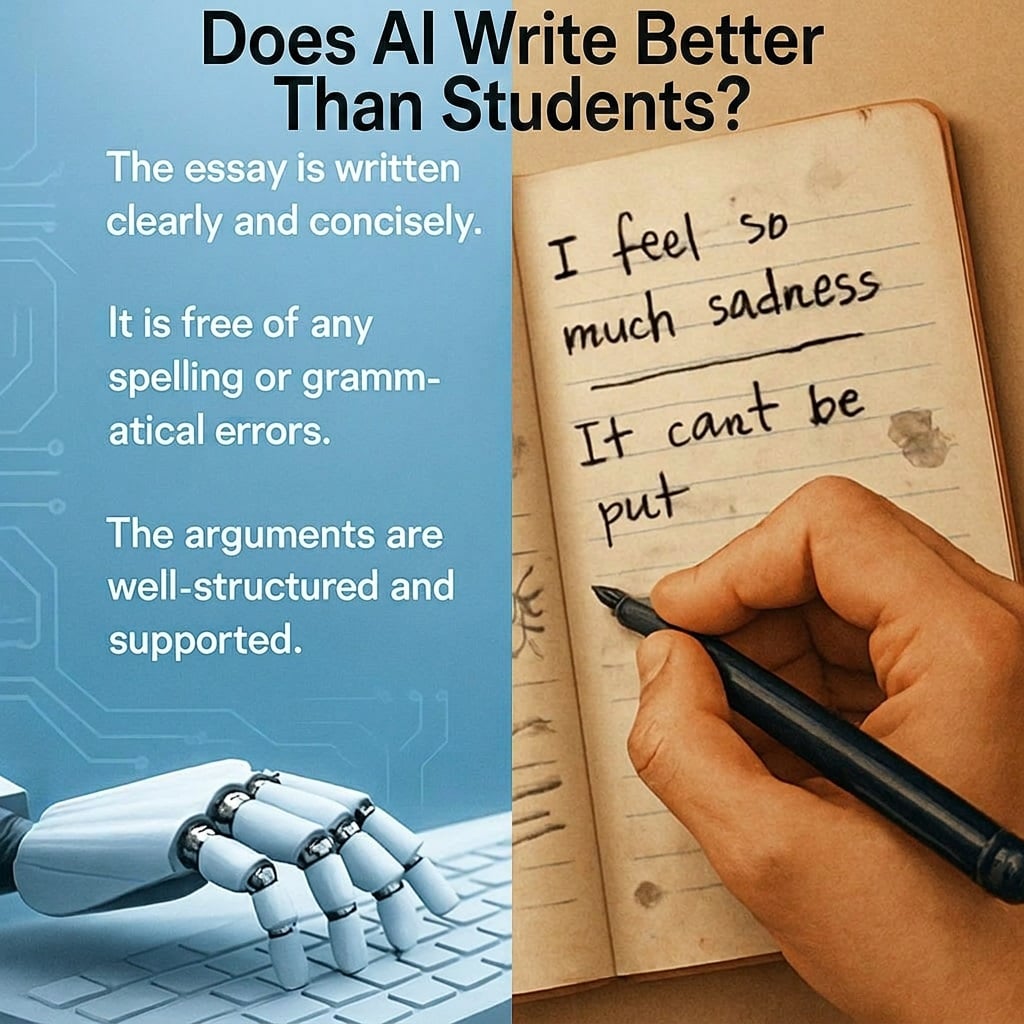
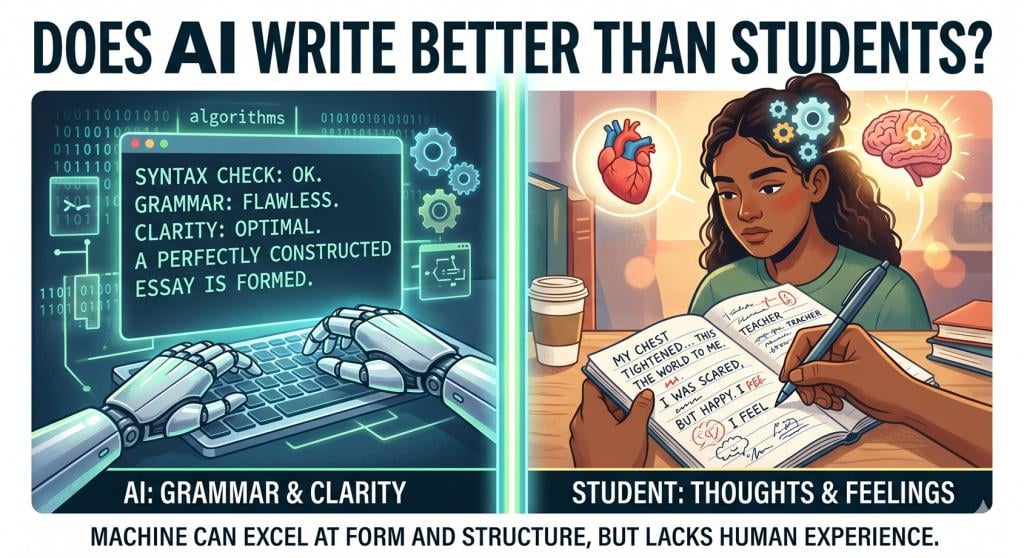
The question that my question raises in turn, of course, is what we mean by writing “better.” If the evaluation is in terms of grammar and clarity, then surely the answer is that AI does a better job than a great many students.
The reason why human beings in the present seem to be less and less able to make good use of words is presumably that they have spent much less time reading as well as writing in their formative years. There is no other means to become eloquent than to be immersed in eloquent speech and writing.
The arrival of generative AI does not mean that this shortcoming is now irrelevant. AI tools may help polish someone’s prose, to be sure, but unless someone can express themselves clearly in the first place, including expressing themselves clearly in their prompts to a chatbot, AI is never going to be able to do a better job of expressing that person’s thoughts and feelings. Instead, it will become a substitute for it, and to the extent that this works, it will be a tragic technological variation on the famous play Cyrano de Bergerac. We will have employers mistakenly hiring people based on AI-generated outputs that the hired person cannot consistently produce even with AI assistance, because their own skills and too riddled with shortcomings. Yet on discovering that their true love was AI outputs, it will be lost to them, since AI cannot produce outputs that are meaningful without humans involved. Meaningfulness is as important in the workplace as in expression of love in poetry or engaging in academic research.
The fact that many students will not understand the Cyrano de Bergerac reference highlights where the problem lies. As I said above, it is through exposure to text through which humans have expressed themselves eloquently that humans learn to express themselves.
The most important question about what makes writing “better” is whether it is serving effectively as a tool for exploring our own thinking and expressing our own perspectives. That is something that by definition an AI system cannot do better on its own.
Universities Caught Unprepared?
Here is the heart of the matter. I want to emphasize two things that may seem contradictory:
- This is no time for business as usual.
- The historic work of the university is precisely what this present moment needs.
How can both be true? On the one hand, educators cannot ignore AI. That doesn’t mean embracing and using it in all the ways that tech company marketing hype insists that we should.
On the other hand, those who truly understand what LLMs are, what they do and what they can never be relied upon safely to do, emphasize that the liberal arts are more important than ever.
What this moment needs is for faculty who take the time to understand and engage with the latest technology to continue teaching in ways that facilitate the development of critical thinking, creativity, imagination, innovation, problem solving, and all the things that we have been.
Not only are universities not unprepared for this moment, we may be the ones who are best prepared to meet its challenges. Individual faculty, to be sure, are not yet prepared. But universities as institutions and educators as communities most certainly are. There is nowhere I can think of where computer scientists, teachers of writing, philosophers, and other relevant specialists are in closer proximity and more open to dialogue than at a university.
Education that forms well-rounded individuals, and in particular the things that the humanities cultivate, are not obsolete. On the contrary, they are more important than ever.
No Technological Fix
Rather than developing better AI tools to “improve” the writing of successive generations of students who are worse and worse at it from a perspective of technical form and clarity, we need to stop testing students on memorization of facts and details about literature and focus on instilling love and enjoyment of it.
There’s simply no technological alternative. We can imagine a tragic dystopian future in which AI trained on the best human speech of the past exists but is now something no longer used by human beings, who are no longer capable of understanding it, never mind producing something similar.
Does AI write better than students? To answer “yes” is to suggest that the existence of textual output is the point, and not the expression of human meaning and intention. That does not seem to me to be the right answer.
I write this, as anyone who reads what I write regularly will know, as someone who believes that AI can be a useful tool in the hands of those who are well-educated and who have cultivated their ability to express themselves.
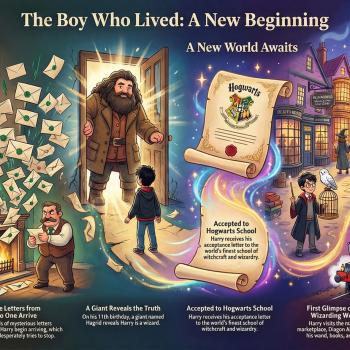
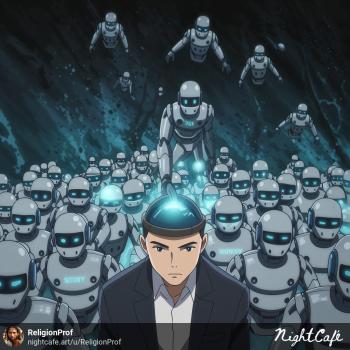
This post contains images that I used AI to generate, to help me encapsulate and convey my point. I would be interested to hear your thoughts on them.
In the absence of my ability to think about this topic, write a response to the article linked towards the beginning, and clearly convey my point to an AI tool, there would be no post and no images.
But even if there were, would they be worth reading and looking at?
Butler University Stands Ready
When I read Jim Danko’s article, I am filled with a mixture of pride, hope, and concern. My concern is that our president may be paying too much attention to the hype-generating rhetoric of tech companies and their prophets, and reacting to the corporate rush to integrate AI whose real fruit and gains are as yet undemonstrated.
Yet I am also filled with pride and hope because of the extent to which Butler University is already doing what Jim calls for. He writes:
In an AI-shaped world, every graduate will need to think and act with a degree of independence and adaptability that resembles entrepreneurship, regardless of field. They will need to integrate knowledge across domains, continue learning over a lifetime, and create value in environments that are constantly evolving.
This is the premise that must guide everything that follows. The university must organize around what human beings uniquely contribute in a world increasingly shaped by artificial intelligence. Ethical reasoning, creativity, emotional intelligence, relationship-building, trust, and the ability to integrate knowledge across domains.
Universities remain among the last dense, intentional spaces for human formation and community. That is not incidental. It is essential.
My colleagues in the Humanities have already been exploring degrees that allow students to explore the liberal arts without silos and boundaries. Our programs have created combined majors and have encouraged students to pursue double majors and minors. Butler University has an individualized major program that means a student can craft their own degree program from our course offerings under the mentorship of one or more faculty members. There are more innovations worth exploring along these lines, but not everything that is hypothetically worth pursuing is practically feasible. While being broadly and interdisciplinarily educated is crucial to our current moment, it isn’t clear that such an education can be offered without homes for concentrated expertise of the sorts that departments, programs, and faculty experts offer. It is worth mentioning both that liberal arts colleges that have tried these things have closed, but also that such closures may say more about what society currently values than about the value of those innovative schools.
Either way, Butler University’s core curriculum and many programs are focusing on ethical reasoning, creativity, relationship building, trust and discernment in an era of misinformation, integration of knowledge across domains, and more. We have been resisting the corporate pressures to focus only on skills and maintaining intentional spaces for human formation and community.
We need to continue what we have been doing, engaging with AI as we do so.
Perhaps above all else, we need to proclaim loudly that the things that people have been declaring irrelevant in a STEM-focused world are the key to human flourishing in the era of AI.
The era of AI doesn’t require us to change everything. It does require us to change some things. It also necessitates that we bring to the fore those liberal arts and humanities approaches that our era of corporate mindset has sought to marginalize.
How would you answer the question “Does AI write better than students?” The question is worth asking because how we answer it reveals what we value, and the most fundamental questions in this AI-focused moment are about what we value, and most of all, what makes human thoughts and human creations valuable when technology can mimic them.
As you ponder the question, also consider this. What we already value as individuals, and what our society as a whole values, is not what we are obligated to value. We can choose to place value on people and activities even when it has not been our habit to do so, even when it is countercultural.
This moment requires creativity of a sort that requires human minds and action. If some need to be persuaded that human writing is inherently better as an activity than an algorithmic process generating text, that is the best way to make the case. The creativity and ambition this moment requires are cultivated by developing our thinking and our imagination. Composing in words (and in other ways) will always be a crucial part of that, no matter how well a machine can mimic it.
For Further Reading
Also on or related to this topic:
Real Education: Teaching in the Era of Generative AI (open access book, also available in print form)
How to Future-Proof Your Career
Higher Ed Will Look Retro in a Bad Way
Is AI Rewriting the Purpose of High Schools and Colleges?
Training Christian Writers in the Age of AI
Starting with the “Why” Shifts the Conversation
AI-Integrated Assignment Design
What AI and Finance Leaders Say Students Need
Why Speech and Debate Kids Will Thrive (Version 2.0)
Universities Forcing AI on People?
Faculty are Hungry to Talk to Each Other
Now The Classroom’s Greatest Asset is Human Interaction
Launching New Courses in Response to AI
Developing Student Builders in the Age of AI
Leading Your Organization Through AI Change
Project Based Learning is Now College Prep
AI Cheating Panic vs. Actual Student Use













 Ad-Free & Subscriber Log-In