

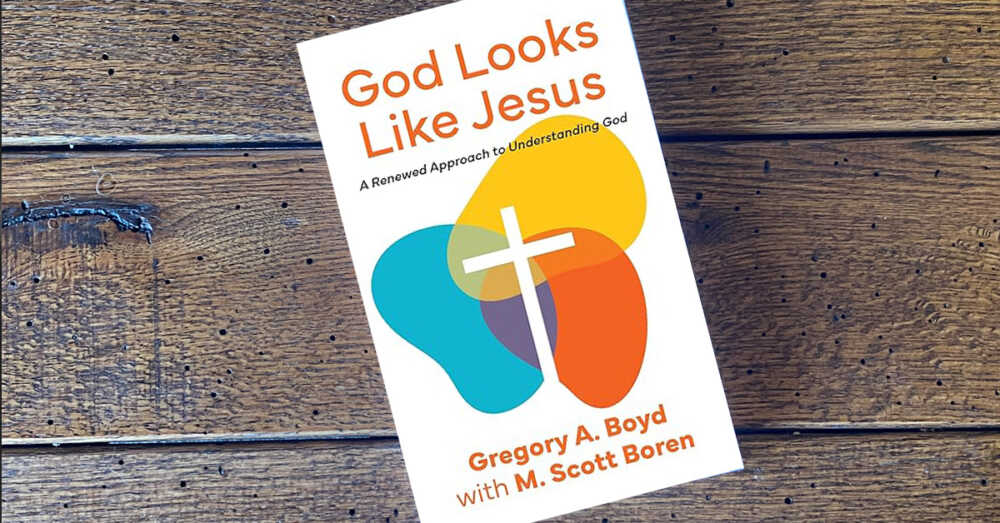
Here I continue discussion of Greg Boyd’s and Scott Boren’s book God Who Looks Like Jesus: A Renewed Approach to Understanding God (Herald Press, 2025). If you have read Chapter 2, The Center of the Center, you may comment on it. If not, only ask a question.
Here, in this chapter, Greg wants to go beyond a “Christocentric” theology to a “cruciform” theology and Christianity and reading of the Bible.
According to him (and Boren), “The character of the Father is most unambiguously disclosed when Jesus allowed himself to be crucified. The cross culminates, expresses, and weaves together everything Jesus was about—namely, revealing the true enemy-embracing, nonviolent, self-sacrificial, loving character of his Father.” (35)
The most controversial part of this chapter will inevitably be, for those who read it, pages 45-49. There he discusses The Cross and the Book of Revelation. According to him, Revelation does NOT teach that at his return Jesus Christ will slaughter anyone. “Something other than literal killing is being described here.” (48) “This battle scene, which at first glance seems so ghastly, turns out, on closer examination, to be a magnificent symbol of the liberating power of the cross.” (49) “The blood Jesus is soaked in is not the blood of his enemies—he is drenched in his own blood.” (48)
Now, as is often the case, you must read the chapter, especially those final pages, to get it, to get what Boyd is saying. I can’t repeat it all here and it’s impossible to summarize well. Just read it.
What do I think of Greg’s cross-centered theology of God? I came to such a view long ago by reading Juergen Moltmann’s The Crucified God. So that is not controversial for me. However, I do not know what to make of Greg’s interpretation of Revelation because I have long thought The Apocalypse, the Book of Revelation is beyond human complete comprehension. (There I side with Luther who told his ministers not preach from it.) I do think there is meaning in it, but I don’t think anyone can claim fully to understand it. People say its meaning is that “In the end, God wins.” Yes, to be sure. But how to interpret all of the apocalyptic imagery and language is always going to be questionable unless we find a commentary by John or one of his closest disciples.
*Note: If you choose to comment, make sure your comment is relatively brief (no more than 100 words), on topic, addressed to me, civil and respectful (not hostile or argumentative), and devoid of pictures or links.*









 Ad-Free & Subscriber Log-In