

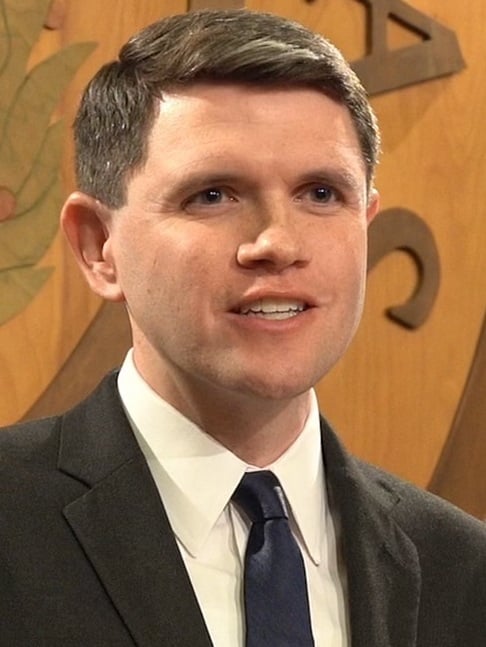
The accompanying picture is of Texas Democrat James Talarico, Democratic candidate for the United States Senate. He is a Presbyterian seminary graduate and openly Christian. He makes no secret of his Christian beliefs and motives for his political involvement. Many are now asking if his popularity, even in a traditionally conservative district and state, signals the rise of a new “Religious Left” in America.
I don’t know if that is the case. That is, I don’t know if Talarico’s rising star in American political life signals the rise of a new Religious Left. Time will tell.
Years ago, in fact in 1999, I was in the audience when evangelical speaker and writer Tony Campolo spoke disparagingly about the Religious Right. During the Q&A I asked him for his thoughts about the Religious Left. He dismissed it as irrelevant because whatever of that exists it had no organization or public influence. Of course, I meant him! He and Jim Wallis and Ronald Sider and many non-evangelicals, mainline Protestant and Catholics.
There have been Religious Lefts, liberal-leaning Christians and Jews, before James Talarico. The Social Gospel Movement of the first two decades of the 20th century (with roots back into the early 19th century) was a Religious Left. They were part of the Progressive Movement. Later, Martin Luther King, Jr and Jesse Jackson and the Civil Rights Movement in America was part of a Religious Left. Eventually, however, the media and political commentators played down the religious impulses of those people—including William Jennings Bryan, a leading left-leaning religious political leader in America. The only thing most people know about him was that he was a raving fundamentalist. If he really was. His involvement in the infamous Scopes “Monkey Trial” is not the whole truth of him.
During the 1970s many young American evangelical intellectuals formed a Religious Left movement. It expressed itself in a magazine called The PostAmerican. That evolved into Sojourners. At least two major volumes have been published recently analyzing the movement’s history and legacy. Years ago Richard Quebedeaux wrote The Young Evangelicals about that movement. The movement provoked a very strong reaction among conservative evangelicals including Carl Henry and Jerry Falwell.
I disagree with Talarico on a few issues, but, having been awakened by The PostAmerican and its founders including especially Ron Sider, Donald W. Dayton and others, when I was in seminary, I wish him all the best. If I lived in his district I would almost certainly vote for him as I voted for Jesse Jackson for president in 1988.
*Note: If you choose to comment, make sure your comment is relatively brief (no more than 100 words), on topic, addressed to me, civil and respectful (not hostile or argumentative), and devoid of pictures or links.*










 Ad-Free & Subscriber Log-In