

This week’s failed Rapture “prophecy” has provided such an egregious example of how “global south” Christianity is often no such thing, but rather just an artifact of religious colonialism — a blurry copy-of-a-copy of American white evangelicalism, slaver hermeneutics, and “biblical literalism” that is neither of those things.
Since the poor guy at the center of this debacle is a Black South African pastor, I want to take a moment to contrast his embarrassing flop with a genuine, world-changing example of actual, contextual theology from the global south that came from Black South African pastors.
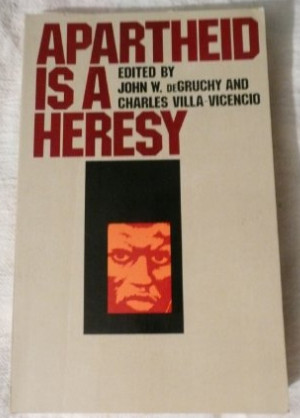 In 1982, the World Alliance of Reformed Churches declared that Apartheid is a heresy. Not only that it was a bad policy, or a violation of human rights, or a denial of the fundamental principles of liberal democracy. Not even that it was merely a sin. It was found to be heresy — a grave theological mistake and a lie.
This wasn’t the declaration of some supposedly “squishy” liberal mainline denomination in some office up on Riverside Drive. This was an association of staunch Calvinists who take their theologizing very seriously.
And the declaration was a work of very serious, very scholarly, and very Black South African theology. It was an extremely Reformed argument and an extremely Reformed conclusion, and that theological tradition, of course, comes out of Europe. But that theology was applied to and informed by — and reshaped by — the context of Christians living in the continent that gave us Augustine of Hippo, the African theologian who influenced all those European Reformers in the first place.
A major piece of the argument convincing Reformed churches around the world to condemn Apartheid as heresey was a deep dive into the book of Revelation. This had nothing to do with the “Rapture.” Here in America, most Rapture Christians consider themselves Reformed because they preach a roughly grace-not-works soteriology — albeit one that is far more otherworldly, and more reflexively anti-“good works” than anything in Calvin or Luther. But generally speaking, even here in America, the Reformed churches themselves never much got into Rapture folklore.
This study of Revelation wasn’t about “The Antichrist,” either, even though it centered on the 13th chapter of Revelation, which is a key passage for every “Bible prophecy scholar” putting together an Antichrist checklist. Revelation 13 is a fever-dream roiling with strange imagery and layers upon layers of madness. But it is the literature of a people living under tyranny and oppression — the voice of the human face being stomped on by a boot, forever. It’s hard to make sense of for a person like me because it was not written by or written for a person like me. But it made perfect sense to the Black Christians living under the reign of the blasphemous image of Apartheid, Christians who were denied their freedom because they did not bear in their flesh the mark and the name of the beast.
These Christians were responding to their white brethren from churches around the world who were questioning their choice to protest Apartheid because of the 13th chapter from another book in the New Testament. Those white Christians loved to cite Romans 13 — well, part of it anyway, the bit excised from it’s surrounding context which starts with “Do not be conformed to this world” and ends with “love is the fulfillment of the law.”
For white Christians in America or Canada or western Europe in the late 20th century, Romans 13:1-7 was the final word on protest against government authority: “Let everyone be subject to the governing authorities, for there is no authority except that which God has established. The authorities that exist have been established by God. Consequently, whoever rebels against the authority is rebelling against what God has instituted, and those who do so will bring judgment on themselves.”
This may have seemed like a harsh thing for white Christians to quote at those Black Christians in South Africa in 1980 — basically telling them that Nelson Mandela deserved to be locked up on Robben Island, and that their oppression was “established” by God — but, hey, scripture is scripture. That’s what Romans 13 says about governments and governing authorities.
So the South African Christians dug into Romans 13 by studying it alongside Revelation 13, another passage explicitly about government and governing authorities.
The whole world was filled with wonder and followed the beast. People worshiped the dragon because he had given authority to the beast, and they also worshiped the beast and asked, “Who is like the beast? Who can wage war against it?”
The beast was given a mouth to utter proud words and blasphemies and to exercise its authority for forty-two months. It opened its mouth to blaspheme God, and to slander his name and his dwelling place and those who live in heaven. It was given power to wage war against God’s holy people and to conquer them. And it was given authority over every tribe, people, language and nation. All inhabitants of the earth will worship the beast. …
The study of this was longer and richer than I can summarize here, but you get the basic gist. When the “governing authorities” are beastly — when they blaspheme and demand the worship of a conquered people — are Christians still obliged to obey them?
It was a powerful, compelling argument and it prevailed in the World Alliance of Reformed Churches. This was theology from “the global south” contributing to and reforming the dominant theology from Europe and America. It changed the way white Reformed Christians around the world understood a key passage from the book of Romans, an epistle that is one of the most-studied texts in all of the Bible for Reformed Christians.
If you’re wondering if there was any theological response or theological rebuttal to the Black South African-driven campaign that led to WARC formally declaring Apartheid a heresy, there was. Sort of. This led white conservative political activists in America to pour tons of money into groups like the Institute on Religion and Democracy to fund a campaign to attack the WARC and every other ecumenical body that listened to Christian voices from the global south. IRD spent the next decade smearing the World Council of Churches as “Marxist” and “Communist,” and advocating for U.S. foreign policy in Latin America that helped to crush and kill every form of Christianity in that region that was not a docile, colonial replica of white American evangelicalism.
But that’s just money and guns. Wasn’t there some theological response to this global south theology? That’s the point here — the money and guns is the theology. It is the form and the substance of the “theological argument” that silences and sidelines any Christian voice from the global south that doesn’t sound exactly like a white Christian voice from America.
And that is why, today, most of the Christian voices allowed to be heard are like those of that poor, goofy pastor who beclowned himself with his American-televangelist-style visions and his failed Rapture prophecy.













 Ad-Free & Subscriber Log-In