

Michael Woolf, “Why clergy should risk assault to protest ICE”
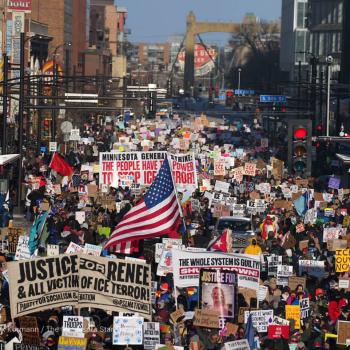
Despite the Trump administration’s mischaracterizations, the protests I have attended have felt much more like church than a violent insurrection. There is plenty of prayer, a lot of singing and some sermons. Most of all, there is a real sense of community that pervades the atmosphere. We are all there to support our neighbors and one another. That community is so important as we strive to confront the powers of evil that are at work in this administration’s cruelty. Alone, resistance is impossible, but together, there can even be a remarkable amount of joy. …
Our country needs religious leaders of all different faiths to reach deep within their traditions and find the strength to resist tyranny. Each of our traditions has different resources that we can draw from, and they are all needed now. For clergy with privilege like me, now is the time to use it to protect our neighbors and fight for their freedom. I fear that if we wait, it will be too late.
Pema Levy and Ari Berman, “This Is All John Roberts’ Fault”
The Roberts court has spent Trump’s second term not applying the law so much as clearing it out of his way. In a matter of months, the court’s 6–3 GOP-aligned majority has permitted a long list of lawless actions, including firing independent agency commissioners, using racial profiling in immigration sweeps, disappearing immigrants to authoritarian and war-torn nations, and defying Congress’ power of the purse. But the court’s acquiescence to an antidemocratic America didn’t start in 2025. Roberts has been embedding white-dominant authoritarianism into the country’s source code for two decades. It’s impossible to imagine today’s crisis without the Roberts court having first undermined the foundations of our democracy.
Spencer Ackerman, “Profaning the Holocaust”
I took that to be the point of Holocaust education. Not to exceptionalize Jewish suffering, but to activate solidarity. To recognize that there is a continuum of atrocity perpetrated by dominant classes against subjugated ones. The Holocaust shows where, once normalized, such things can lead. Antisemitism doesn’t have to be the exact same as anti-black racism for the lesson of antisemitism to be to confront anti-black racism. The ongoing Nakba doesn’t have to be the exact same as the Holocaust for me to find it appalling—particularly because it is performed in the name of my safety.
That was what I learned from my Holocaust education: Never again for anyone.
Stuart Hall, in “Culture, community, nation” (via)
Since cultural diversity is, increasingly, the fate of the modern world, and ethnic absolutism a regressive feature of late-modernity, the greatest danger now arises from forms of national and cultural identity — new or old — which attempt to secure their identity by adopting closed versions of culture or community and by the refusal to engage — in the name of an ‘oppressed white minority’ (sic) — with the difficult problems that arise from trying to live with difference. The capacity to live with difference is, in my view, the coming question of the twenty-first century. New national movements that, in their struggle against old closures, reach for too closed, unitary, homogeneous and essentialist a reading of “culture” and “community” will have succeeded in overcoming one terrible historical hurdle only to fall at the second.
Tatianna Schlossberg, “A Battle With My Blood”
Suddenly, the health-care system on which I relied felt strained, shaky. Doctors and scientists at Columbia, including George, didn’t know if they would be able to continue their research, or even have jobs. (Columbia was one of the Trump Administration’s first targets in its crusade against alleged antisemitism on campuses; in May, the university laid off a hundred and eighty researchers after federal-funding cuts.) If George changed jobs, we didn’t know if we’d be able to get insurance, now that I had a pre-existing condition. Bobby is a known skeptic of vaccines, and I was especially concerned that I wouldn’t be able to get mine again, leaving me to spend the rest of my life immunocompromised, along with millions of cancer survivors, small children, and the elderly. Bobby has said, “There’s no vaccine that is safe and effective.” Bobby probably doesn’t remember the millions of people who were paralyzed or killed by polio before the vaccine was available. My dad, who grew up in New York City in the nineteen-forties and fifties, does remember. Recently, I asked him what it was like when he got the vaccine. He said that it felt like freedom.
As I spent more and more of my life under the care of doctors, nurses, and researchers striving to improve the lives of others, I watched as Bobby cut nearly a half billion dollars for research into mRNA vaccines, technology that could be used against certain cancers; slashed billions in funding from the National Institutes of Health, the world’s largest sponsor of medical research; and threatened to oust the panel of medical experts charged with recommending preventive cancer screenings. Hundreds of N.I.H. grants and clinical trials were cancelled, affecting thousands of patients. I worried about funding for leukemia and bone-marrow research at Memorial Sloan Kettering. I worried about the trials that were my only shot at remission. Early in my illness, when I had the postpartum hemorrhage, I was given a dose of misoprostol to help stop the bleeding. This drug is part of medication abortion, which, at Bobby’s urging, is currently “under review” by the Food and Drug Administration. I freeze when I think about what would have happened if it had not been immediately available to me and to millions of other women who need it to save their lives or to get the care they deserve.
My plan, had I not gotten sick, was to write a book about the oceans — their destruction, but also the possibilities they offer. During treatment, I learned that one of my chemotherapy drugs, cytarabine, owes its existence to an ocean animal: a sponge that lives in the Caribbean Sea, Tectitethya crypta. This discovery was made by scientists at the University of California, Berkeley, who first synthesized the drug in 1959, and who almost certainly relied on government funding, the very thing that Bobby has already cut.
Bill McKibben, “They’re doing to America what they did to Christianity”
The obvious and straightforward fact that the Jesus of the gospels calls for a kind of radical love centered on the poor is what has always made Christianity something of a scandalous religion: appealing to the masses, but because of its inherent radicalness needing to be contained. In the 1950s it was contained by dilution – Protestantism was so dominant that it basically baptized the status quo. The 1960s broke that – the leadership of these churches, who were among the most committed followers of Jesus, found that they had little choice but to march in Selma, literally or figuratively. But many of their followers did not want to; they had been on board because Protestantism was part of the fabric of American life, not a challenge to it. Membership in mainline churches began dropping off. And for many of those who still felt a cultural or personal need for Christianity, evangelicalism was on the rise: it meshed wonderfully with the emerging Reagan-era emphasis on individualism and spoke directly to Americans who rejected the movements of the civil rights era.
The idea that personal salvation – as opposed to concern for others – was at the heart of Christianity always bordered on the heretical, but over the decades it has morphed into the absurd farce we see now, where Jesus is held to bless every show of dominance and aggression we can imagine.











 Ad-Free & Subscriber Log-In