

So, yeah, OK, I’m still mad about the “Call to Unity” cosplayers and the stream of poorly performed feigned horror, willful blindness, and sludgy thinking in response to the protest at that Vichy church in St. Paul where one of its pastors also is the acting field director for ICE and thus for the lethally violent ethnic cleansing campaign that agency is conducting Minnesota.
This man– David Easterwood — has stationed his goon squads outside of “ethnic” churches for months, preventing nonwhite Minnesotans from attending services and detaining countless worshippers on their way to and from services every Sunday (and Friday). No one at the ICE pastor’s church has a problem with that.
And white evangelical pundits and pastors and professors didn’t have a problem with that.*
But when other Christians attended, then interrupted, services at that ICE official’s church, calling for his repentance and resignation, those white evangelical pundits gasped in indignation and flounced on their fainting couches and rushed to Twitter to send forth statements that all could have passed for direct quotations from the “white moderates” excoriated in the Letter From a Birmingham Jail.
The impotence of those white moderates’ “Call to Unity” was exposed in how their posturing against the Civil Rights Movement forced them to concede, for the first time, that activists like Martin Luther King Jr. maybe had at least something of a legitimate point about the violent injustice of violent white supremacy. But even this belated and belittling acknowledgement of injustice only came about because of the very protests and protest tactics decried in their “Call to Unity.” It was only after the Civil Rights protesters forced the issue that they begrudgingly conceded there might be something to it, but this vague concession was merely a rhetorical set-up for their main argument, which was that protests must always be conducted in the proper way, by supplicants who never interfered with or interrupted the unjust status quo.
A common thread through most of the white evangelical responses in that link above is some notion that the idea of interrupting a worship service with an act of protest is unprecedented and previously inconceivable.
Richard Allen would like to have a word about that. And so would Benjamin Lay.
And so would Barbara Henry Vickers.
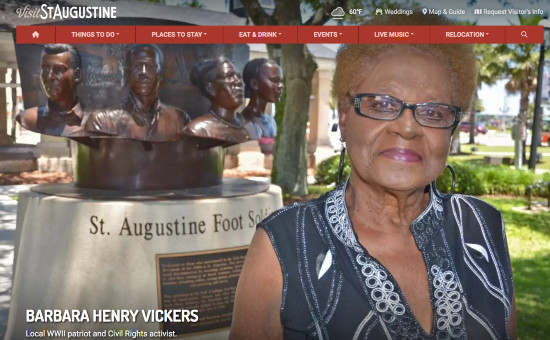
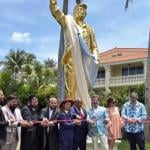
Vickers is one of the Civil Rights “foot soldiers” honored by a statue in her hometown of St. Augustine, Florida, where she was born in 1923, After growing up in the Jim Crow south, she left for New York City, where she worked as a tack welder during World War II. After the war, she returned to segregated St. Augustine and switched careers, opening her own hair salon. She almost lost that business when her community was terrorized for weeks by orchestrated Klan violence, an experience that led her to get involved in the struggle for civil rights — the struggle for an America in which the equal rights enshrined in our Constitution might actually be lived and enforced as the law of the land.
Here’s a terrific interview with her for the Smithsonian’s Southern Oral History Program.
And here is a video of Barbara Henry Vickers telling her story for Voices of the Civil Rights Movement:
Anybody who’s been watching the community response to the occupation of Minneapolis being implemented by “Pastor” Easterwood and his bosses at ICE will think of that when hearing Vickers talk about the phone-tree alert system Black Americans in St. Augustine implemented to protect their neighbors from the Klan. It’s just like the current day networks created by people in the Twin Cities to protect their neighbors from Easterwood’s klavern.
But the key thing here is Vicker’s recollection of her involvement in the kneel-in protests that the Civil Rights Movement conducted — for years — at segregated white churches. This goes directly to the audacity and caucasity and ignorance of many of the pundits and pontificators in that post linked above — especially academics who have had every opportunity to know better, like the Baylor prof who tried to distinguish a church protest from the lunch counter sit-ins and to claim it was a violation of what his mascot-substitute for MLK taught and preached.
VICKERS: Well, Dr. King was there, and he was sitting at the pulpit. and they needed these people to go in to the kneel-ins. And he just looked around, and he just looked me in the eye, and Dr. King said, “Will you go, young lady?” And you can’t refuse Dr. King. So I said yes.
“Kneel-ins have somehow fallen through the sifting bowl of history,” says Rhodes College professor Stephen Haynes.
I suspect that’s because, unlike the lunch-counter sit-ins, they didn’t have much success. Woolworth’s eventually changed its segregationist policy. Most white churches did not change theirs. Woolworth’s repented of its sin and, because of that repentance, it takes responsibility for its place in history. White Christians did not repent of their sin and so they do their best to erase and forget their history.
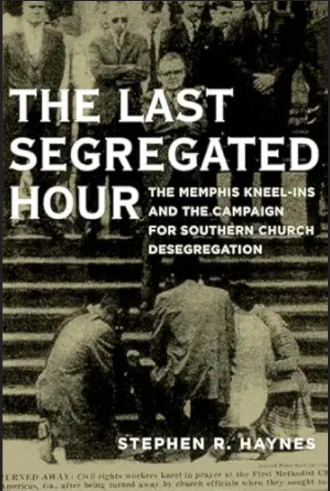 But while that history may be more obscure than the March on Washington, it’s not entirely forgotten.
Haynes wrote a history of this long, important part of the Civil Rights Movement, The Last Segregated Hour: The Memphis Kneel-ins and the Campaign for Southern Church Desegregation. Historian Ansley Quiros has written about the kneel-in campaign in Georgia. Neither campaign had much immediate success.
As Haynes tells us, the protests during services at Second Presbyterian in Memphis met with stiff opposition from the all-white congregation, But the national denomination sided with the Spirit granted to the church at Pentecost, and thus with the protesters, pressuring the church to allow nonwhite people to worship and become members there.
That led half the white congregation to leave, forming a new, still-segregated congregation, Independent Presbyterian Church (now a PCA congregation, obviously, and still all white). Haynes writes of that segregationist splinter church:
In 2010, after 45 years of downplaying or denying its racist origins, a sermon attacking the supposed biblical injunction against interracial marriage stirred so much controversy that the pastor resigned and the church began to engage its history in a process of “prayer and corporate repentance.”
I’m sure that’s going well.
In addition to the Florida kneel-ins coordinated by King and Robert Hayling through the Southern Christian Leadership Conference and those in Memphis and in Georgia, coordinated by the Student Nonviolent Coordinating Committee, there were also SCLC kneel-ins in Birmingham, which were denounced by the local commissioner for public safety in terms identical to those found throughout that “Evangelical Roundup” of white evangelical responses to the protest in Minnesota.
The injunction that commissioner — Eugene “Bull” Connor — brought against civil rights activists barred them from “parading, demonstrating, boycotting, trespassing and picketing” and specifically from “conduct customarily known as ‘kneel-ins’ in churches.” Protests in churches were not perceived — even by freaking Bull Connor — as some outrageous innovation violating some previously unbroken ancient taboo. They were “customary” — a custom to which Americans were accustomed.
And they were and have been and are customary as a response to precisely the same thing that the protesters were protesting against at Cities Church in St. Paul — the notion of whites-only Christianity in a whites-only America.
In different times and different places, Lay and Allen and Vickers and Nekima Levy Armstrong have all protested against that same whites-only ideology. And they all protested against it wherever it was strongest and most supported, which is to say they all protested against it in white churches.
All of these protests disrupting worship services in churches here in America since before it was America have focused on churches for two reasons: 1) to try to change society by changing the church, and 2) to call upon specific churches to repent of their specific sin.
Even the mostly secular ACT UP protests that disrupted worship services in churches were driven by both of these aims. The activists were aware of those churches’ purported teachings — it’s not as though their talk of “the cardinal acts of mercy” were some great secret known only to initiates, or that 1980s Catholics were quiet about their supposed devotion to a “culture of life.” ACT UP was challenging those churches to live up to their own alleged standards. Even if they didn’t use the explicit sectarian language, they were calling on those churches to repent from sin.
Richard Allen did use that specific sectarian language when he disrupted a worship service. So did Benjamin Lay. And Anne Hutchinson. And Barbara Vickers. And Nekima Levy-Armstrong.
All of which is why the defiant defenses of sin and rejections of repentance posted by all of those white evangelical pundits on — of all days — Martin Luther King Day leads us unavoidably again to Jesus’ warning in Matthew 23 to self-righteous religious folk who make a show of honoring the slain prophets of ancient times while despising the prophets God puts before them right now:
Woe to you, professors and pastors,** hypocrites! For you build the tombs of the prophets and decorate the graves of the righteous, and you say, “If we had lived in the days of our ancestors, we would not have taken part with them in shedding the blood of the prophets!” … For this reason I send you prophets, sages, and scribes, some of whom you will kill and crucify, and some you will flog in your churches and pursue from town to town.
The common thread in all of these stories, from Abel to Zechariah, from Anne to ACT UP to Armstrong, is that the prophets and protesters were right and that the churches disrupted by them were wrong. Those churches were — and are — in sin. They are in sin that they hard-heartedly and stiff-neckedly refuse to acknowledge, let alone give any thought to repenting from or atoning for.
Even now the axe is lying at the root and whatnot.
Anne Hutchinson was right and those who condemned her protests while ignoring the substance of them were wrong.
Benjamin Lay was right and those who condemned his protests while ignoring the substance of them were wrong.
Richard Allen was right and those who condemned his protests while ignoring the substance of them were wrong.
Barbara Vickers was right and those who condemned her protests while ignoring the substance of them were wrong.
ACT UP was right and those who condemned their protests while ignoring the substance of them were wrong.
But somehow all of these folks are sure that this time condemning the protesters while ignoring the substance of their protest will turn out, for the first and only time since the blood of righteous Abel, to be the right call.
That’s a choice. It’s not a good or a wise choice, but it’s a choice.
* Well, white evangelicals and white evangelical pastors outside of the Twin Cities, where the only white evangelicals who aren’t actively opposing ICE’s ethnic-cleansing campaign seem to be those at a handful of Doug Wilson-affiliated churches.
See again Jack Jenkins’ “How one conservative Christian family is pushing back against ICE.” Or consider the very evangelical language used by this white Christian protester objecting to ICE’s harrassment of non-white church-goers. Not only does he object to their preventing nonwhite Christians from going to church, he urges them to repent and “go to church” themselves — lovely advice, but not much help if they wind up going to Easterwood’s services most weeks. Or remember that evangelical clergy have been among those praying and protesting and getting arrested en masse by ICE and its local enablers.
But the professional pundits and Twitter pastors in that “Evangelical Roundup” aren’t any more inclined to listen to their white evangelical brethren in the Twin Cities than they are to ever listen to anyone who isn’t also white and evangelical (and a professional pundit and on Twitter). The circle of people these folks will ever listen to is very small, and always shrinking.
** I am paraphrasing here to the dynamic equivalent to better enable contemporary readers to understand the passage and also to ensure that these contemporary readers do not fall into the snare of the centuries of self-serving, self-flattering, faux-exculpatory antisemitism that has been constructed around heretical, amnesiac gentile interpretations of “the Pharisees.”
We can debate whether or to what extent Jesus of Nazareth was associated with the Beit Hillel faction of the Pharisees, but the fact that he frequently repeated their teaching and took their side in the internal arguments among the various schools of Pharisees is not really debatable among anyone who’s studied first-century Judaism. This whole “Alas, alas for you, lawyers and Pharisees” passage in Matthew 23 should be understood in terms of those internal arguments among Pharisees.
Yeah, I know, that’s not what they taught you in Sunday school. Heck, I didn’t even know anything about this when I had to sing this whole chapter when I played Jesus in Godspell, and I was a TA in a seminary at that point. (I was just worried about whether or not I would hit those high notes — Victor Garber I’m not.)
But this is really, really important if we want to avoid the theological errors of the “old perspective” (i.e., the false perspective) on Paul and if we want to avoid repeating “the whole offense / From Luther until now / That has driven a culture mad.”***
Rabbi Danya Ruttenberg has an excellent, engaging introduction to all of this in a series of posts we discussed here a few years ago:
This is urgently relevant to the whole long American tradition of Christian protesters disrupting Christian worship services because it underscores that these contentious internal arguments among the followers of God go back not just centuries, but millennia.
That’s what the author of Matthew’s Gospel was emphasizing by including that bit in Matthew 23 about “all the righteous blood shed on earth, from the blood of righteous Abel to the blood of Zechariah son of Barachiah.” (The evangelist was so intent on making the chronological gamut parallel with the alphabetical one that he probably got his Zechariahs mixed up, but let’s be charitable — who hasn’t at some point gotten their Zechariahs mixed up when reading the scriptures?)
*** That’s from Auden’s “September 1, 1939,” which also supplied the name for Larry Kramer’s play The Normal Heart. Kramer’s play chronicled the early years of the AIDS epidemic, dramatizing — among many other things — the internal arguments among activists about ACT UP’s strategy of protests disrupting church services.
Those protests were covered in all the newspapers at the time. And those protests are right there, plain as day in all the history books so, again, it is very odd to see all those white evangelical professors acting like they’ve never heard of such things. It strains credibility.
Also too, white evangelical pastors and pundits had a lot to say about those now-forgotten-by-them ACT UP protests back in the ’80s. They all recited the Proper Christian Stance on those protests which was then, as it is now, an unrepentant and defiant defense of sin.
And white evangelical pastors and pundits will continue to recite and to cling to those sinful Proper Christian Stances, lest
… we should see where we are,
Lost in a haunted wood,
Children afraid of the night
Who have never been happy or good.
“We must love one another or die.”











 Ad-Free & Subscriber Log-In