

• “The good news is that all of the ‘H’s are now properly oriented. To see the bad news, look at the ‘S’ in ‘WORSHIP’ — now that is upside-down! (The other ‘S,’ in ‘SERVICE,’ is properly oriented.)”
That’s Paul Lukas, plumbing the archives in pursuit of “A Frank Lloyd Wright Typographic Mystery.” This is the kind of idiosyncratic, obsessive thread-pulling that I like to see from the internet. Well done.
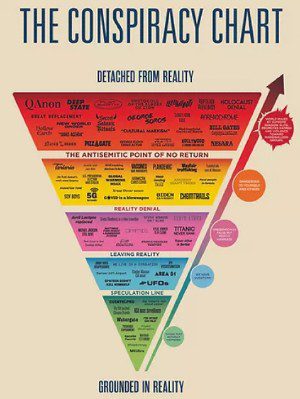
• Kathryn Post writes about “Starseeds: The alien subculture offering a conspiratorial spiritual escape.”
This initially sounds mostly harmless and well-intentioned in a wifty, hippy-dippy way. I mean, OK, sure, you believe you’re not human, but actually an extraterrestrial being who chose to become human to spread a message of goodness and light and “vibrations” or whatever. The premise seems shaky, but the intent seems to be all peace, love, harmony, and kumbaya. But then you hear more of the story and how also includes nefarious races of reptilian aliens and a shadowy government conspiracy to cover all of this up and you realize that these sweet innocent-seeming New Age-y folks are tightrope-walking on the antisemitic line of no return.
• Also couldn’t help but think of Abbie Richards’ work on the antisemitic trajectory of all conspiracy theories when reading Miriam Eve Mora’s piece on “Why the manosphere has an antisemitism problem.”
• “For more than 15 years, botanist Naomi Fraga of the California Botanic Garden has been trying to collect seeds from the rare Death Valley sage, for safekeeping in a vault of native California seeds.”
Heard this story on the radio and was glad to see the online edition has lots of photos. (The online article also seems shorter than what was broadcast, so give it a listen.) I like stories about obsessive, determined people who are good at whatever it is they do.
• And here’s another NPR piece on western American plants I’ve never seen in person: “Tumbleweeds can be so bad in the Great Plains that they bury homes and cause fire danger.”
• Jim Cocola introduces us to “Emil L. Scharf’s 1908 book The Metafysics and Psychology of Base Ball: An Investigation and Analysis of the Causes, Both Fysical and Psychological, That Produce the Various Fenomena of the Game.”
Scharf “wrote the book in Simplified Spelling, a revised system of orthography designed to meet the American masses at their typical levels of literacy,” which was a weird early 20th-century fad that soon fizzled, but it’s far from the only weird thing — or the weirdest thing — about this wonderfully strange book.
And also, at this point, I’m thinking about buying a copy and sending it to Mets manager Carlos Mendoza. It couldn’t hurt.
• “The enduring mystery of Roberto Clemente’s bat.”
Kevin Guilfoile grew up in Cooperstown and he has so many stories —
I talked hitting with Ted Williams and baserunning with Cool Papa Bell. I sat at my own dining room table with former baseball commissioner Bowie Kuhn as legendary Yankees pitcher Waite Hoyt spun first-hand yarns about Babe Ruth.
Years before we lived in our house on Lake Street, Joe DiMaggio and Marilyn Monroe ate dinner at that same table with a previous owner and helped with the dishes afterward. Marilyn Monroe doing dishes at the same sink where I washed dishes every night — that’s a mental picture that will make a 13-year-old boy’s head explode.
— and he’s also a thoughtful, lovely writer:
The French philosopher Henri Bergson once said, “Time is the thing that keeps everything from happening all at once.” I’ve also seen the quote attributed to “The Sisterhood of the Traveling Pants,” but whatever the source, it’s the principle that I use to understand what has happened to my father since the caulk of Alzheimer’s has filled in the synapses of his brain.
To my dad, I am 5 years old and also a novelist. I am 43 years old and also an undergrad at the University of Notre Dame. I am an assistant media relations director for the Houston Astros, and I am not yet old enough to drive. I am a Little League coach in La Grange, Ill., and a Little League player in Bethel Park, Pa. I also work in advertising.
My mother knows me as all these things, too, but she understands time as an organizing principle, that I was each of these things at a different stage of my life. My father does not. To him I am all of these things at once. He lives in an unrelenting present, with no real concept of yesterday or tomorrow.
My mother is easier for him to recognize because she has always been the same, reliable thing to him. But he does sometimes offer to carry her books to class.
And all of that is just the set-up for the mystery of Clemente’s bat.
• Simon Young’s history of “The Baum Bunny.” This history of a legendary, fearsome rabbit is, Young notes, also about “supernatural rabbits more generally.”
• “This letter is to notify you that you are banned from visiting all properties owned by C. Edwards Group, d.b.a. McDonald’s.”
Rep. Chuck Edwards is a MAGA Republican who represents a Western North Carolina district in Congress. He is also a rich guy who owns six McDonald’s franchises in the district. And he’s a jerk whose idea of constituent service involves telling a grieving mother that “you know, a lot of people just want a handout.”
I enjoyed reading about that mom, Leslie Boyd, and her protests at Edwards’ restaurants.
I would take this as a model for protesting against my own out-of-touch Congress critter, but Sen. Dave McCormick’s hedge fund for billionaires doesn’t have any local franchise locations nearby.
• Stan Goff on “The art of lying.” This is a rant, but it’s an entertaining rant, and Goff’s discussion of the various types of lies and liars is keenly observed.
• “Theosophy,” Philip Jenkins writes:
… is either (a) a fringe esoteric/religious movement founded in the 1870s, one of many such marginal sects; or (b) the indispensable key to understanding Western culture in the early twentieth century. I can make a case for either of these extreme statements, but the arguments for (b) are much stronger than you might think.
Jenkins’ current project (well, one of them — he always seems to have several) is a book about America in the 1890s, so he keeps running into both hardcore Theosophists and others who at least dabbled in the esoteric movement trendy ideas. At some point he realized that he’d encountered so many people who took it seriously that he would need to take it seriously, which he does here. That’s not to say he’s likely to become a convert, but he’s making a serious effort here to understand and to summarize what these folks believed. (Or, I suppose, “believe” — present tense — since there may still be a few Theosophists sticking around today.) It’s an odd, interesting, sometimes surprising read.
• This is fun: “What ‘The Pitt’ Gets Right (and Wrong) About ‘Pittsburghese.‘” I’m gonna need to borrow somebody’s password to watch Season 2. And then, speaking of hard-to-capture local accents, to watch the second season of Mare of Easttown if that happens. (My wife didn’t like Kate Winslet’s Delco accent. “She’s oaver-doing it,” she said, utterly unaware that she was pronouncing “over” with exactly the same hoagie-mouth as Kate.)
Each year in New England, on the first warm, wet night of spring, when the ground has thawed, and the temperature is just right, armies of frogs and maelstroms of salamanders emerge from the woods. They hop and undulate through the night, following the same routes their ancestors traveled to the vernal pools of their birth, where they lay their eggs, chirping and clucking all the while.







 Ad-Free & Subscriber Log-In