

Bunni’s Bible-thon — the “America Reads the Bible” event/fundraiser/MAGA rally being held this week at the Museum of the Bible — included a special guest star on video.
The books of Chronicles didn’t promise to be a highlight for this event, what with 1 Chronicles starting with nine chapters of genealogies and census records, followed by a long retelling — a sometimes very altered retelling — of the stories we’ve just finished reading from 1 & 2 Samuel and 1 & 2 Kings. But finally, in 2 Chronicles 7, we arrive at a famous verse, one many Christians have memorized. It’s a passage that has been quoted by dozens of politicians, has been printed on inspirational posters and T-shirts, has appeared as yearbook quotes at Christian schools, and sometimes even gets used in the PowerPoint slides during pledge week at local churches.
2 Chronicles 7:14 is a celebrity rock-star Bible verse:
If My people who are called by My name will humble themselves, and pray and seek My face, and turn from their wicked ways, then I will hear from heaven, and will forgive their sin and heal their land.
Some of you will, like me, hear the music in your head when this verse gets quoted. It’s not just “If My people who are called by My name,” but “If My people (people, ooh) …” That made for a pretty praise chorus.
“America Reads the Bible” chose to have this celebrity rock-star Bible verse read by the organizers’ idea of the ultimate Bible Celebrity Rock Star: President Trump.
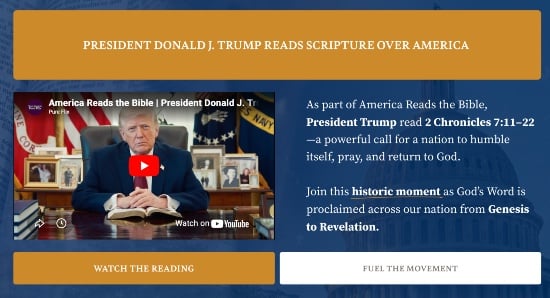
Trump didn’t read this live and in-person there at the Museum of the Bible, but he submitted a pre-recorded video of him reading 11 verses from 2 Chronicles 7 while sitting at his desk in the Gilded Office at the White House.
Bible-thon organizers described this as “Trump Reads Scripture Over America.” The use of “over” there is evangelical-speak suggesting an act of pastoral or spiritual beneficence, expressing the idea that Trump is mediating* on our behalf something like a faith healer laying hands on the entire country.
Given the president’s usual difficulty of sticking to any prepared text, I doubt he recorded this reading in a single take and I would very much like to see the outtakes and blooper reel from this recording session. I can’t help but wonder how many times they had to stop filming to edit out “the weave” with random tangents about sharks and batteries or about the straits of Hormuz or Nares.
2 Chronicles 7:14 is, in context, a specific promise God makes to a specific people in a specific time and place. That time and place is not 21st-century America and that people is not white Protestant Christians. So it’s important for modern Christians not to appropriate this passage and its promise in a supercessionist way — the whole idea that European Christians are the New Israel, replacing the Jews. That gets very antisemitic and very blasphemous very quickly, and it’s particularly dumb and dim as a reading of this passage, which involves God making a promise. See, the whole basis of supercessionism is that God’s promises are not worth diddly squat and can be revoked at any time because God is a capricious liar.
 But 2 Chronicles 7:14 is also about more than a specific promise in a specific context. It also has something to say about the character of God, about how God is always willing to be merciful to those who repent. If that is true of God in all times and places, then that is true for all readers of this passage, regardless of their time or place or status, so I think it’s very possible for Christians to treasure this verse as a description of that.** But we need to tread carefully to avoid the self-defeating blasphemy and antisemitism that flows from just assuming “My people” here is obviously and exclusively about us, because we are now the people who have claim to God’s (apparently worthless) promises.
I’ve seen a few news reports on Trump’s video Bible-reading stunt that attempt to report the full context of this passage in 2 Chronicles 7. (See, for example, here and here.) These all include the context of these verses in the history of American civil religion noting, for example, that Dwight Eisenhower was sworn into office with his hand on a Bible opened to this passage. But they all describe its biblical context as being from the time of Solomon.
That’s wrong.
The context of 2 Chronicles 7 is the story of Solomon, but it is not at all the time of Solomon. The Chronicles were written many centuries later, long after Solomon died and his kingdom was divided, after each of the divided kingdoms was conquered and destroyed, after the people of Judah were carried off into exile, and after some of those people were allowed to return.
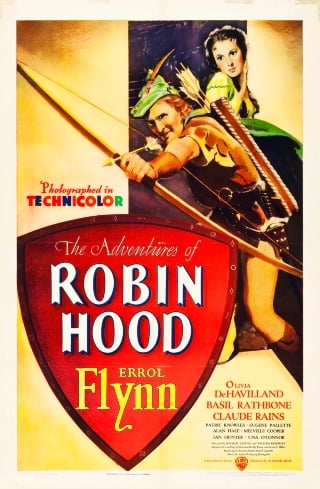
So, no, saying the context of 2 Chronicles 7 is “the reign of King Solomon” is wrong in much the same way it is wrong to say that the reign of Prince John is the context of Errol Flynn’s The Adventures of Robin Hood. That movie was written and filmed in California in 1937, not in England in the early 1200s.
So 2 Chronicles 7 is the work of a pro-monarchy, but post-monarchy writer advocating for the restoration of a lost and fallen kingdom years after its destruction, It was written by and for people who were living in the aftermath of that destruction, and it employs the devastation of that context to argue for a restored monarchy that will get it right this time around because it will be guided by the spiritual leadership of the priests.
That context makes this passage way more interesting as a favorite verse of civil religion advocates and Christian nationalists. It also makes it a very interesting passage given the current political context of Trump and his lackeys at the Pentagon trying to pick a fight with the pope based on the president’s utter inability to comprehend what a pope even is or does or means.
* The use of the word “mediating” there is a reference to 1 Timothy 2:5, which reads, in the KJV, “For there is one God and one mediator between God and man, the man Christ Jesus.” That’s the verse white evangelicals will quote against Catholic Christians who pray for the intervention of the saints on their behalf. Appealing to St. Francis or St. Oscar Romero for spiritual intervention on our behalf is regarded by these evangelicals as tantamount to idolatry. But the idea that America will be blessed because “Trump Reads Scripture Over” us is, somehow, different. For there is one God and one mediator between God and country, their man, Donald Trump.
** 2 Chronicles 7:14 is echoed in Jonah 4, where Jonah says, “You are a gracious and compassionate God, slow to anger and abounding in love, a God who relents from sending calamity.”
Of course, the full context there in Jonah has the resentful anti-prophet saying this:
When God saw what they did and how they turned from their evil ways, he relented and did not bring on them the destruction he had threatened.
But to Jonah this seemed very wrong, and he became angry. He prayed to the Lord, “Isn’t this what I said, Lord, when I was still at home? That is what I tried to forestall by fleeing to Tarshish. I knew that you are a gracious and compassionate God, slow to anger and abounding in love, a God who relents from sending calamity. Now, Lord, take away my life, for it is better for me to die than to live.”
Like most of the polemical satire of the book of Jonah, that bit is funny. But it’s even funnier if we recognize that Chronicles is traditionally attributed to Ezra, and is, at least, Ezrahic, and that the author of Jonah is deliberately and specifically mocking that perspective here.
God’s mercy is available to me not because God has broken God’s promise to Abraham and replaced Abraham’s children with people like me. It is available to people like me because it was available to people in Ninevah. (And even to camels in Ninevah, which the book of Jonah tells us donned sackcloth and ashes and knelt in repentance. For 21st-century white Christians reading 2 Chronicles 7:14 I would suggest its meaning is this: emulate the camels of Ninevah.)













 Ad-Free & Subscriber Log-In