

• Paul Campos gets theological in contemplating “Why do Republicans have unlimited tolerance for Trump’s unprecedented corruption?”
For some of them, he posits, it may be due to their ideas of the Calvinist doctrine of “total depravity,” and the way this is popularly understood to mean that all sins are equally damning for eternity and, therefore, equally consequential here on earth. Thus, according to this view, “in God’s eyes there’s therefore no meaningful difference between taking a dubious tax deduction and being a serial killer or Hitler for that matter.”
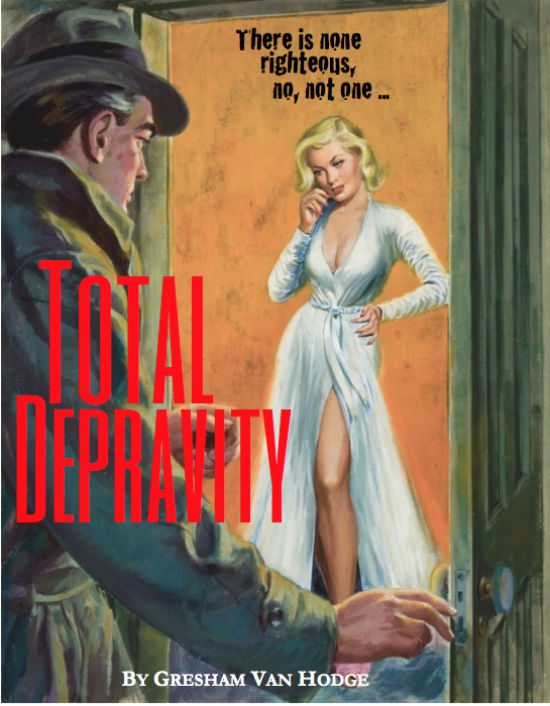 I agree that this is a widely held view, but this pop-Calvinism distorts what Calvin et. al. actually taught about “total depravity.” That idea was not the belief that humans are superlatively depraved, but rather that our sinfulness is pervasive — not isolated in one aspect of our being. It’s a counter to the notion that our sinfulness is specifically located in our material flesh, or in the will, or in our genitalia or whatnot, and thus can be overcome by relying only on our untainted mind or spirit, etc. One corollary to that is that our human goodness as bearers of the image of God os also “total” and pervasive, not isolated to a particular aspect of our being.
This is why no human can be trusted with unchecked power — why benevolence is never a sufficient or adequate check on humans granted power over other humans. Reinhold Niebuhr was being eminently Calvinist when he said “[Humanity’s] capacity for justice makes democracy possible, but [humanity’s] capacity for injustice makes democracy necessary.”
This Calvinist/Augustinian understanding of “total depravity” — of pervasive sinfulness — is about human nature. It has nothing to say and nothing to suggest about how various sins appear “in God’s eyes.” The pop-Calvinism that teaches that all sins are equivalent and “in God’s eyes there’s therefore no meaningful difference between taking a dubious tax deduction and being a serial killer” is derived from the blasphemous soteriology of the latter parts of the Calvinist “TULIP” welded onto the pernicious, antibfiblical folklore of Hell. This takes the pessimistic, Augustinian view of human nature and slanderously projects it onto God, suggesting a monstrous “holiness” that we humans are tempted and taught to emulate.
The real moral and ethical danger of this is not the bumbling evangelist’s attempts to convince would-be converts that they deserve an eternity of conscious torment in Tundal’s Hell because they once told a single white lie. The serious danger comes from teaching sinful humans to regard all of their fellow humans as irredeemably wicked creatures who deserve such eternal torment, compared to which no temporal earthly suffering or oppression or injustice can begin to compare. What does it matter if those widows and orphans are neglected and exploited for the brief span of their mortal lives when we all know that God intends to torture them all for all of eternity because that is what God says they deserve?
The perverse evil of that logic is a consequence of pop-Calvinism. But it is also, like Trump’s unprecedented corruption, a confirmation of everything Niebuhr argued about the “total depravity” of human nature unrestrained by grace and justice.
• Less theology, but even more depravity, in this post from Campos about the precedent-setting criminal case of R v. Dudley and Stephens or, as the title of his post puts it, about “Cannibalism and the common law.”
Even if you do not have the, um, appetite to read all the details of this tale of the desperate measures taken by shipwrecked sailors adrift for weeks in a lifeboat, skim to the bottom of the post to read the excerpt from Edgar Allan Poe and the reason it has Campos humming the theme from the Twilight Zone.
While on the subject of cannibalism, Campos also writes about the 1970s novelty pop hit “Timothy,” by The Buoys, which was like Dudley and Stephens set to music. That song was written (and cleverly promoted) by Rupert Holmes, best known for “Escape (the Piña Colada Song).”
I had the delightful privilege of conversing with Holmes via email years ago. He lamented that whenever you write a song in the first person (“I was tired of my lady …”), many people will assume that song is autobiographical. He was talking about “Escape,” but I suppose that also applies to “Timothy.”
• This headline got me to click: “10th Annual Blessing of the Bikes at First Lutheran Church.”
The “bikes” here are motorcycles, and the event conducted by this Kingsville, Ontario, church invites bikers to come to receive prayers and blessings. It reminds me of the annual “Blessing of the Fleet” at Fisherman’s Wharf in Lewes, Delaware.
These rituals can cater to a superstitious understanding of religion, with participants viewing the “blessing” as a kind of talisman against the potential danger of their vocation or avocation, and it’s important to conduct such rituals in a way that doesn’t encourage that understanding. But they can also be a demonstration of solidarity and neighborliness — a way for the church to say “You are a part of this community and we care about you.”
Still, finding out the “Blessing of the Bikes” was about motorcycles was initially disappointing because my initial thought — or hope, maybe — when I saw that headline was that this was about bicycles.
I was imagining something like the Blessing of the Animals that many churches conduct each year on the Feast of St. Francis, except for, you know, with bicycles. I was picturing a line of cyclists — commuters, triathletes, hobbyists, messengers, paper carriers, little kids still using training wheels, every kind of bike-rider imaginable — queuing up to receive a personal benediction and prayer for safety.
The bikers-welcome message of the Kingsville Lutherans is nice, too. But some church should also start doing this for bicycles.
• The local news in Nashville asks “What is Progressive Christianity?” Answering that question isn’t really what that interview segment is about, but it gets me wondering about the recent rise and adoption of this term.
I’m not sure I ever encountered the phrase “progressive Christianity” used in this way until the rebranding here at Patheos. At the time I just assumed it was a phrase Tim Dalrymple made up so that he could move folks like me and Scot McKnight off of the “evangelical” channel so we didn’t scare away the more typical evangelical readers he was hoping to attract. To his partial credit, Tim recognized that Just because we were the “wrong” kind of evangelical didn’t automatically turn us into Mainline Protestants. So Tim’s solution was to rebrand Patheos’s “Mainline Protestant channel” as the “Progressive Christian” channel and thus allow it to accommodate not just United Methodists and Presbyterians, but also to include renegade white evangelicals who voted for Obama or advocated for women’s ordination or whatever it was Warren Throckmorton did to get anathematized here.
Playing around with Google Books I’ve found occasional uses of the phrase back in the early 20th century, but not used in the same way it’s used here on Patheos or referenced in that NewsChannel5 Nashville story. It only seems to have take on this new, now ubiquitous sense relatively recently at some point within the last 20 years. I found a few uses of it that I think preceded the Patheos rebranding — so Tim didn’t invent this himself — but it still strikes me as a term that arose from branding and marketing and product differentiation.
That makes it a bit slippery and nebulous, one of those words or phrases that is more about telling you what something is not than what it is. It’s similar to “evangelical” in that regard.
“Evangelical” is a rebranding term that originally meant “not fundamentalist” but then came to mean “not Mainline Protestant.” It’s easier to say what “evangelicalism” is not than to say what it is. And since “progressive Christianity” seems to mean, roughly, “not evangelical,” it can be hard to say what it is too.
I suppose if NewsChannel5 Nashville asked me “What is Progressive Christianity?” I would just quote big chunks of 1 John 4 and say it’s people who believe that you cannot love and know God unless you love and know your neighbors, who believe that can only love and know God by loving and knowing your neighbors.
I’m not sure if that’s what this term does mean, but I think it’s what it should mean.












 Ad-Free & Subscriber Log-In