


American Christianity didn’t accidentally become obsessed with escape. The fixation on rapture timelines, prophetic spectacle, and the quiet relief that comes with imagining the world finally getting what it deserves didn’t emerge organically from the teachings of Jesus. It was learned. It was practiced. And it has a paper trail.
The modern evangelical posture toward suffering, justice, and politics was not inherited from the early church. It was rewired. And that rewiring can be traced back to a single theological move that slowly metastasized into a worldview: the belief that faithfulness looks like departure.
At the center of that shift stands John Nelson Darby—not because he was uniquely evil, but because he was uniquely unchecked. Darby didn’t just introduce a new end-times framework. He built a system so totalizing that it quietly retrained Christians to disengage from the world while calling it holiness.
Darby didn’t merely invent a doctrine. He normalized a way of leaving.
John Nelson Darby and the Birth of Theological Abandonment
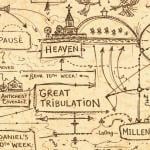
Darby’s lasting contribution wasn’t dispensationalism as a technical theory. It was dispensationalism as orientation. His system fractured time into segments, disconnected the church from its own history, and reframed suffering as background noise in a story God was about to abruptly end.
Without formal theological training or sustained accountability to historical consensus, Darby approached Scripture like a system engineer, not a pastor. He wasn’t asking how faith shapes people over time. He was asking how the pieces fit together—and once they did, the human cost barely mattered.
In Darby’s framework, the world is not something to be healed but something to be exited. History is not a story of slow redemption but a countdown clock. Suffering is not a summons to solidarity but a sign that things are proceeding exactly as planned. The faithful are not called to remain, endure, or repair. They are called to be ready to go.
That shift matters because theology doesn’t just explain reality—it trains instincts. And Darby’s system trained Christians to see detachment as wisdom and disengagement as spiritual maturity.
From Fringe System to Default Setting
If Darby was the architect, C. I. Scofield was the distributor. And Scofield’s influence can’t be overstated—not because he was more insightful, but because he was more practical.
Scofield’s study Bible did something quietly radical: it embedded Darby’s interpretive framework directly into the margins of Scripture. This didn’t just teach readers what to believe—it taught them how to read. Suddenly, dispensational assumptions felt native to the text itself. Dissent didn’t feel like disagreement with an idea; it felt like disagreement with the Bible.
This is where abandonment stopped looking like a theological choice and started looking like basic literacy. If the world is slated for destruction, then emotional investment becomes naïve. If history is segmented and disposable, then wisdom from the past becomes irrelevant. If departure is imminent, then long-term responsibility starts to feel like a distraction.
The genius—and danger—of Scofield wasn’t innovation. It was normalization.
How American Evangelicalism Absorbed the Exit Strategy
By the time dispensational thinking fully embedded itself in American evangelicalism, it no longer needed defending. It had become instinct.
The rapture reshaped Christian posture in subtle but profound ways. Urgency replaced responsibility. Certainty replaced humility. Conversion replaced repair. Faith became about where you’ll be rather than how you’ll live.
Justice suffered first. Why pour energy into systems marked for destruction? Why confront structural evil when collapse is not only inevitable but divinely scheduled? Concern for the poor, the oppressed, or the planet itself became optional—commendable at best, suspicious at worst.
Presence suffered next. The call to love neighbors over time was quietly replaced by the call to extract individuals before the lights go out. Churches learned how to save souls without learning how to stay.
None of this required overt malice. It was simply the logical outcome of a theology that trained believers to see the world as a sinking ship rather than a shared home.
Christian Zionism and the Political Logic of Abandonment
Once abandonment becomes theological instinct, its political applications follow naturally. Christian Zionism didn’t emerge from careful ethical reasoning or deep historical engagement. It emerged from prophetic impatience.
In this framework, real people become symbolic actors in an end-times script. Suffering is no longer something to interrupt but something to interpret. God’s will becomes legible through geopolitical alignment rather than moral imagination.
Compassion becomes conditional. Cruelty becomes defensible. Entire populations can be sidelined because their pain serves a larger narrative. This isn’t a bug—it’s a feature of a system that already treats abandonment as obedience.
When theology teaches believers that God is about to walk away from the world, it becomes remarkably easy for believers to do the same.
End-Times Obsession in the Age of the Algorithm
What we’re seeing now—the TikTok prophets, the viral rapture warnings, the dopamine-fueled apocalypse content—is not a distortion of dispensational theology. It’s its natural afterlife.
End-times obsession thrives because it offers emotional payoff without ethical cost. Fear becomes content. Spectacle becomes confirmation. Every disaster feels meaningful, every crisis validating.
The algorithm loves this theology because it rewards disengagement. The more chaotic the world appears, the more righteous withdrawal feels. Abandonment is no longer just theological—it’s monetized.
At this stage, the system doesn’t even require belief. It only requires attention. This is why The Tribulation Survival Guide exists—not to mock belief, but to expose how a theology of exit hollowed out Christian responsibility long before it went viral.
The Cost of a Faith Trained to Leave
The deepest problem with rapture theology isn’t bad predictions or failed timelines. It’s formation. A faith trained to expect evacuation will always struggle to practice presence. A theology that treats departure as holiness will hollow out justice, responsibility, and love over time.
This is why so much American Christianity feels thin, brittle, and morally exhausted. It was never trained to stay. It was trained to watch the clock.
Darby didn’t teach Christians how to wait well. He taught them how to leave early. And for generations now, American Christianity has been practicing that exit—calling it faith, and wondering why the world feels increasingly disposable along the way.

For more Snarky Faith, check out the podcast and more:
- Snarky Faith website
- Snarky Faith on Instagram: @stuartdelony
- Snarky Faith on YouTube: @snarkyfaith
- Snarky Faith on Bluesky: @snarkyfaith.bsky.social
- Snarky Faith Group on Facebook: www.facebook.com/snarkyfaith
- Snarky Faith t-shirts and mugs available here.















 Ad-Free & Subscriber Log-In