

Moreover, the gate is relational, not institutional. It is not a rigid structure but a living person. This suggests that justice is not achieved merely through policies or systems, but through embodied solidarity. It’s accomplished through people who, like the shepherd, place themselves at the threshold to ensure others are safe and free.
Welcome Readers! Please subscribe to Social Jesus Here.
This is Part 3 of the series The Imagery of a Good Shepherd
(Read this series from its beginning here.)
In a world marked by exclusion, injustice and inequity, the image of Jesus as the gate invites communities to reimagine access, protection, and belonging. It calls for the dismantling of harmful barriers and the creation of spaces where all can enter Jesus’ vision for human community, move freely there, and experience the fullness of life.
In the earliest centuries of Christianity, the dominant image of Jesus was not the crucified victim but the Good Shepherd. (For a detailed history of this see Parker and Brock’s Saving Paradise: How Christianity Traded Love of This World for Crucifixion and Empire.) Originally drawn from gospel passages such as our reading this week, early Christian artists echoed this image of shepherd. The shepherd carried a sheep on his shoulders, which symbolized care, protection, and intimate solidarity with the vulnerable. This image reflected a marginal movement shaped by communities living under the shadow of imperial power, where survival depended on mutual care and resistance to systems of domination.
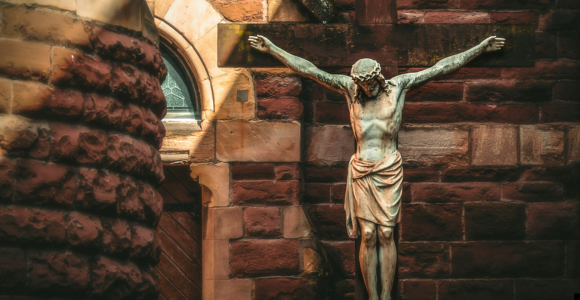
However, as Christianity moved from the margins to the center of power, particularly after Constantine the Great legalized it in the fourth century and it align with the Roman Empire, the dominant imagery of Jesus began to shift. The cross, once a symbol of state terror and execution, became the central emblem of the faith and replaced the image of the Good Shepherd. What had been a sign of imperial violence against dissidents became, paradoxically, a symbol that often supported those imperial structures.
This symbolic shift was not merely artistic but also theological and political. The shepherd image emphasizes care, guidance, and the flourishing of the community, particularly the most vulnerable. It invites us to imitate acts of compassion and justice. By contrast, an overemphasis on the cross, especially when interpreted through frameworks that prioritize passive suffering or divine sanction of violence, becomes religious imagery that accomplishes its original purpose (terror) with a religious twist. It becomes a subtle communication that this is what the Divine is really like. He may have done this to his son instead of you, but don’t cross him! Or he may cross you, too! With this change, the cross becomes an instrument of empire used to suppress resistance once again. Now, though, it suppresses resistance using fear of the Divine (often disguised in the language of Divine love) and human institutions define compliance or “obedience.”
As Christianity became intertwined with imperial power, the cross was often reframed to emphasize obedience, sacrifice, and submission. Those in power, both within ecclesiastical and imperial systems, used this interpretation to justify hierarchical systems, discourage dissent, and sanctify suffering rather than challenge its causes. The crucified Jesus, once a victim of injustice, was presented in ways that muted the political reality of his execution and the critique it implied of imperial violence.
Meanwhile, the Good Shepherd image, with its implications of mutual care and its challenge to“the hired hand” who abandons the sheep, receded in prominence. It was less easily co-opted by systems that benefited from inequality and control. A shepherd who lays down his life for the sheep in opposition to predators invites resistance to injustice, not accommodation to it.
In our context today, recovering the image of Jesus as shepherd is a way of reclaiming a vision of faith rooted in solidarity, protection, and the flourishing of all people. It reminds us that the earliest Christian imagination centered not on glorifying suffering but on resisting the forces that cause it and nurturing communities where abundant life, where justice and compassion, are possible.
Begin each day being inspired toward love, compassion, justice and action. Free.
Sign up at HERE.


















 Ad-Free & Subscriber Log-In