


Your Spotify knows your mood before you do.
Amazon knows you’re one bad Tuesday away from buying an air fryer you don’t need.
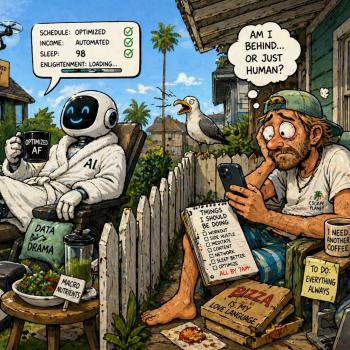
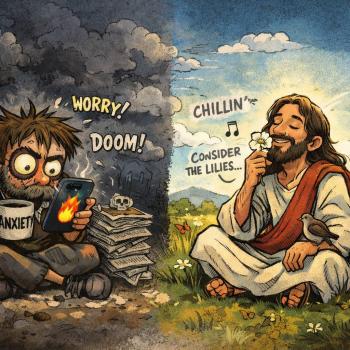
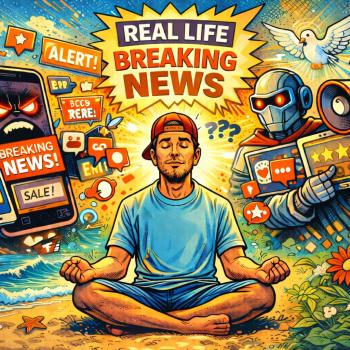
Your phone knows what will keep you scrolling—angry, anxious, affirmed, or afraid.
Algorithms don’t just recommend products anymore.
They shape attention. Identity. Belief.
They’ve become our digital prophets.
And unlike the old prophets—wandering deserts in sackcloth, eating locusts—these ones live in our pockets, whispering:
“People who liked what you liked also liked this.”
The problem? Algorithms don’t riff.
They don’t jam.
They don’t improvise.
They don’t surprise.
They never stop mid-song and take things somewhere risky, weird, or alive. They are careful. Metrics-driven. Risk-averse. Allergic to anything they can’t measure.
And if we’re not careful, we become the same way.
Here’s the twist: real transformation—the deep soul, identity, God-discovery kind—doesn’t come from optimized scripts. It comes from riffing inside the algorithm. Letting go of outcomes. Releasing the death grip on results. Daring to improvise in a world obsessed with guarantees.
Why We’re Addicted to Results
Let’s be honest—we love results.
Scale numbers going down.
Bank balances going up.
Posts getting likes.
I love results too. Every workout, rec-league basketball game (unnecessarily competitive), humiliating pickleball loss to a 70-year-old, or paddle out on a “big” (okay, midsize) set—I want payoff.
But this addiction isn’t just personal. It’s cultural.
Businesses optimize profits.
Students optimize GPAs.
Churches optimize engagement.
Politicians optimize polling.
We measure everything because measurement feels like control. Algorithms feed that hunger. Clicks. Views. Binge time. Dopamine hits.
But in our obsession with results, we’ve lost the art of becoming.
We don’t wander.
We don’t risk.
We don’t improvise.
We just hit safe notes.
And the soul doesn’t thrive on predictability.
The Streetball of Transformation
Remember the AND1 era?
Streetball wasn’t about perfect systems. It was about creativity, swagger, trust. Risking embarrassment. Letting the moment take you somewhere unplanned.
Cracked blacktop, chain nets, sweat dripping. Someone crosses over, pulls a move so wild the defender reaches for air.
That’s the game.
Real transformation works the same way. You don’t find yourself—or God—by tracking stats. You find them in the flow. In prayers that stumble. Conversations that wander. Losses that don’t make sense until years later.
Even Scripture reads like freestyle:
Abraham leaves without a destination.
Moses argues with God in the desert.
David writes psalms full of praise and despair in the same breath.
Jesus answers questions with stories that refuse to land clean.
None of them followed formulas.
They trusted the game.
Algorithms, Power, and the Modern Soul
Here’s where it gets uncomfortable.
Our public conversations—especially around issues like immigration and ICE—get flattened by algorithmic logic. Nuance doesn’t spread well. Complexity doesn’t trend. Outrage does.
On one feed, fear dominates.
On another, blame.
Rarely does patience or presence break through.
This isn’t about left or right. It’s about what happens when human beings are processed instead of encountered. When systems—technological, political, even religious—optimize efficiency but forget dignity.
The algorithm doesn’t ask, Who is my neighbor?
It asks, What keeps them engaged?
And when the soul starts thinking that way, something essential goes missing.
God Doesn’t Run on Code
We treat prayer like a transaction.
Relationships like formulas.
Faith like an investment strategy.
But God doesn’t work that way.
If He did, Job would’ve been spared. Jesus wouldn’t have been crucified. And your phone wouldn’t freeze exactly when TSA asks for your boarding pass.
God is more jazz musician than software engineer.
More riff than rule.
Letting go of outcomes is hard. It looks like putting your phone down “casually” and checking it three seconds later. Or telling your kids they can eat whatever they want—then immediately vetoing marshmallows.
Letting go isn’t elegant.
It’s slapstick.
And maybe that’s the point.
You can’t script laughter. It sneaks up on you. Grace does too.
Riffing in Real Life
So what does riffing actually look like?
Work: Follow curiosity for an hour—even if it doesn’t pay off.
Relationships: Stop steering conversations. Sit in the awkward silence.
Spirituality: Pray without an agenda. Let God interrupt.
Growth: Accept that becoming whole is more freestyle than checklist.
Why God Shows Up in the Riff
Here’s the paradox: the more control we demand, the less room there is for God.
If everything is guaranteed, transformation shrinks into self-improvement—spiritual Peloton for the soul.
Grace isn’t an algorithm.
God isn’t a formula.
Presence can’t be optimized.
We chase metrics and milestones and outcomes—and still feel empty.
Meanwhile, God is backstage, instrument in hand, asking, “You ready to jam?”
Transformation isn’t a trophy you earn.
It’s a song you discover.
We live in a world addicted to optimization.
But the deepest things—love, beauty, grace, God—refuse to be optimized.
So maybe the invitation isn’t tighter control.
Maybe it’s letting go.
Laughing at the wrong notes.
Trusting the music.
And riffing right in the middle of the algorithm.
Because when we do, we just might discover God playing along.












 Ad-Free & Subscriber Log-In