

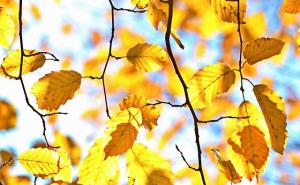
Autumn came this week.
It rolled in on Adrienne’s fourteenth birthday, as I ran back and forth wrapping presents and baking a cake. We still didn’t have a car for running errands. That will be ready Tuesday. Jimmy’s got a chain wrapped around Sacre Bleu’s ruined motor, ready to attach the cherry picker and hoist the old motor out, but the junkyard hasn’t quite finished digging the replacement motor out of the totaled car somebody scrapped. It was a rear end crash, so that motor is in perfect condition. I will be back on the road in less than a week. As it was, on Adrienne’s birthday, I ran to the dollar store for gift wrap on foot. The air was warm and humid, but it smelled like Autumn instead of summer: not of green grass, but of honey and brown sugar. The first of the fallen leaves crackled under my feet. And then it rained.
It rained for days, rinsing the dust of summer away. Jimmy’s boy came to see me in between cloud bursts. He ate Adrienne’s leftover birthday cake, and told me what he’d been learning in school. This month, he learned about the 9/11 terrorist attacks.
I suppose that’s one of the things that happens more and more often when you get older: the things you saw happening live, become things that other people learn about in school.
“Can we watch videos of 9/11?” asked Jimmy’s boy.
He and I sat side by side on the sofa. I went to YouTube and pulled up some fuzzy footage of smoking buildings and chaos on the street. At one moment, the cameraman turned and ran, still filming, the shadow of his camera spread before him on the pavement, as the dust from the first tower overtook Manhattan. The whole world seemed to be running with him. Men and women in their business suits and dresses were running. Sidewalk vendors were running. Policemen were waving their arms, gesturing which way to run.
“There they go! There they go!” said Jimmy’s boy, smiling. To him, it looked like a scene from a movie or a video game and not real life.
“We were all so scared,” I said. “We didn’t know what was happening, or if it would stop. We thought the whole country might be attacked.”
The camera turned for a moment, to show a great black cloud rolling down the street like a living thing. Jimmy’s boy laughed with excitement: again, to him, this was a movie and not real life. He was excited at the sight of the dust cloud, as if it was the appearance of Godzilla.
I pointed to the human beings crouched behind cars, crying. We watched as several people took refuge in a delicatessen. The proprietor slammed the doors, then opened them to admit one more person, then slammed them again. The cloud of dust settled over the street, turning day to night. It didn’t look like a monster anymore. It just looked frightening. Even Jimmy’s boy was quiet, for a moment.
“If I was there,” he said finally, with all the mirth drained out of his voice, “I would be carrying people on my back! I would be carrying the children and… the… the elderly. I would run with the elderly on my back.”
The next video in the playlist was of the cameraman and a local newscaster, very close to the tower’s base: the tower disintegrated starting with the top, and the cameraman was running again. The newscaster yelled at some people to follow him into a parking garage, crying that the cloud was going to “jump over the building.”
Again, Jimmy’s boy laughed as if this was all pretend as the people ran and the cloud appeared. And then, again, he was grave when the cloud of dust found its way into the parking garage, while the people took refuge in an office. Somebody had a mask over his face and somebody else was covering her face with a sweater. The newscaster ran out and found a paramedic, who gave them each a turn on his oxygen. Another paramedic poured bottled water to clear the dust from a woman’s eyes.
“If I was there,” said Jimmy’s boy, “I’d have taken a car. I’d have driven them away in one of those cars! I’d have said ‘stay alive, you guys! We gotta stay alive!’ And I’d drive them away!”
I suppose that one of the ways you find out that an event in your life has become a part of history, is when people stop telling you what they were doing when the disaster happened, and instead tell you what they would have done if they’d been there to save the day.
“What was the most popular building in America?” asked Jimmy’s boy.
“The most popular building? You mean a stadium or a museum?”
“No, I mean the most… the most FAMOUS building.”
I thought for a minute. “The Capitol? Oh! You mean the White House!”
Jimmy’s boy nodded. “The White House.” He began to tell me a garbled version of the story of Flight Ninety-Three, which he’d also learned about in school.
“Yes,” I said, nodding gravely. “That’s right. They didn’t have a chance to save their own lives, but they died fighting the terrorists so that the plane wouldn’t crash into the White House. That made them heroes. When you do everything you can to save somebody else’s life, that makes you a hero.”
Jimmy’s boy bounced off the sofa and ran around the living room, telling me a made-up story about another plane full of heroes and terrorists. This one ended with a brave man steering the plane to the nearest airport and saving the day without a tragedy. I smiled as he finished.
He asked to look at Google Maps next, and I showed him photos of the street view of our houses, now and a few years ago. He was excited to see that some of the street views downtown had pictures from 2020 when he was a baby, and 2018 and 2015 before he was born. My heart twinged just a little as I saw Fourth Street looking the way it had when I came to Steubenville. I used to be so sad here. I used to be so eager to leave. I used to think I’d be out of here in just a little while, and then I despaired.
I can’t have lived in this valley for going on twenty years.
I came here in Autumn of 2006, which was just a little while ago. I had my whole life ahead of me and surely I still do, because I haven’t done anything. Surely, the events that happened just before I came to Steubenville are still recent history.
Later, Jimmy gave me a ride downtown to the church outreach, to read to the children. I told him what his boy and I had been talking about, and of course we lapsed into remembering what we’d been doing on 9/11. That was how I found out that Jimmy and I were the same age. I thought he was much older. He has a grandchild.
The next day, Jimmy’s boy came back. He asked me to take him for a walk.
We walked down the alley to see the asters and goldenrod. We went up the side street to look at the apple trees hanging over a neighbor’s fence. Some of the fruit was ripe on the branches and a lot had rolled all over the pavement, so the whole sidewalk smelled like a cider house. I expressed my usual consternation at anyone who would plant a fruit tree just for the beautiful flowers, and not take advantage of the free food, as Jimmy’s Boy jumped up and helped himself to an apple. Then we walked further, and had a similar conversation about somebody’s pear tree.
We came home and had hot chocolate, and talked some more.
“I’m your nephew, right?” said Jimmy’s boy as he was leaving.
“Of course you are.”
“How young do you have to be to be a nephew?”
“There’s no age limit. You’re my friend’s son, so you’re my nephew. That’s all it takes.”
As he left, I felt old. Things that happened more than twenty years ago really seemed to be more than twenty years away. But I also felt that I was home.
Mary Pezzulo is the author of Meditations on the Way of the Cross, The Sorrows and Joys of Mary, and Stumbling into Grace: How We Meet God in Tiny Works of Mercy.









 Ad-Free & Subscriber Log-In