

I went to Mount Pleasant.
Mount Pleasant is one of those places I’d seen on road signs for the five years I’ve been driving, but I’d never actually visited. It’s off the main road from the Ohio river, always a little too out of the way to be worth a trip. But I wanted to see it, because I’ve heard that practically the whole town is on the Register of Historic Places, so I packed up Sacre Bleu and hit the road.
In order to find Mount Pleasant, I had to get off of Route Seven at the Tiltonsville exit, right near that thousand-year-old burial mound I visit from time to time. Then I went west, away from the river, over the railroad tracks. Up through the farmland, past the library at the end of the world. I thought I lost my way at least three times, and then I emerged at the top of one of the shale hills, where there was a gazebo. Just beyond that was the Quaker Yearly Meetinghouse.
That’s why I wanted to go to Mount Pleasant. The Quakers were the ones who settled here and named the place Mount Pleasant in 1803, the same year that Ohio became a state. They built a Meetinghouse that’s over two hundred years old, and I wanted to see the building and explore the town they lived in. I know next to nothing about the Quakers, liturgically speaking. It certainly sounds nice to go to church on Sunday and just sit quietly instead of having to hear a sermon, which is what these Quakers would have done.
The meetinghouse was a massive rectangle of orange brick, two stories high, comforting in its symmetry. There were two white doors on one side: one for women and one for men. The men and women apparently sat on opposite sides of the building, with the little children up in the loft. It isn’t open this time of year, so I peeked through the window instead of going inside. I could see rows of whitewashed benches facing each other in a square formation. No altar, no pulpit, no tabernacle, just places to sit with that same austere yet comforting geometric symmetry. I wanted to worship in that church. I could imagine myself seated by the window, trying not to stim with my feet or hands, not afraid that the wrong line from a sermon or the wrong hymn played on the organ would give me a panic attack, just afraid I would accidentally squeak the boards of the bench. That would be delightful.
I felt a twinge of grief as I thought about this.
There was a time when I’d have been terrified that I was in sin, if I even pretended about belonging to any other religion but the Catholic Church. And it wasn’t that long ago.
Surely it can’t have been just a few years ago that I started finding out that the religious movement that formed me, not the Catholic Church itself but this loud and officious sect of the Church, was a personality cult led by multiple spiritually and sexually abusive priests. It feels like I’ve been trapped in this long dark night of the soul for a decade or more. Surely the girl who used to go to daily Mass, sometimes twice a day, at Franciscan University, because she loved it, is an entirely different person and not me. I’m terrified of going to Mass. I’m afraid God will hurt me.
The wind blew cold as I walked away from the meetinghouse, down to Union Street.
Union Street is where most of the really old homes are. The narrow road was lined with yet more solid and symmetrical orange brick buildings, built shortly after the construction of that meetinghouse. At least five of them are confirmed to be stations on the Underground Railroad, but many more might have been stations as well. On one end of the street is the Free Goods Store which was built to sell only things that were made or farmed without enslaved labor. Across from the Free Goods Store is the house of Benjamin Lundy, the famous abolitionist who published a newspaper. Quakers opposed slavery. The Quakers of Mount Pleasant worked together to do something about it.
Again, I imagined myself part of that community. I saw myself sweeping around Union Street in a hoop skirt and a calico day dress, thinner and prettier than I actually am. I saw myself buying things at the Free Goods Store and tending the garden outside one of these houses. I’d have conspired with my neighbors to know just what to do, if a person came to me needing a place to hide. I would be a brave and heroic member of a brave and heroic community at a pivotal time in history, fighting injustice.
There was that twinge of grief again.
When I came to Franciscan University, all the way back in 2006, I thought that I was going to be a part of just such a community.
The Catholics of Steubenville had the best reputation. They weren’t lukewarm Christians; they were on fire with the Holy Ghost. I was excited to be one of them. I thought we would all live the Gospel as one body. But it hasn’t been like that. Of course I’ve found friends here. Of course there are plenty of wonderful people in Steubenville who are Catholic; I could name lots and lots. But the Catholic community isn’t an intentional community formed around living the Gospel. It’s a clique, formed around rules I’ve never been able to understand.
Now that I know all that I know: now that Father Mike Scanlan’s mask has been ripped away, and I recognize the Charismatic Renewal as the falsehood it is, you’d expect I wouldn’t care so much that I haven’t found a real community among the Catholics. But it still hurts, badly. It still feels as if God is the one who rejected me.
My soul hurt as I walked back up to the meetinghouse.
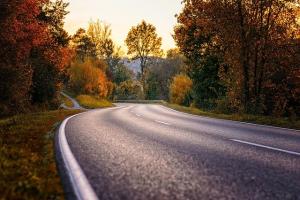
Of course I got lost on the way home. At a certain time of the late afternoon, just before twilight sets in, every country road looks about the same to my astigmatism. I ended up on a narrow black ribbon of pavement twisting past farmhouses further and further away from the Ohio river, never in the direction I expected, never to a place that I recognized. Every time I got to the crest of a hill, expecting to find a town or a business with a parking lot I could turn around in, I found that there wasn’t one. White-tailed deer out feeding for the evening turned their heads to stare at Sacre Bleu, and other than that, I was alone. I must have been almost as far south as Martin’s Ferry when I gave up and made a u-turn in some farmer’s driveway. Eventually, I found Route Seven.
Evening fell in that cold, bright, November way, sending golden rays across the whole sky.
There was no perfect community of pristine rectangular buildings to go home to: only the ragtag community I’ve found, with my neighbors and friends who don’t all believe the same things or worship in the same place, but who have shown God to me.
There was no idealized and picturesque imaginary version of the past to do good in: only the time I happened to be living in, no matter how ugly it is and how much it hurts. Though it didn’t hurt very much, just then.
I couldn’t be an interesting person from some other era in history. I could only be Mary Pezzulo.
No promises, no certainty, no easy answers, just the message of the Gospel and a mysterious, suffering God.
Only this world to find that God in.
Only here.
Only now.
Mary Pezzulo is the author of Meditations on the Way of the Cross, The Sorrows and Joys of Mary, and Stumbling into Grace: How We Meet God in Tiny Works of Mercy.








 Ad-Free & Subscriber Log-In