


I took Jimmy’s boy to the Nutcracker Village, as a Christmas treat.
We stopped at the coffee shop, where Adrienne got a nice grown-up latte and Jimmy’s boy got hot chocolate and marshmallows. Then, of course, we had to rummage through the candy in the treat shop next door. Jimmy’s boy walked out with a stash of gum and lollipops that made my teeth ache just looking at it. We found the perfect Christmas ornament for a present for his mother as we went further on. He kept stuffing the items we bought in my purse until I felt like I was carrying Santa’s sack. The next stop was a tour of the Nativity Museum.
This is a pretty recent addition to the Christmas festivities in Steubenville. There’s a store front near the coffee shop which is opened up in the month before Christmas to display a privately owned collection of Nativity scenes. I’ve never seen so many Nativity scenes in one place. There are creches made of transparent crystal, of seashells, of wood. There are Nativities where each figure is portrayed by a rubber duck or a Charlie Brown character. There’s one that was knitted, one embroidered, one of braided corn husks. There are creche sets from Africa, South America and Asia.
Jimmy’s boy walked reverently next to me as we gazed at the art.
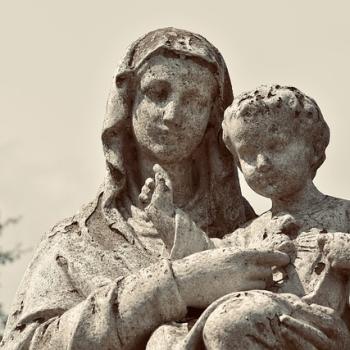
There they were again and again: the glorious Lady conceived without sin. Her husband, the Just Man, a simple carpenter so soft-spoken that nothing he said has been passed down to us. The baby, nearly invisible, a bundle of cloth with a head. A handful of shepherds. Three astrologers. A camel, a donkey, a small flock of sheep, an angel, and a star. There they were, looking like Indigenous Americans, with wise men’s elephant replaced by a buffalo. There they were again, looking like a family from Tanzania, carved out of dark wood. There, looking Caucasian and dressed like European peasants. Their likenesses were braided from rubber bands or modeled out of clay, painted on the sides of wooden boxes, molded from plastic.
Incarnation is such a wondrous thing.
To believe in the Incarnation is to believe that the God Who created all things descended to be part of creation. That Someone Who is beyond time, descended to be a person who lived in a certain time. That Someone Who is everywhere present and filling all things, became someone who lived in a certain place, as part of a certain culture. That a Being in Whose image and likeness everyone is made, became a certain man, with a certain face and body, and a certain life and death. That all of this was accomplished, so that every human life might be taken up into the life of the Holy Trinity.
We, in turn, commemorate the Incarnation by making works of art out of the materials we have at hand, which reflect our own cultures and the times we live in. God made each human in God’s own image and likeness. Then God came to earth to be a specific human in a specific culture. We reflect this mystery back at God, by making diverse pictures of God that look like us.
After the shopping and the museum, we took Jimmy’s boy to Fort Steuben Park. He admired the Christmas tree standing in the middle of the municipal fountain. He laughed at the nutcracker that sings and plays the drums when you feed him a dollar. And then we went on a tour of the reconstructed Fort Steuben itself.
The fort was offering self-guided tours for three dollars each. Adrienne and I showed Jimmy’s boy the muskets and other weapons hanging on the wall in the soldiers’ quarters. We showed him Steubenville where we live and Toronto where his grandmother lives, and Columbus where I come from, on a big elaborate map of Ohio. I pointed out the old-fashioned canoe the soldiers used to get across the Ohio back to West Virginia, and explained that that place used to just be called Virginia. I told him about the Mingo Indians who lived on this spot long before the Europeans came. Jimmy’s boy referred to every historic event as happening “back in the day.” Back in the day, they had to hunt for the meat they ate because there wasn’t a grocery store here. Back in the day, the soldiers had to warm their beds with metal bedwarmers, because there was no furnace. Back in the day, the Mingo lived in the woods and built things out of logs.
It all felt sacred and numinous, in a way I couldn’t articulate at the time.
To believe in the Incarnation, is to believe that everything and everyone in history is sacred.
To profess the Incarnation is to profess that God became Man so that Man might become God, and that means that everything that happens to Man is a godly thing. Every joy a human has is shared by God. Every pain that humans suffer is suffered by God. When we honor one another, we honor God. When we hurt one another, we crucify God. Everything humans see and do and learn and make, is part of the Life of the Holy Trinity.
When the Virgin Mary became pregnant with God, the whole of human history became pregnant with God.
All the earth is a tabernacle, and every letter of history you will ever read is a gospel.
Jimmy’s boy came with us on the rest of our errands: to lunch, to the car wash, to the library. I read Dr. Seuss to him as he played with toy cars in the library’s children’s section, and everything around me shimmered with a supernatural light.
To profess the Incarnation is to profess that the light shines forth in the darkness, and the darkness does not comprehend it, and the Light remains with us even to the end of the age.
I felt that light around me for the rest of the day.
Mary Pezzulo is the author of Meditations on the Way of the Cross, The Sorrows and Joys of Mary, and Stumbling into Grace: How We Meet God in Tiny Works of Mercy.











 Ad-Free & Subscriber Log-In