

If I am just overreacting lately, I’ll be pleased. But I don’t think I am.
If things never get any worse in the United States, but just stay exactly as they are, it’ll be better than I expect. But I think they’ll get worse, and I think they’ll get worse quickly.
I don’t know how it feels to be in a great big city right now. I only know how it feels to be in a small town in a red state, where they mostly leave us alone. For awhile, it felt like the calm before the storm, and now it feels different: as if the clouds are black overhead and the first great big drops are splashing down, slowly, and you keep checking the horizon for a twister.
I said in Spring that it seemed Northern Appalachia was somehow cut off from the rest of the world, and I wondered how long it was last. Now it feels like the world is reeling us in, bit by bit. I don’t notice it every day, but once in awhile. The cost of that great big log of ground beef we buy to slice up and freeze for the month jumped by seven dollars in just a few weeks. Those little jars of seasonings on the endcap of the baking aisle cost a third again as much. I’ve started sighing with relief whenever I see my friends who have been here on a visa for awhile, because I expect a catastrophe any day. Some of the neighbors have finally taken down their TRUMP flags, but the ones who haven’t given up seem angrier.
School starts tomorrow, and I hope Adrienne and Jimmy’s boy will be all right.
This weekend, Jimmy’s boy and I dug up the potatoes.
We got so many this year. I’ve never had a successful potato crop before. This time, I managed to fertilize just enough. Jimmy’s boy and I were digging through the loam in the planters with our fingernails, pulling out spud after spud after spud. Some were red potatoes, and some were purple, and some were Yukon gold. Some were the size of marbles, but many were real potato sized, like the kind you buy in a store. I felt like a success for the first time in my life. I wished I could give up on writing and just be a gardener full time. That’s the world I want to live in. I want to live in Northern Appalachia with the neighbors I love, and help people, and grow food. I don’t want to think about the world outside.
I came in with my potatoes, and watched the video of masked government agents brutalizing a delivery man in Washington, DC. They would not present a badge. They jeered at bystanders who begged them to stop.
“You guys are ruining this country. You know that, right?” demanded the person holding the camera.
“Liberals already ruined it,” taunted the assailant from behind his mask.
There were also videos of National Guardsmen with armored trucks, in front of the Lincoln Memorial. People don’t commit a lot of crimes at the Lincoln Memorial. The dangerous parts of Washington didn’t seem to be getting military patrols, only the telegenic parts. I don’t think anyone really believes they’re doing this because of crime.
I didn’t sleep well that night.
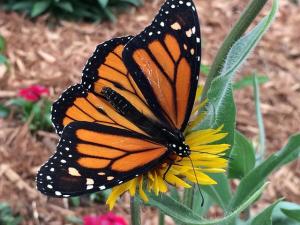
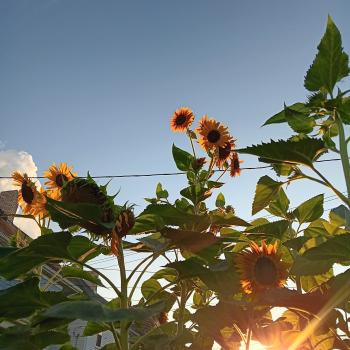
Today, Jimmy’s boy came over to play on the last day before school began. We went out to the backyard and fed the guinea pig dandelions, and again, life seemed to be just what it ought to be. It was the warmest, brightest, gentlest of late summer afternoons. Goldfinches and a cardinal jeered at us from the light pole. The cat stalked moths in the tall grass behind the haunted house. Jimmy’s boy squealed with excitement when a monarch butterfly fluttered up to the sunflowers. This was the fist monarch I had ever seen in the garden. We’ve had swallowtails and white cabbage moths, but never a monarch. I got a photo of him hanging from my red Autumn Beauty sunflower, the prettiest sunflower I’ve grown all year.
The butterfly put Jimmy’s boy in mind of the spotted lanternflies he’d seen on the great big walnut tree in the vacant lot. He asked if I’d remembered to get lanternfly poison.
I got out my atomizer of diatomaceous earth. He led me to the afflicted tree. It’s a great big one that towers over the houses. The trunk was black with scum. The branches dripped sickly sweet honeydew from the invaders. The grass around the tree was dry from the August drought, but the earth under the tree was soaked with the honeydew. And the whole tree was crawling with hundreds of gray invasive pests.
We fought valiantly for twenty minutes. I went around and around the tree trunk, spraying the bugs with a puff of powder. Jimmy’s boy hit them with sticks and stomped where they hit the ground. After awhile he ran and got his father’s ladder, determined to climb to the very top, but I told him it wasn’t safe. It wouldn’t do any good anyway. The boughs of the walnut tree were coated all the way up, thirty feet in the air, crawling with the bugs so you could barely see the bark. There were too many for us. We couldn’t stop the invasion. The tree might be doomed, and they’ll surely spread all over the neighborhood even worse than they are now.
I felt angry and afraid, as if it was a sign.
I came in, and saw more videos of the masked men and the soldiers menacing civilians, here in my home country, which feels as though it’s falling apart.
If it never gets worse than this, it was bad enough already. It was bad enough the way we were before, ten years ago or more, when the current situation sounded like a punchline that could never come true. But things are dire now. I think we’re on the verge of collapse. I hope I’m wrong.
I hope the tree recovers, and the pests disappear, and nothing bad ever happens to anyone again. But I don’t think I’ll be so lucky.
The smell of honeydew hovered in the air, and it was night.
Mary Pezzulo is the author of Meditations on the Way of the Cross, The Sorrows and Joys of Mary, and Stumbling into Grace: How We Meet God in Tiny Works of Mercy.










 Ad-Free & Subscriber Log-In