


I went for a drive, in early November.
It’s soon enough after the end of Daylight Savings that I am still waking up early. I woke up so early I had time for a short hike in between running errands, and I knew my mind wouldn’t pay attention to anything if I didn’t get out in nature. I wanted to go hiking out at the Hellbender Preserve, a beautiful new park with an ugly name down in Bloomingdale, halfway between here and Cadiz. The Hellbender Preserve is named for a type of large salamander that lives there; it’s locally famous for a sandstone bridge commissioned by Abraham Lincoln after he nearly fell off the wooden bridge in that spot, on the way to the inauguration on Valentine’s Day, 1861. There is also a train tunnel, Tunnel Number Eight, which was dug by feuding Irish miners more than ten years before Lincoln got there. The little trail through the park takes you over the bridge and through that tunnel, where it connects with the Great American Rail Trail. I like to wander around there and stand on top of the bridge, or stand at one end of the tunnel and wish I dared walk through it. So I packed up Sacre Bleu, and I drove out into the countryside.
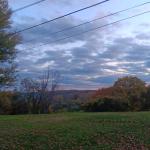
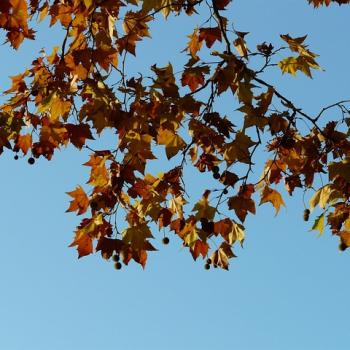
When I was nearly to the Hellbender Preserve, I saw a sign directing me to a Catholic retreat center where families go to dedicate themselves to the Holy Family, further up the road. I’d been told the place was impressive, and I’d wanted to see it for myself. I passed the entrance to the park with the ugly name, and I drove further down beautiful Country Road 36 to find the retreat center. I drove past pristine farms that looked like something out of a storybook, over shale hillsides still on fire with the yellow and orange of Autumn. The sky above was blue. All around me was beauty and light. I felt like I was driving in Heaven, until I got to the place.
I parked and got out to walk around.
Ahead of me was a large brick plaza. In the middle of the plaza was an architectural something-or other whose name I didn’t know: a sort of square gazebo, a canopy made of stone or plaster, a square building with a roof but no walls. On top of the structure was a great big blocky statue of the Holy Family carved from stone: Mary and Joseph, their backs ramrod straight, looking rather like the deities carved into pillars on an Egyptian temple. With her free hand, the Virgin Mary was tapping her stone immaculate heart. With his free hand, Saint Joseph was making the Hand of Benediction, which priests and popes use to bless– even though Saint Joseph was neither a priest nor a pope. Their other hands, Joseph’s left hand and Mary’s right, were both supporting a stern looking toddler Jesus. The Christ Child was sitting on their hands as if they were a platform, both arms extended, ready to fall over. If I saw a real family posing like that, I’d be jumping to catch the baby to prevent a disaster. I’d be yelling at his parents that they were committing child endangerment. I’d scream at them to attend to their child instead of showing off.
I felt all the pain bubbling out of my chest in a moment.
I felt my childhood in the Charismatic Renewal, afraid of everything. I felt the Franciscan University dorm-mates who held my hand and absolutely wouldn’t let me leave the chapel until I said the Louis De Montfort Consecration, even though I was terrified of that line about the Virgin Mary making me suffer without human consolation. I felt them reporting that they’d talked to a priest who said my panic wasn’t psychological but a demonic attack. I felt Father Scanlan, the cult leader and sex predator, holding me to his chest and giving me that kiss on the forehead during deliverance prayer. His protege, the rapist, staring at me when I confessed to him that I couldn’t forgive MY rapist, and making me say a prayer releasing the rapist from culpability. The other priest, the malignant narcissist who yelled at everybody, yelling at me until I cried. Father Scanlan assuring me that I was very close to Jesus.
I remembered the night of the rape itself, in that ridiculous apartment near campus, praying to the Virgin Mary to kill me or black me out so I wouldn’t feel, but of course, she didn’t.
I got back into the car, muttering “never touch me again” at that weird blocky Virgin Mary who didn’t know how to hold a baby.
Back down Country Road 36, playing the most secular music I could find on the radio to drown out all the memories. Past those beautiful farms again. Through those wonderful trees. Far, far away from the stone Holy Family.
I stopped at the Hellbender Preserve, to walk off my anxiety.
The Hellbender Preserve has a great many sycamores, with their bony white fingers jutting up to the blue sky. There is something impossibly grounding about standing at the trunk of a nice old sycamore tree and staring up at the branches, on a cold day in November.
They also have a place called the Ghost Wall, a rocky cliff where Irish immigrants their names as they were working on the railroad tunnel. It’s known as the Ghost Wall because the names of the miners seem to appear and disappear as you look at the rock from different angles in the sun. Two different factions of Irish rail workers, the Fardowners and the Corkians, fought each other in armed riots in the 1850s just on this spot and in many places in and around Steubenville, and some of them died here. It’s been said that some were even buried right on the park’s grounds.
There is a shallow, noisy crick where the salamanders sleep under flat shale rock at the Hellbender Preserve, and the sound of water over shale is mesmerizing.
Over the crick stretches a sandstone bridge, that bridge which was commissioned by Lincoln. I climbed up to it by a series of sandstone steps, carved for a person of Lincoln’s height and not mine, stopping to pant after every oversized step. On top of the bridge, I watched the crick run under me until I couldn’t feel anything at all.
On the other side of the bridge is Tunnel Number Eight.
Tunnel Number Eight is the railroad tunnel those feisty Irish immigrants suffered and died digging out of the rock. It’s the tunnel that Lincoln’s train came through, before they all got out and walked over that railroad bridge, just shy of 165 years ago. The people who made the park covered the rocky floor of the tunnel in soft sand, but they didn’t install any lights. I could see the mouth of the tunnel at the far end, smaller than a dime. I don’t know how long the tunnel is, but it’s long enough to be intimidating.
I’m told it’s haunted, by the ghosts of those rail workers.
I walked right in.
Instantly, it was not only cool but cold. The little bit of breeze that had been tickling those sycamore trees became an irritating wind in the tunnel. I hugged my jacket close to me, but it didn’t help much. The sand muted my steps but something all around me echoed just a bit, and I didn’t like it.
The circle of light behind me was as big as I was, and the circle at the far end was terribly small. I walked forward, and as I did, it grew darker and darker. The circle of light behind me was half as big as I was, and the end of the tunnel was still terribly small. It grew so dark I couldn’t make out the sand at my feet anymore. I was afraid of tripping, because I could barely see at all. That wind was so irritating I felt as if it was winter and not November. That echo was ominous all around. The circle of light behind me was much, much smaller than I, and the one ahead was not much bigger than it had been. And then it grew. The light just ahead was the size of a dime, and then a quarter, and then a silver dollar, as the light behind me shrunk further and further. And then the circle of light at the far end of the tunnel was bigger than I was, and I was stepping out of the tunnel into the gold and blue splendor of a clear day in late Autumn.
The path went on ahead of me with no end in sight, neither reassuring nor frightening, just there. But the world was beautiful, and I wanted to see it. I had gotten through the dark at last.
I left for home, feeling that I had communed with God, though not in the place I’d expected to.
Mary Pezzulo is the author of Meditations on the Way of the Cross, The Sorrows and Joys of Mary, and Stumbling into Grace: How We Meet God in Tiny Works of Mercy.









 Ad-Free & Subscriber Log-In