


I went back to the chapel at the old hospital, to ask for mercy.
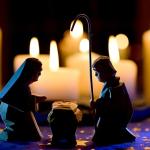
Sometimes I think I’m the only one who prays in that chapel. I’m not, but it must be very sparsely visited. Most days when I sneak in to pray, I find the old Bible that’s set in a corner still open to whatever passage I was reading the last time I was there. Sometimes I find a little bouquet of wildflowers that was left there weeks ago, all dried out in a waterless cup. This time of year there’s a wreath with Advent candles in it, but they don’t look like they’ve been lit. Somebody put a whimsical little Christmas tree with a fluffy lace-clad angel on it in the entryway, next to a stack of prayer cards, but I haven’t seen the pile diminish. All of this makes me feel safe.
I went to the chapel to apologize to Jesus again.
I am, in so many ways, better off than I’ve ever been. But I’d failed, again, at going to confession.
I’ve struggled with panic and anxiety in church ever since a bit before Adrienne was born. I can’t say whether I consciously connected it to Franciscan University all the way back then. It’s all crystal clear now: I spent part of my childhood in the Charismatic Renewal, an intensely abusive religious movement that has nothing to do with Jesus. I ended up at Franciscan University, part of Father Mike Scanlan’s personality cult, and was emotionally and spiritually tortured. I experienced shunning. I was bawled out and humiliated at by a priest who went on to emotionally abuse many others. In the university’s Christ the King Chapel, I went to confession to two different sex abusers, one of whom forced me to forgive my rapist with a weird long dramatic prayer he made up. I had another sex abuser, Scanlan himself, give me “deliverance prayer” to make imaginary demons go away when I should have been getting help for the autism and childhood trauma. I was groomed with kisses and other inappropriate touch during deliverance prayer, though it took years to realize I was groomed. I mourned for Scanlan when he died, and now I admit the truth to myself. I am far, far, far from the worst case, but the only story I know is my own. I can only talk about myself. And I am traumatized.
I couldn’t even go to Mass for much of 2023 and 2024. The panic was so bad that I would sit outside the church building and pray in my car. Lately, I can go to Mass. I even sit in the congregation. It isn’t easy. I still cringe when I walk past the Franciscan sisters in their three-knot belts, and I suppose I always will. But I get through, and I am glad to be able to go to Mass again.
I had a harebrained plan to try to go to confession, as a Christmas present to myself and to Jesus. I’d planned to write out my confession on an index card and just hand it to the priest in the confessional, since I still panic and choke and can’t speak if I’m alone with a priest. I thought maybe that would work. But I couldn’t stop thinking about what might go wrong. I thought of all the terrible things a priest might do or say to me in that dark little box. What if he hurt me so severely that I was traumatized all over again, and had to go back to sitting in the car during Mass? Would Jesus really want that? I fought, but I couldn’t make myself go.
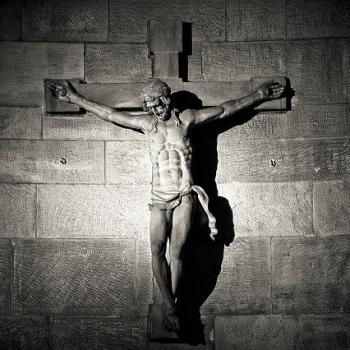
I’d been on my knees, but I swiveled around and sat on the carpet with my legs tucked under me, stimming with both hands as I do when I’m anxious. Ten years ago, when I took four-year-old Adrienne to see the mall Santa, she’d declined to sit on his lap and sat on the floor at his feet in just this posture, to ask him for a dump truck and blocks. Now I was sitting at Jesus’s feet, in the last days before Christmas, to ask for patience and mercy.
Why would a God of mercy institute a sacrament so terrible? Then again, is it really the God of mercy who did?
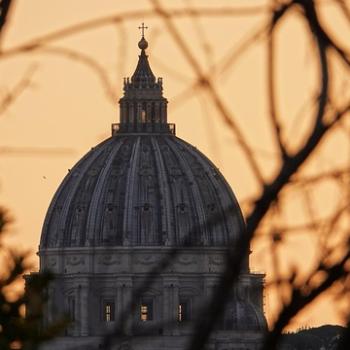
I’m not asking if confession is really a sacrament. I’m asking what confession would look like, if priests were who they ought to be. In fact, I’d like to know what the Church would look like, if everyone in it was who we ought to be, because we all ought to be in persona Christi for each other in one way or another. The Church as the Barque of Peter, and not some pirate ship piloted by fools who like to throw people overboard. The Church as a hospital for sinners, where they don’t give sociopaths the scalpel and let them pretend to be surgeons. The Church as a mother who shouldn’t have social services called to take the children away. I’ve seen glimpses of that church sometimes, but I haven’t terribly often. A religion, unmarred by human sin, is something hard to imagine.
This is the problem of the Catholic Church: it’s made of humans. All religions are made of humans.
I’m not saying they’re not willed by God, but God doesn’t need a religion. Religions are for knowing and communing with God. God knows Godself perfectly, and communes with Godself eternally. The name of that communion is the Holy Trinity. It’s humans who need a religion. You will never, ever, ever see a pure religion apart from the humans who practice it. Religion is always embodied, enculturated and inculturated; acted out, performed, and muddled by people. There isn’t any other kind of religion. You can’t say “abusers aren’t the Church,” because they are a part of the Church. They may be a cancer on the Church, but they’re the Church. The Church is her people. There isn’t any other Church than the Church made of people. Some of those people are monsters.
The Church is also me, and you, and every other human who is baptized by water or blood or desire. We don’t know exactly how far the Church extends, because the Church extends as far as the mercy of God. The story of every human life is meant to be a hagiography. Mine is, and so is yours. We are all the Church. My only clue as to what I’m supposed to do, is to be myself. And that is fortunate because I can’t possibly be anyone else. But it’s also terrible, because I can’t do what I’m supposed to do, due to somebody else’s sin. That is excruciating.
I had no one to be in persona Christi for me just then, so I talked to Christ by myself.
I asked Him to please give me more time to heal, and to be patient with me.
Patience, after all, is one of those things that Advent is about.
I will be back to the chapel again soon.
Mary Pezzulo is the author of Meditations on the Way of the Cross, The Sorrows and Joys of Mary, and Stumbling into Grace: How We Meet God in Tiny Works of Mercy.










 Ad-Free & Subscriber Log-In