

I went for a hike with Adrienne, and Jimmy’s boy.
We went to Frankfort Mineral Spring, to the waterfall and the shale rock cave where I once felt so certain I was going to hell. I didn’t feel as if I was going to hell now. I felt as if I was in Heaven. Adrienne and Jimmy’s boy also seemed to think they were in Heaven. We climbed up the hill and through those magnificent pines, marveling at everything, happy, joking with one another, so glad that winter was behind us and all of spring and summer lay ahead.
When we got to the waterfall, I warned Jimmy’s boy that he’d have a cold ride home if he got too wet. But of course, he didn’t listen. He dipped his head under that natural stone font where I once made the Sign of the Cross, giving his hair a thorough wash. He clamored around the rocks of the grotto, calling every dent in the stones a fossil he’d discovered. He danced in the spray of the waterfall until he was soaked and streaked with red clay. I just sat there, happy to be alive, drinking in the sunshine.
“All right,” I said at last. “Let’s get going! I’ll take us to the lake beach next, to dip our toes in the water. Then we’ll go to the playground before we have to get home!”
Adrienne sprinted ahead joyfully, so that she could hide behind a tree far around the bend and surprise us. Jimmy’s boy walked slower than ever, pointing out every deep pool of water that would make a wonderful swimming spot come summer. He enjoyed looking down the mouth of a hollow log to see the moss inside. He had great fun hopping on the stepping stones at the shallow place in the crick. When we got to the wooden bridge towards the bend in the trail, he laid down on his stomach to look for a crawfish– and, to my astonishment, he actually found one. I hadn’t seen a crawfish in that crick, not once.
Jimmy’s boy found a stick. He reached it down into the noisy water to pet the red crustacean and watch it scoot backwards, just as my cousins and I used to do. I thought he was going to go headfirst over the side, but he’s far more dexterous than I have ever been. He petted the crawfish, got up, and we walked on.
Meanwhile, Adrienne kept sneaking further ahead.
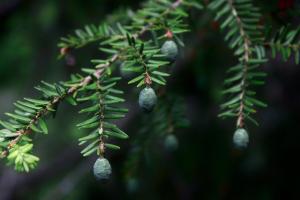
Jimmy’s boy and I were under the hemlock trees a little further on, looking for Adrienne, when we heard the siren.
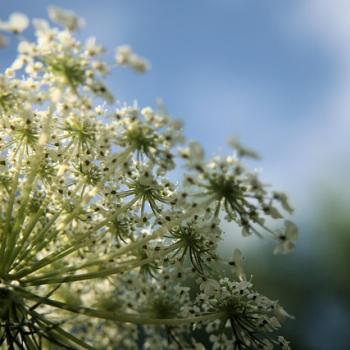
I was explaining to Jimmy’s boy that the hemlock PLANT, a white flower that looks like Queen Anne’s Lace, was deadly poisonous and he must never touch it– but that this type of hemlock, the evergreen tree called a hemlock, was harmless. Yes, he could touch and smell the sap. Yes, he could pick up some cones to look at. I would teach him how to identify the poison hemlock when we got home to my computer. The park rangers would never allow a poison hemlock to grow close to the trail. Jimmy’s boy was picking up cones and branches, pointing out to me how the roots of the hemlocks made natural stair steps on this part of the hill. And then we both heard a bone-chilling electrical wail, from somewhere near.
I would have thought it was a tornado warning, if it had been cloudy, but there wasn’t a cloud in the sky.
Jimmy’s boy voiced my other fear. “It’s a nuclear war!”
Even though there was absolutely no chance of this, my heart shot into my throat. I have always been terrified of nuclear war. Reading or thinking too much about nuclear war has frightened me into nightmares more than once. I don’t even like to look at pictures of the mushroom clouds. When I studied films in an attempt to finish my master’s thesis when Adrienne was a baby, I loved every single Stanley Kubrick movie except Doctor Strangelove which I couldn’t watch at all. I’ve frightened myself into panic by watching scenes from Fail Safe and Threads. When I taught the children at the church outreach about the bombings of Hiroshima and Nagasaki, I made myself anxious just by showing them photos of the destroyed statues in Urukami cathedral. I never, ever, ever want to think about a nuclear war.
I lifted my eyes to the sky between the hemlock branches, half expecting to see the mushroom cloud, but of course there was nothing.
“It couldn’t possibly be a nuclear war,” I insisted.
“That sound means it’s a nuclear war!” Jimmy’s boy was genuinely worried.
“It could be any other kind of attack, or a tornado, for that matter. They use the exact same alarm. But it’s not. I promise. If there was a nuclear war, we’d know.”
“How would we know?”
“There’d be a shockwave and…. look, we’re close enough to the road to have wifi. I’ll check my phone. If there’s a nuclear war, I’ll get a text alert.”
Of course I wouldn’t get a text alert if, for some reason, a nuclear bomb went off in the vicinity of Raccoon Creek State Park. And, of course, I wouldn’t NEED a text alert to tell me if there was actually a bombing nearby. The whole idea was ludicrous. But I checked my phone anyway.
The only news alert on my phone was notifying me that Rob Mueller passed away.
An ambulance screamed up the road by the trail on the other side of the crick just then, headed to the ranger station.
“There!” I said, putting the phone back in my pocket. “You see? There hasn’t been a nuclear war. Somebody just got hurt and rang the alarm at the ranger station. Come on, let’s go find Adrienne.”
Jimmy’s boy looked a little nervous. He and I had gotten into arguments about wars, lately. Of course, he’s an eight-year-old, and he likes to think and pretend about violence and explosives, and of course that terrifies me. The last time he mentioned the war in Iran, I told him about the school for little girls that had been blown up. I asked what he’d feel like if that was his school. And then he and I had started brainstorming imaginary, fanciful nonlethal weapons for war– bombs that made sleeping gas or giant nets to catch the enemy alive.
This time, he looked up at me and said “I like LEARNING about bombs. I like learning about the explosions they make. I think they’re cool. I like the shape of them.”
“The shape? You mean the mushroom cloud?”
He nodded happily as we hiked forward again.
It was perfectly natural that Jimmy’s boy would be fascinated by bombs. I didn’t have a right to expect otherwise.
It was equally natural that I, an elder Millennial with a handful of memories of the end of the Cold War, raised in an apocalyptic religious sect, would be terrified by the same topic.
Adrienne surprised us at just that moment, and we said no more about bombings that day.
Down at the beach, the sun was brilliant. The air was warm as summer, though the water still felt like ice. Jimmy’s boy made friends with another child who had brought his shovel and pail while I watched a gull soaring low over the lake’s surface. She dove down and up again, ruthless, searching for prey.
I no longer felt as if I was in Heaven. I was standing on a planet that seemed to be hell bent on hurtling itself into extinction.
It took me until I was forty for me to find good friends and learn to like my life. And now, when I was not yet forty-two, the earth was crumbling around me, and my country was at war again. We are always at war, but this time it feels so different. It feels like the end of the world.
All I want is for life to be normal, for everyone I love.
If, by any sacrifice, I could make my friends happy and safe, I would. If I could create a world for us where wars and bombings were just imaginary things for children to play about, I would pay any price to do so. I would give my life a thousand times over, if no one ever had to feel this fear.
The gull skimmed across the water to the opposite shore, and disappeared.
And it was evening, and we went home.
Mary Pezzulo is the author of Meditations on the Way of the Cross, The Sorrows and Joys of Mary, and Stumbling into Grace: How We Meet God in Tiny Works of Mercy.










 Ad-Free & Subscriber Log-In