


There are several ways in which the term “revelation” can be used, even within a theological framework. However, at a fundamental level, revelation refers to the transcendent Creator of the universe making Himself known to human beings. Revelation also forms the foundation of the biblical message: God has made Himself known and has interacted with His creation throughout human history.
From a Catholic perspective, this message reaches its climax in the belief that God became human in the person of Jesus of Nazareth. But is the biblical message unique in human history, and does it apply to all peoples at all times and places?
This essay examines the uniqueness and universality of the Catholic and biblical message.
Is The Biblical Message Really Unique?
Depending on the source, it is estimated that humans have worshipped at least 18,000 different gods throughout human history. While there is no agreed-upon number, it is likely that more than 20,000 books have been considered sacred by various cultures.
In asking whether the biblical revelation is unique, one is asking how and in what way it differs from other religious claims. Complicating matters, Judaism and Catholicism do not share a consistent message. Here, too, however, the fundamental difference is revelation.
Both Judaism and Catholicism assert that God has revealed Himself to humanity. They differ in the extent and type of that revelation. Specifically, Catholicism holds that revelation is personal and incarnational (God becoming man), whereas Judaism holds that revelation remains centered on the Covenant and the Law (Torah). Still, one has to ask whether, in light of these facts, it is coherent to speak of the biblical message being unique and universal.
To answer that question requires that another question be answered first: what is the biblical message(s)?
What Is The Message Of The Bible?
A very concise answer to what the biblical message might be is that God became a human being so that human beings might become participants again in the life of God, an ontological state lost due to the effects of original sin. As the Son of God, Christ reveals God’s redemptive plan to humanity. As such, Catholicism holds that Christ is the ultimate source of what is to be believed about God. Said differently, Christ represents the fullness of divine revelation.
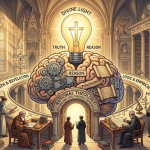
Broadly speaking, there are two ways, intertwined and unseparable though they are, that divine revelation is made present: Sacred Tradition and Sacred Scripture.
Generally, Sacred Tradition refers to beliefs, doctrines, customs, ethical and moral standards, and cultural values and attitudes transmitted orally or by personal example and teaching. Catholic theology holds that Sacred Tradition consists of the stories and teachings that the apostles passed on orally through their preaching. Sacred Tradition, more technically, also means, within this transmitted revelation, that part of God’s revealed word is not contained in Sacred Scripture.
Sacred Scripture is the inspired word of God, the collection of sacred books that hand on the truth of revelation in written form. The Bible, as the fruit of Sacred Tradition, is a collection of writings recognized by the Catholic Church as inspired by God, though written by human beings.
Above all, both the Old and New Testaments share the same religious purpose and the same inspired character. They form the two parts of a great organic whole, the center of which is the person and mission of Christ. The biblical message, therefore, is that God has fulfilled his saving plan to free humanity from the chains of sin. This plan includes the words, teachings, and deeds of Christ, in particular his Passion, death, and Resurrection.
The correct human response to God’s mission of salvation is faith, baptism, and a life of discipleship within the body of Christ, which is the Catholic Church.
Unique And Universal
Accepting then what the biblical message is, one can adequately address whether that message is both unique and universal.
While easily overlooked, within the broader horizon of theology, the belief in a single, transcendent God (monotheism) has historically been the minority theological position. In contrast to the gods of the ancient world, the God of the Bible is one and stands over/above creation. (Deuteronomy 6:4-5; Mark 12:29-30).
Additionally, the 18,000 gods referred to above lack the historicity of the biblical God. That is, the biblical message insists that God has entered into linear, documented history (e.g., “under Pontius Pilate”), a claim not made by the various pagan and polytheistic faiths. This point, while not entirely excluding other faith traditions, does make the biblical narrative unusual.
Ultimately, however, the uniqueness and universality of the biblical message reside in revelation, specifically, that the completely transcendent God and Creator of the universe has made Himself known to humanity. Moreover, the biblical revelation is considered unique in its specific, redemptive focus on Jesus Christ and its authoritative, inspired content.
Catholic theology recognizes two types of divine revelation: general and special revelation. General revelation is a posteriori (by experience and observation) in that it refers to the truths about God that can be known through nature. Objective moral claims and an ordered and contingent universe are examples of general revelation.
Special revelation refers to specific truths about God known through the supernatural. Unlike general revelation, special revelation is the numinous, direct, and historical unveiling of God’s redemptive plan, culminating in Jesus Christ. Knowledge of the Holy Trinity and the Resurrection of Christ is considered special revelation.
Additionally, the two forms of revelation serve different purposes. General revelation serves as a foundation for knowledge of God and is available to everyone at all times and in all places. It makes God’s existence known but has no specific soteriological influence. Special revelation, as evidenced by Scripture, is intended for global proclamation, making it universal in scope and application. Moreover, special revelation provides the specific message necessary for salvation.
Because the Bible makes special revelation known to all (here we can allude to the universality of the biblical message), Scripture is considered final, sufficient, and authoritative.
So, while the biblical message is unique in its claims about the one God entering human history to bring about salvation, it is also universal in its proclamation (intended for all people) and in its reliance on general revelation accessible to all. Together, these aspects form a complete, non-repeating message.
Finally, the universality of the biblical message is made clear by the text itself, “Go, therefore, and make disciples of all nations, baptizing them in the name of the Father, and of the Son, and of the holy Spirit, teaching them to observe all that I have commanded you.” (Matthew 28:18-20).
Conclusion
Human beings are naturally religious. Unfortunately, a consequence of this inclination has led man to mistake the created for the Creator far too often. In turn, this error has led human beings to devise numerous religions that worship countless deities. All of this makes the question of whether the biblical message is both unique and universal of utmost importance.
In this paper, I have suggested that the message of the Bible, as understood and promulgated by the Catholic Church, is indeed unique in its meaning and universal in its import.










 Ad-Free & Subscriber Log-In