

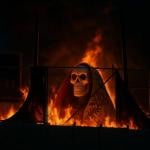
In the heart of Torre Annunziata (Naples), amidst the shadows of the Vesuvian cemeteries, endures a story where faith, mystery, and ritual converge. Maria la Sposa (“Maria the Bride”), often called the “Neapolitan Santa Muerte,” is a fascinating and controversial figure who has survived both time and ecclesiastical prohibition to remain alive in collective memory.
The cult traces back to a tragedy on December 29, 1939, when a train from Reggio Calabria crashed at the Torre Annunziata station, killing many passengers. Among the dead, legend tells of a newlywed couple traveling on their honeymoon. Their bodies, never claimed by relatives, were buried in the cemetery’s common grave.
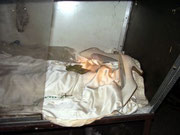
In the following years, a local merchant—later remembered as the “Apostle of the Bride”—reported a vision of the young woman in bridal dress, who guided him to her skeleton. With the help of local women, he recovered the remains and placed them in a glass case, adorned in a wedding gown, gloves, and crown.
By 1944, the parish priest Don Felice Scafa noted that the skeleton, dressed as a bride and displayed “standing” in the ossuary, had already drawn popular devotion. Soon, flowers, candles, ex-votos, coins, and banknotes filled the shrine, as devotees sought protection, healing, and good fortune in love and marriage.
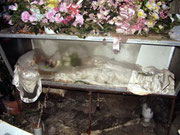
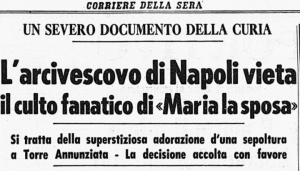
During the 1950s and 1960s, Salvatore Cirillo—believed to have been favored by Maria—commissioned a permanent glass case, elevating her from relic to symbol of hope, purity, and devotion in Vesuvian culture. Yet in 1968 the Curia of Nola formally banned the cult, condemning it as idolatry. Despite the prohibition, veneration continued discreetly and still persists today through private rituals, offerings, and pilgrimages.
Over time, numerous legends enriched her aura:
- Protector of lovers: those who left offerings at her shrine were said to receive blessings in marriage or romance.
- Miraculous signs: witnesses reported mysterious lights or movements in the case at night.
- Secret rituals: before the ban, pilgrims lit candles and prayed for favors or cures.
- Dream visions: some devotees claimed Maria appeared in dreams to guide or protect them.
Though compared to Mexico’s Santa Muerte, Maria la Sposa remains uniquely rooted in Neapolitan and Campanian traditions, blending memory of the dead, popular piety, and bridal symbolism. She embodies the hope of love and protection within the stark image of death, creating an unexpected religious syncretism.
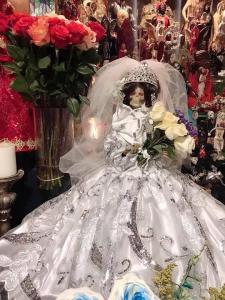
Ultimately, Maria la Sposa stands as one of Campania’s most intriguing figures of vernacular faith. Between myth and reality, prohibition and devotion, she continues to represent the enduring tension between life and death, memory and hope. Her story will be explored further in the forthcoming book “Devoti Violenti.”
Guest contributor, Luciano Martucci, is an Italian anthropologist and ethnographer who studies shamanism, folk healing, traditional medicine, and religion in Latin America. He is the author of El Gauchito Gil, de bandido a Santo and “Yo soy del San”: El culto a San La Muerte, and the forthcoming “Devoti Violenti.” Follow him on Facebook and Instagram.











 Ad-Free & Subscriber Log-In