

Guest writer: Pilgrim
The Loss of Faith from Humanae Vitae to Amoris Laetitia
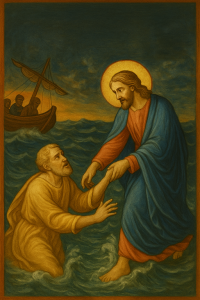
So Peter got out of the boat, started walking on the water, and came toward Jesus. But when he noticed the strong wind, he became frightened, and beginning to sink, he cried out, “Lord, save me!” Jesus immediately reached out his hand and caught him, saying to him, “You of little faith, why did you doubt?” (Matthew 14:30-31)
Introduction: The Boat, Battered by Waves
The boat, battered by the waves, was far from the land, for the wind was against them.
When Amoris Laetitia (AL) appeared in 2016, it came with the kind of fanfare reserved for epochal turns. The press framed it as a victory for mercy over law, of inclusion over rigidity. In truth, it was neither, and it was both. It marked a moment of capitulation born of exhaustion.
This was a time when our Church stopped believing grace was strong enough to convert. By ‘Church,’ I mean primarily the Church in Western Europe, North America, and similar societies where cultural Christianity has collapsed.
Some will read what follows as a failure to understand pastoral complexity, grace and mercy. It is not. The question is not whether accompaniment matters. It does. But mercy must be radical without being sacramentally indiscriminate.
Part One: The Church Chose Retreat
When he noticed the strong wind, he became frightened
The Choice
The seeds of AL were planted in a papal resignation. When Benedict XVI stepped aside in February 2013, citing age and weariness, he made visible the Church’s exhaustion.
His resignation was an act of realism. He had seen the “filth”: the abuse, the curial corruption, the rot that went deeper than individual sins.
He understood what needed to be done: confront the abuse crisis, root out corruption, maintain doctrinal clarity, and resist accommodation to the world.
But at 85, frail and depleted, he stepped aside.
The Cardinals who gathered that March faced a choice. The Church needed reform, clarity and direction. They knew this. They had watched Benedict. They had seen what it cost him. But they lacked the unity to pursue such a course.
They elected Francis.
Exhaustion and conflict tend toward avoidance. The Church leadership was weak, too divided. So, in 2013, their ecclesial instinct was respite.
Having watched the storms batter Peter’s boat for so long, they chose a truce.
Understanding Francis’s Pastoral Vision
The Church didn’t choose Francis despite his approach. He was chosen because of it. His biography and his rhetoric pointed toward mercy-over-law, accompaniment-over-judgment, and flexibility-over-rigidity.
Three months into his pontificate, Francis was asked about rumors of a ‘gay lobby’ in the Vatican. His response, attempting to distinguish between orientation and conduct, between individuals seeking God and organized lobbying, included the phrase: “If someone is gay and seeks the Lord with goodwill, who am I to judge?”
The world applauded. The sentence became a slogan for what Francis never fully intended: that pastoral mercy means suspending moral judgment. This pattern would repeat throughout his pontificate. Every attempt at pastoral nuance, ‘field hospital,’ ‘accompaniment,’ warnings against ‘rigidity’ was received as permission for accommodation by some and an assault on doctrine by others.
The Cardinals chose “Who am I to judge?” because they wanted that posture. They chose the bishop who spoke of ‘field hospitals’ because they no longer believed they could hold the line. They chose the man who would emphasise accompaniment because they were too weary to call anyone toward anything too demanding. And when a Church uncertain of grace’s transforming power elects a pope whose emphasis is accompaniment over destination, the result will be confusion, not renewal.
Some will say Francis’s emphasis on mercy is the Gospel, that the Church had become too obsessed with rules, with boundaries and needed to recover Christ’s radical openness. Yet, this fails to account for what happens when mercy is proclaimed without repentance and when accompaniment lacks a destination,.
Francis was not the cause of the coming storm. He was its manifestation; a mirror of our collective weariness, our doubt that grace could still sustain us. The Church was like Peter in that moment when the wind first struck; already doubting, already sinking. She could not elect someone who would stand firm because she questioned whether it was possible. This was a choice. Not inevitable. Chosen.
And this appeasement would be whispered three years later in a small footnote, in the most analyzed sentence of the pontificate.
Part Two: Was Amoris Laetitia Inevitable?
Beginning to sink, he cried out, ‘Lord, save me!’
By 2016, one great wound had opened, and from it three crises flowed. Not the abuse crisis, though that was devastating; not demographic collapse, though that was real; and not cultural rejection, though that was fierce.
The deep wound was pneumatological; doubt that the Holy Spirit and grace were strong enough to sustain the demands the Gospel makes.
The Deepest Wound: Little Faith
The Church has always asked “too much” by worldly standards. Chastity. Lifelong fidelity. Continence outside a sacramental marriage. Openness to life. Self-gift. The Cross. These demands are impossible by human strength alone.
The Church has always proclaimed that grace makes the impossible possible, that the Holy Spirit transforms, that holiness is attainable because God is faithful. Large parts of the Church no longer fully believed this. And so, AL emphasized “gradualness” without naming the goal, and invoked “accompaniment” without naming its destination.
AL presented the Church’s moral teaching as ideas to be approached gradually, but perhaps never quite reached. It treated sacramental discipline as something to be loosened for those who might find it too difficult. It portrayed grace as something that accepts rather than transforms human weakness.
Is this mercy? Compassion untethered from conversion becomes permission to remain where you are? It becomes, in the end, a failure of faith in the very grace the Church exists to proclaim and in the power of her sacraments.
AL’s greatest failure was not doctrinal; it was a loss of confidence in the Holy Spirit’s power to sanctify, to heal, to make whole.
The Credibility Crisis
By 2016, the Catholic Church had lost the moral authority to speak about sexuality and the body because its witness had collapsed.
The abuse crisis did not just harm victims, though that was catastrophic. It destroyed the Church’s standing to speak about sex and sacramental discipline. How does a Church invoke “objective contradiction” in irregular unions when her bishops lived in monstrous contradiction by protecting predators? How does she demand continence when she harbored men who violated the most vulnerable?
She cannot. Not credibly. Not without first facing what she had done and had failed to do.
The Church not only protected abusers. She was weakened intellectually. Dissenting theologians attacked her doctrines with impunity, saying these could change, teaching seminarians that conscience could override truth, that no act was intrinsically evil if circumstances suggested otherwise. This counter-theology formed many of the priests and bishops who, when confronted with abuse, could not see evil clearly or act decisively. Benedict saw this connection and he knew how deep the rot had gone.
And here some will say: but this is why the Church needed Francis’s emphasis on mercy for the faithful. It means more listening, more humility, more accompaniment of the wounded; less ‘clericalism.’ But there is a muddle here. Mercy does not mean doctrinal ambiguity. Humility about the Church’s sins does not mean uncertainty about her teachings. The answer is both clarity about truth and profound compassion for those struggling to live it. Instead, AL offered studied imprecision.
The Church that lost credibility was not only the Church that protected abusers. Decades earlier, she had practised a harsh, fear-driven Catholicism. scrupulous confession, obsession with sexual sins, while structural injustices were ignored. This created real wounds that drove many away and provoked heterodoxy, even heresy, in others.
Francis’s warnings against ‘rigidity,’ his insistence that ‘the confessional is not a torture chamber,’ his critique of ‘promethean neo-Pelagianism,’ responded to pathologies from an earlier era. The Church had treated confession as interrogation, had magnified sins of the flesh while overlooking sins of exploitation and power.
Francis was fighting yesterday’s flaws. By 2016, the threat wasn’t excessive rigidity, it was laxity. The younger generations seeking the sacraments hadn’t experienced harsh confessionals, they’d experienced barely any formation at all. They didn’t need liberation from scrupulosity. They needed to hear that the Church’s teachings were true, binding, and livable by grace.
The early Church offered accompaniment more than the modern Church: longer catechumenates, public penance that could last years, and the possibility of reconciliation even after grave sin. There was one thing they never compromised: access to the Eucharist required being in a state of grace and objective conformity with the Gospel. The early Church would exclude people from Communion for years while accompanying them toward reconciliation. They understood that mercy can be radical without being sacramentally indiscriminate, and you can walk with someone toward holiness without pretending they’ve already arrived.
To a Church bleeding from permissiveness, Francis prescribed medicine for a disease she no longer had. His warnings against rigidity were heard not by those clinging too tightly to law, but by those searching for boundaries. The faithful who asked, “Does the Church still believe what she teaches?” were labelled ‘rigid.’ The bishops, trying to maintain discipline, were warned against ‘Pharisaism.’
The response to cruel rigidity is not ambiguous permissiveness. In escaping one ditch, the Church fell into another.
When you can no longer command, you offer to walk alongside. When judgment seems impossible, you discern. And when you can’t bring yourself to demand too much, you suggest. AL’s shift in tone from law to mercy, from judgment to accompaniment, from clarity to discernment, was the sound of a Church trying to speak without the moral authority truth requires.
And when leadership comes from uncertainty, it slips into appeasement, perhaps reasoning it is mercy’s gentler form. But appeasement never satisfies. It emboldens further demands.
The Humanae Vitae Precedent
There is a line that runs from Humanae Vitae (HV) in 1968 to AL in 2016. It is not a line of doctrinal development. It is one of pastoral retreat.
HV was prophetic. It predicted with uncanny accuracy the consequences of severing the unitive from the procreative in marital love: the objectification of women, the trivialization of sex, the collapse of marriage, the normalization of abortion. Every prediction came true, and more.
But the Church lost. Not theologically, the teaching remains intact. But pastorally, culturally, practically, the Church lost.
Western Catholics rejected HV en masse. By the 1980s, many Catholic couples were using contraception at rates similar to their secular neighbors. Preaching and pastoral insistence had largely fallen silent. Confessors stopped asking. Bishops stopped enforcing. The teaching existed on paper but had ceased to exist in practice.
And here is where the logic turns fatal. If Catholics can use contraception, grave matter, intrinsically evil, and still receive Communion, on what principled basis do you exclude the divorced and remarried?
The answer is: you cannot.
Once the Church conceded, tacitly, through silence, that grave matter in the sexual realm does not exclude someone from the Eucharist, the entire structure of sacramental discipline began to wobble.
AL did not introduce a new principle. It extended explicitly, institutionally, the principle that was already operating implicitly. The document’s footnote 351 is less a rupture than a revelation. It made visible what had already been happening for decades.
The tragedy of HV is not that it was wrong; it’s that the Church failed to form Catholics to live it, failed to defend it when her theologians attacked it, and failed to uphold it when her own people abandoned it. Having faltered in these areas, the Church found herself unable to defend sacramental boundaries without appearing arbitrary.
The Cultural Rout and the Panic
By 2016, the Church was being routed. Same-sex marriage was legalised, gender ideology ascending, cohabitation and divorce normalised, and abortion accepted as a fundamental right.
And Catholics? They weren’t resisting. They were participating.
Catholics cohabited before marriage and divorced at similar rates to non-Catholics. They used contraception at equivalent rates. They supported same-sex marriage in growing numbers. They voted for abortion access. The distinction between ‘Catholic’ and ‘secular’ had become statistical noise. The Church saw her members living as if her teachings did not exist. Yet they still showed up. They still wanted their children baptized, their marriages blessed, and their funerals said.
They wanted the Church, just not her teachings.
And beneath this, something more primal developed: fear. The demographic collapse of Western Catholicism was undeniable. Mass attendance plummeted. Seminaries emptied. Parishes closed. The young were leaving. This bred a quiet panic, a fear that if we demanded too much, we would drive away the few who remained.
The hemorrhaging had other causes too: the abuse scandals, poor catechesis, cultural irrelevance, and the Church’s entanglement with politics. Her response: softening demands and an emphasis on accompaniment. She had come to believe the problem was the cost of discipleship, not her failure to form disciples who could bear the cost.
In facing the storm, the Church’s gaze drifted from Christ, and she began to sink.
Part Three: The Church Chose Ambiguity
Jesus immediately reached out his hand
Given the state of the Church in 2013, was AL inevitable? Or was it simply the path of least resistance?
The document emerged from synodality, two synods, extensive consultation, and listening to ‘the faithful.’ Selected bishops and laity gathered, debated, discerned, and what did the synodal process produce? A teaching on Christian marriage that was overshadowed by a footnote.
AL hovered between ‘Yes’ and ‘No’ to sin, presenting an imprecision that allowed divergent readings all the while maintaining papal reserve.
Here, the limits of synodality become clear. A Church uncertain of grace’s power struggles to discern, because discernment requires agreeing on a destination and trusting the journey. When you no longer agree that the goal is attainable or desirable, all that synodality can produce is negotiation between truth and error.
The Church still faced a choice. She could have spoken plainly. Reaffirmed her teachings, accepted smaller numbers, trusted that grace is strong enough, showed priests how they might accompany the divorced and remarried with compassion towards continence, using the tools that already existed: spiritual direction, the confessional, gradual formation in conscience.
Or she could have confessed plainly that she was attempting something new. An explicit penitential path for those in irregular unions, acknowledging that certain cases require suspending norms. Bold, controversial? Maybe even impossible. But clear.
AL danced between both options, neither reaffirming nor reforming. It left bishops to “apply” principles never quite defined, to “discern” according to criteria never quite specified. It gave discretion to local bishops and priests to set suspend teachings in individual cases.
The result was not pastoral freedom but pastoral chaos. Germany moved in one direction, Poland another. San Diego one way, Philadelphia another. The same text, opposite outcomes.
Why choose ambiguity? Because it seemed to offer a way through the storm. It allowed the Church to speak of mercy without abandoning doctrine, to compromise without explicitly changing teaching.
Now, some will object. This is not a retreat but a development; the Church is growing in understanding of conscience, discernment, and the complexities of irregular situations. Some of this is true, the modern Church is not the early Church. But they forget that genuine development clarifies and deepens. It makes explicit what is implicit in the faith. AL produced confusion, not a deeper understanding.
Ambiguity is not neutral. It has a gravitational pull. It invites interpretations that stretch toward what was never quite said but never quite denied.
Thus, what began as a pastoral document became a theological shibboleth; its reading depended on which faction you belonged to. This is what appeasement produces: a compromise that satisfies no one, emboldens those who seek more, and demoralizes or angers those who believe the line should be held.
Part Four: The Price of Doubt
You of little faith, why did you doubt?
Now the costs are clear, and they cut to the bone: geographic relativism, confusion about whether teachings are negotiable, demoralisation among those who have made heroic sacrifices to live the Church’s teachings, emboldening of those seeking further accommodation using the logic of discernment, and, most devastating, a loss of confidence that the Church speaks with divine authority about anything.
If the teachings on marriage and sexuality can be set aside through “pastoral discernment,” why should anyone trust that other teachings are immutable? When sacramental discipline varies by diocese, catholicity itself fractures.
And so, what began as an attempt at peace became an uneasy appeasement. The concessions that was meant to preserve what remains threatened to undermine everything.
We remember: “God uses crooked sticks to draw straight lines.” The Church that emerges from our time may be smaller, more faithful, more trusting.
Conclusion: The Wind Ceased
Take heart, it is I; do not be afraid.
Amoris Laetitia was not the moment of capitulation. It was the moment when decades of retreat became visible, codified, and institutionalized. Beneath its many causes, secularization, abuse, failed catechesis, and leadership failures, lay a loss of faith that grace could do what we claim grace does.
Peter began to sink not because the wind was too strong, but because he doubted. He took his eyes off the One who called him. The Church is sinking for the same reason: not because the storm is too fierce, but because we doubted.
When the Church loses faith in grace’s power, she needs the one who stands in Peter’s place to call her back to trust. To insist that the impossible journey is sustained by Christ’s hand. She needs the one in Peter’s place to say: ”He is in the boat beside us.”
Our answer requires only that we look again at the One who walks on water, who reaches out His hand to catch us when we begin to sink and cry, “Lord, save me.”
Clarity and charity are not enemies. Doctrine and tenderness are not rivals. Discipline without love is cruelty, and mercy without conversion is abandonment of the very person we claim to love.
The Gospel needs no footnote.
It needs faith, renewed saints, witnesses willing to walk on water with their eyes fixed on Christ, knowing that when we begin to sink, His hand reaches out, for He is the One who catches us.
References
Pope Francis, Amoris Laetitia (2016)
Pope Paul VI, Humanae Vitae (1968)
Thank you!
Read The Latin Right’s other writing here.
Please visit my Facebook page and IM your questions (and follow my page) or topics for articles you would like covered.














 Ad-Free & Subscriber Log-In