

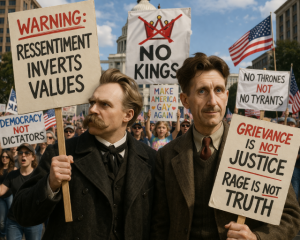
Do you hate rich people? Do you smile at protest signs that read, “Eat the Rich”? Recently, demonstrators displayed such signs—and others like them—at “No Kings” protests in cities across the United States. Participants gathered to express outrage at Donald Trump and his policies.
Yet consider the irony. In a country supposedly ruled by a “king” or “dictator,” these protesters exercised their constitutional rights freely. They spoke, assembled, and protested what they perceived as abuses of power, oppression, and identity. One sign, held by a young child, read: “Make America Gay Again.”
These protests did more than express political disagreement. They advanced a moralized narrative that replaces principled reasoning with anger rooted in grievance and directed toward power. Friedrich Nietzsche called this kind of reaction ressentiment. George Orwell later showed in 1984 how regimes can harness such grievance to secure and maintain control.
Nietzsche and Orwell issue a shared warning: when moral language flows from reaction rather than truth, it does not remain critique for long—it becomes a means of control.
Nietzsche: The Psychology of Ressentiment Applied
In On the Genealogy of Morals, Friedrich Nietzsche defines ressentiment as:
- A reaction of the powerless
- Internalized hostility
- An inversion of values (strength becomes evil; weakness becomes good)
Ressentiment does not merely oppose—it redefines moral categories themselves.
When we apply this framework to the contemporary context, several patterns emerge. First, a growing suspicion of hierarchy, merit, and excellence. Second, the moralization of inequality. Third, the elevation of victimhood as a source of moral authority.
To be clear, justice and injustice are real. But justice evaluates actions, while ressentiment reacts to persons or groups.
Orwell: When Moral Language Becomes System
One of the most influential critiques of totalitarianism in the twentieth century appears in the dystopian novel 1984 by George Orwell. In 1984, Orwell introduces the totalitarian regime of “Big Brother” and shows how it controls the populace through fear, resentment, and the manipulation of truth through language. Through this work, terms like newspeak and doublethink entered the political vocabulary. What Friedrich Nietzsche diagnosed, Orwell dramatized under conditions of power.
In the novel, Big Brother manufactures resentment through a ritual called the “Two Minutes Hate.” During this ritual, citizens direct their outrage toward Emmanuel Goldstein, the Party’s designated enemy. For two minutes, everyone must shout, curse, and vent hatred. In this way, the regime transforms hatred into a kind of civic sacrament. Big Brother names the enemy, directs the anger, and secures loyalty.
Big Brother also constrains thought through newspeak. Under this system, language no longer describes reality—it pre-structures it. The regime reinforces this control through doublethink, which requires citizens to accept contradictions as truth: “war is peace,” “freedom is slavery,” and “ignorance is strength.” Finally, the Party does not train citizens to reason; it trains them to feel correctly. It replaces persuasion with emotional alignment.
Case Study: “No Kings” and the Power of Moral Framing
Now let us evaluate the “No Kings” protests through the lenses provided by Friedrich Nietzsche (moral inversion) and George Orwell (the institutionalization of that inversion). The protests displayed a nationwide surge of shared moral energy. The slogan “No Kings” functions as moral framing, not a literal claim. It encodes ideas such as tyranny and illegitimate authority. In this way, language begins to interpret reality before argument even begins.
The protests also brought together diverse grievances—war, economics, and immigration—under a single moral narrative. This convergence compresses complexity into symbolic opposition.
The Nietzschean question must be asked: does this represent principled resistance to injustice, or reactive moral opposition to perceived power?
Protests like “No Kings” risk becoming Orwellian when moral language grows simplified, emotionally charged, and collectively reinforced—when persuasion gives way to moral conditioning.
To be clear, protest is a legitimate democratic act, and many participants act from sincere moral concern. The concern here is not protest itself, but the structure of the moral language that drives it.
Justice vs Ressentiment: A Diagnostic Framework
Let us return to the distinction between justice and ressentiment, because some readers may need further clarification. Ressentiment begins as a reaction. It focuses on groups, engages in selective outrage, and draws its energy from grievance. Justice, by contrast, begins from principle. It evaluates actions, applies standards consistently, and orders itself toward truth.
Justice provides a stable framework; ressentiment shifts with power dynamics.
Final Thoughts… The Battle for Moral Language
We do not face a choice between ignoring injustice and embracing grievance. We face a deeper question: what governs our moral language? If justice governs it, our judgments remain principled, consistent, and ordered toward truth. If ressentiment governs it, our judgments become reactive, selective, and easily manipulated.
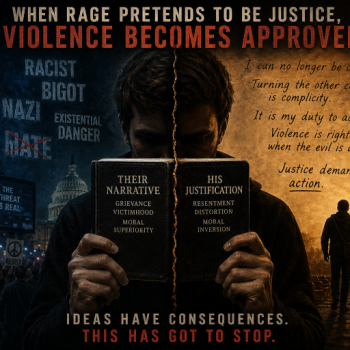
Friedrich Nietzsche exposes how easily moral categories collapse when they arise from reaction rather than truth. George Orwell shows what follows when power seizes that collapse and enforces it through language. What begins as grievance does not stay contained—it hardens into a system that no longer argues, but conditions through rage.
Catholics must reject this outright. The Church does not borrow her moral vision from grievance, identity, or political fashion—she receives it from truth. Catholics who speak of “hating the rich” or joke about “eating them” are not speaking prophetically; they are echoing the very ressentiment that corrodes moral judgment. Rage is not justice. It is its counterfeit.
In the end, this is not merely a political dispute. It is a battle over whether moral language will remain anchored in truth—or be weaponized by resentment and enforced by power.
Thank you!
Read The Latin Right’s other writing here.
Please visit my Facebook page and IM your questions (and follow my page) or topics for articles you would like covered.















 Ad-Free & Subscriber Log-In