

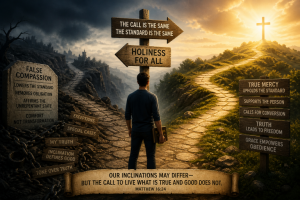
Do all Catholics, regardless of their personal struggles and life situations, deserve access to the truth and the good the Church offers? I think so. Yet many Catholics seem to disagree. They suggest that some people should not fully live—or even fully receive—the truth and the good the Church proclaims when doing so becomes difficult.
Consider how this often plays out. A heterosexual married couple may find it easier to follow the Church’s moral teaching on sexuality, so no one questions their obligation to live it. But when others—such as those who identify as homosexual or transgender—face greater difficulty, the expectation quietly shifts. The assumption becomes that God permits an exception, that He allows them to opt out.
But where does the Church teach such exceptions? Nowhere.
The Church consistently teaches that if something is true and ordered to our good, difficulty—even deep-seated inclination—does not cancel the call to live it.
God offers the true and the good to everyone.
Moral Truth Is Universal, Not Situational
The Church consistently teaches that truth—including moral truth—is objective. As Veritatis Splendor makes clear, moral truth does not bend to circumstance, inclination, or difficulty. If something is truly good, it binds all of us—precisely because it leads to our fulfillment, not our comfort.
…circumstances or intentions can never transform an act intrinsically evil by virtue of its object into an act ‘subjectively’ good or defensible as a choice… an intention is good when it aims at the true good of the person in view of his ultimate end. But acts whose object is ‘not capable of being ordered’ to God and ‘unworthy of the human person’ always and in every case conflict with that good.
Conversely, when we treat circumstance, inclination, or difficulty as grounds to relativize moral teaching—making it bind only those for whom it appears easy—we strip that teaching of its force. A moral teaching that binds only those for whom it is easy is no moral teaching at all.
Difficulty Explains Struggle—Not Exemption
To clarify, difficulty explains why something is hard; it does not remove the obligation. God calls all of us to holiness—no exceptions.
Consider alcoholism. A person struggling with addiction faces a real and lasting condition, along with powerful cravings. Yet sobriety remains the good. We do not redefine drunkenness simply because avoiding it proves difficult.
The same principle applies to overeating, or gluttony. Some studies suggest that, like alcoholism, overeating can involve genetic, psychological, and habitual factors. Even so, the good—temperance—remains binding despite the difficulty.
Many who suffer from these conditions point out that they did not choose their desires. That may be true. But desire does not determine moral judgment. Actions still fall under moral evaluation.
We are not morally obligated to desire the right things—we are obligated to choose the right things.
Culpability vs. Moral Truth
At this point, some may argue that habit, pressure, and weakness reduce culpability. The Catechism of the Catholic Church acknowledges this. It teaches that habit and deeply rooted tendencies can lessen a person’s responsibility. But it also draws a firm line: these factors affect responsibility, not moral truth.
As the Catechism states, “Imputability and responsibility… can be diminished… by… habit…” (CCC 1735). Yet the moral character of the act itself does not change.
Consider the alcoholic who relapses. The addiction may lessen culpability in a particular instance, but drunkenness remains sinful. A diminished responsibility to resist a wrong does not turn the wrong into a right. Reduced culpability does not remove the call to conversion and repentance.
If we reject this distinction, the consequences become severe. If reduced culpability redefines morality, then entrenched vice would justify itself over time.
Answering “God Made Them This Way”
Another common move reframes creation itself. Some argue that a person should not fall under the Church’s moral obligations because God made them in a way that exempts them. This claim remains highly speculative—and the Church does not support it.
Even when an inclination runs deep and persists over a lifetime, acting on it does not become permissible. The Catechism of the Catholic Church addresses this directly in paragraphs 2358 and 2359:
The number of men and women who have deep-seated homosexual tendencies is not negligible. This inclination, which is objectively disordered, constitutes for most of them a trial… Homosexual persons are called to chastity. By the virtues of self-mastery that teach them inner freedom, at times by the support of disinterested friendship, by prayer and sacramental grace, they can and should gradually and resolutely approach Christian perfection.
Furthermore, we do not tell a person prone to anger that anger is therefore good; instead, we call him to greater self-mastery. In short, inclination explains the struggle. It does not define the good.
True Mercy vs. False Compassion
We must distinguish between true mercy and false compassion. False compassion begins with good intentions but leads to spiritual harm. It lowers the standard, removes obligation, and affirms an unrepentant state. True mercy does the opposite: it upholds the standard, supports the person, and calls for conversion.
This is the truth we must remember: Christ does not lower the call—He strengthens us to meet it.
Tone vs. Truth: When “Being a Jerk” Becomes the Argument
Let’s now address tone policing. This tactic often appears when arguments fail to justify exceptions or carveouts. Instead of engaging the reasoning, a person shifts the focus and attacks the speaker.
Christians can present the truth poorly, and such failures can create unnecessary obstacles. But we must not treat uncharitable delivery as a refutation of the teaching itself. A failure in charity belongs to the speaker, not to the truth.
At that point, the question quietly shifts from “Is this true?” to “Does this feel harsh?” Once that shift occurs, discomfort begins to replace truth as the standard.
As stated earlier, a moral law that applies to some but not others is not a moral law at all.
Finally, true charity helps others live the truth—it does not hide it.
Final Thoughts… The Universality of the Call
To avoid confusion, I will restate a few key points. The Church recognizes that the pursuit of the true and the good involves varying degrees of difficulty for sincere Catholics. Inclinations may differ. Culpability may vary. The call to holiness does not.
Difficulty does not rewrite the moral law—it reveals how much we need grace to live it. A Church that adjusts truth to match human weakness offers comfort, not transformation. A Church that proclaims the truth, even when it is hard, offers something greater: the possibility of real freedom.
Whether the struggle involves alcohol, food, anger, or sexuality, the principle remains:
our inclinations may differ—but the call to live what is true and good does not.
Thank you!
Read The Latin Right’s other writing here.
Please visit my Facebook page and IM your questions (and follow my page) or topics for articles you would like covered.









 Ad-Free & Subscriber Log-In