

While wasps may cause me harm, they also have a legitimate function in the larger world of nature, a function often hidden to us humans, limited as we are in our perspective about the world we inhabit—and often destroy—mindless to the larger repercussions.
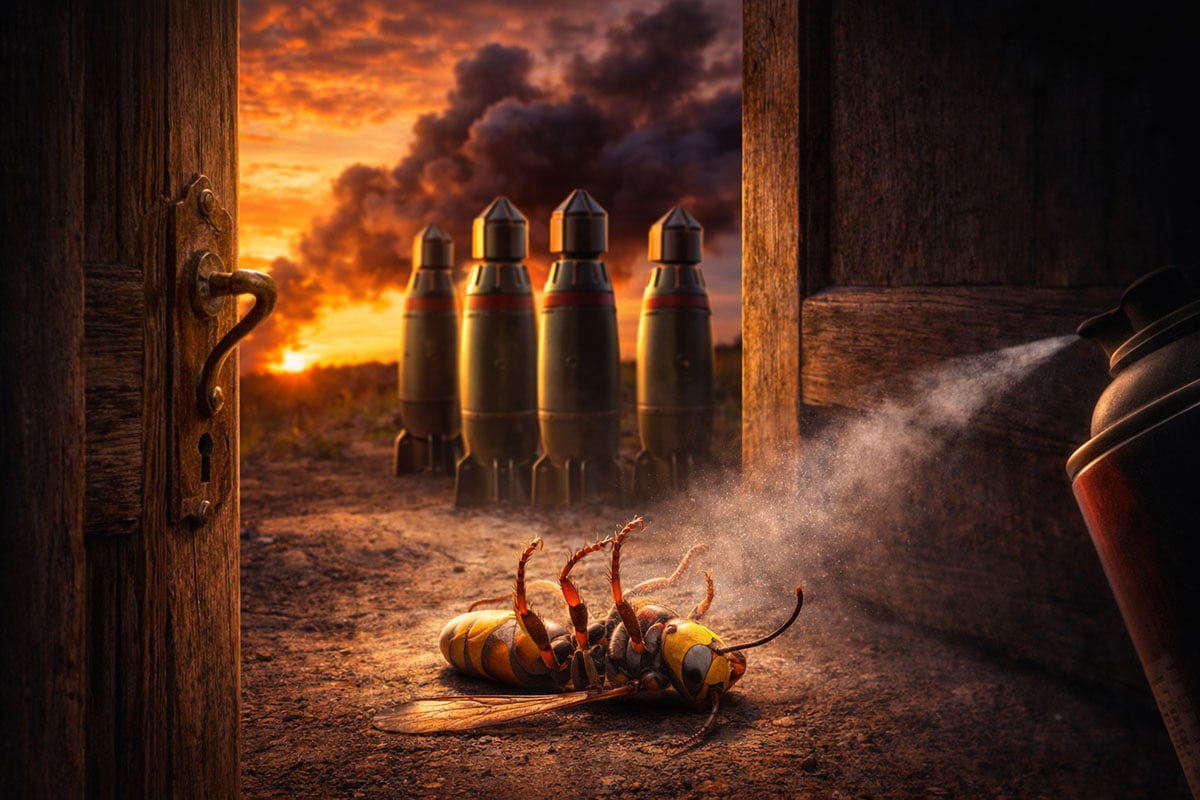
So far this spring, well armed with a can of some horrifically noxious-smelling, lethal substance, I have killed multiple red paper wasps.
I’ve honed the technique to perfection: I see a wasp flitting around, grab the can, carefully follow it (likely a her, the queen, at this time of the year) around, knowing the wasp will fairly soon come to rest on something, and then . . . within seconds, it is writhing on the ground in a fit of whatever wasp-agony feels like.
Every once in a while, the wandering insect will lead me to a nest, and thus I commit waspicide many times over.
Yes, a sense of relief fills me. So does guilt. I am, rightly, terrified of a wasp sting—one got to me last year, and my arm was swollen and painful for three weeks, plus I’m prone to anaphylaxis, a genuinely scary and life-threatening reaction.
And yet . . .
No wasps directly attacked me. Ever.
I’m also aware that not one of the wasps I murdered had directly attacked me. These ferocious stinging creatures are beneficial to the environment, especially for the many Peggy Martin Roses that I have all over my yard. In addition, the wasps and their larvae are food for other living organisms such as cardinals, starlings, woodpeckers, praying mantises, dragonflies, and some mammals.
In other words, while these wasps may cause me harm, they also have a legitimate function in the larger world of nature, a function often hidden to us humans, limited as we are in our perspective about the world we inhabit—and often destroy—mindless to the larger repercussions.
Could this be the never-ending challenge of being human with evolutionarily unusual destructive abilities? That we consistently carry and too often act on the temptation to use whatever power we may have, or hope we have, to destroy anything we imagine might threaten us?
Here’s the problem: the ingrained fear of anything different, anything that might make us face our hubris that our way, and only our way, matters; anything that might prove us wrong with long-held beliefs.
This recent Wall Street Journal article about increased enforcement of “right-think” in China serves as a powerful and sad metaphor for the human condition.
A revealing snippet from the article:
The new law adopted by China’s rubber-stamp legislature on Thursday mandates the Communist Party to ensure the country’s 55 officially recognized ethnic minorities embrace a common language and culture centered on the country’s Han Chinese majority. It cements Xi’s reversal of decades-old ethnic policies that had tolerated more expressions of diversity.
The law on “promoting ethnic unity and progress” prescribes efforts to build a “shared spiritual home” for all ethnic groups. This includes the use of standard Chinese as the primary language in schools and public settings, and programs to promote official narratives on history, ethnicity and religion, according to the adopted text published by state media.
The law also requires parents and guardians to teach minors to love the Communist Party and the motherland. It authorizes the imposition of legal penalties on officials and institutions that neglect their duties to foster national unity, as well as on people deemed to have sown ethnic discord or engaged in separatist acts.
Echoes of anti-diversity efforts in the US
Many echoes here of the anti-diversity effort that has taken over much of the US, where it has become increasingly mandatory that no views differing from the “usual” worm their way into the ears and brains of those who currently hold power.
Uniformity takes on the highest value; differing ideas or ways of seeing the world, economics, politics, religion, or society mean exclusion, even expulsion. Echo chambers grow into desired commodities; comfort without challenge explodes in desirability.
Yes, it’s easier. I’ve lived in that world—my many years in the far-right niche of evangelicalism where the slightest deviation from the “absolutely true doctrines of the faith” earned an eternal seat at the shunned table. In other words, disagree and face elimination. I paid the price—“heresy is mine, saith the Christy.”
But I do ask: is it healthy to live without diversity: diversity of species, of climate, of cultures, of opinions? In the long run, it was far healthier for me, but my experience is not necessarily universal.

What is threatening? How do we decide?
How do we decide when an opinion or action “may” be threatening to our very existence? When is the first strike the most legitimate choice? What about the harm that such a first strike causes to the innocent? How does one measure and manage the collateral damage?
How much is too much? Who makes those decisions? Who advises them? What kind of expertise do they have? What hidden agendas lurk behind their words? What passion for power, legitimate or illegitimate, undergirds the whisperings, the subtle nudges in one direction or another?
Any student of history knows that the most destructive of wars has been precipitated by the most petty of reasons. And yes, sometimes those wars are necessary; sometimes the wasps must die—maybe.
But I still ask, as I sit in my moral dilemma—why is my life worth more than the wasp’s, especially when it has not directly attacked me?
Would love some thoughts from others here.















 Ad-Free & Subscriber Log-In