


The tagline for Guillermo del Toro’s Frankenstein reads, “Only a monster would play God.”
From the time Mary Shelley first brought life to the mad doctor and his creation, Frankenstein has been filled with spiritual themes. In the 1931 film Frankenstein, the doctor exalts, “Now I know what it feels like to be God!” In the 1935 sequel The Bride of Frankenstein, the monster himself becomes a broken Christ-like figure—eating bread and wine in a metaphorical last supper before being tied in a crucifix-like pose. (In a deleted scene, a confused monster tries to pull a statue of Christ off a cross.)
Netflix’s Frankenstein plays with those themes—sometimes amplifying them, sometimes diminishing them, all to drive home del Toro’s purpose. He suggests that Frankenstein’s creation is better than his creator. Better than, perhaps, humankind itself.
And that takes us into some interesting theological territory.
The Sins of the Father …
The story introduces us to Victor Frankenstein when he’s just a teen, growing up with a loving mother and struggling against his tyrannical father—perhaps Europe’s most famous surgeon. When Victor’s mother dies, something cracks in the already morose lad, and he becomes determined to vanquish death itself.
In Edinburgh, Victor unveils his ambitions in the form of a corpse—or rather part of a corpse—given a semblance of life. He tells the assembled doctors and students that he aims to correct “God’s mistake.” He indeed is playing God—but for now, it’s only play. The secret to true re-animation eludes him until he meets Henrich Harlander, a wealthy arms merchant who not only promises Victor unlimited funds to chase his goal, but points him in the direction on how to meet it.
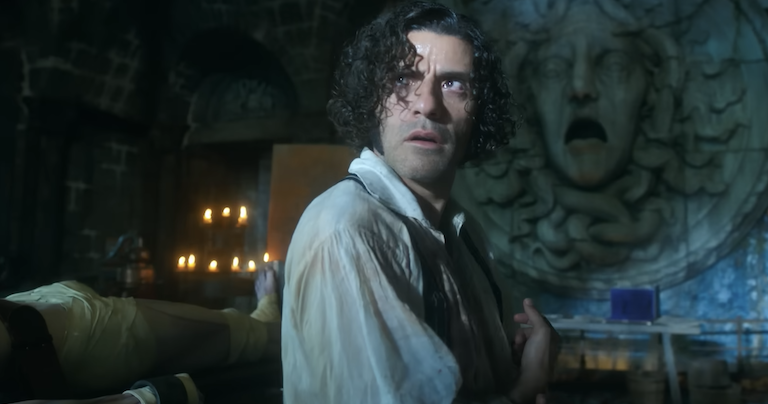
I love what del Toro does with Frankenstein’s castle: From the outside, it looks like a grotesque parody of a Gothic church, looking heavy and dark. The castle’s massive spire shoots skyward, as if in mimicry of the Tower of Babel—reaching unwisely toward heaven. Inside, the corrupted church motif continues: The laboratory has, for some reason, a hole in the center of the floor—as if it’s an entrance to hell itself. A relief of Medusa hangs on the wall, a representation of a great beauty turned monstrous.
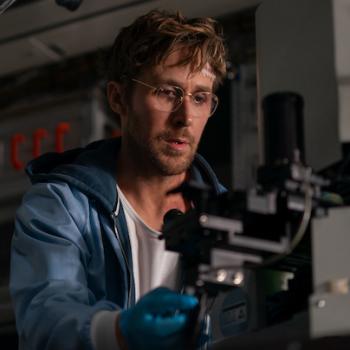
And then there’s Victor Frankenstein himself, filled with hubris and rage. When Mary Shelley wrote Frankenstein, she made tons of allusions to John Milton’s Paradise Lost. And in her eyes, it would seem, Frankenstein feels a lot like Milton’s Satan in all the character’s quasi-heroic, prideful glory. I just wrote about how Doctor Frankenstein, not the creature, is the real monster in the 1931 movie. And in del Toro’s 2025 version, Victor’s monstrous nature is on full display.
But how is his creature so good?
A Blameless Son?
For Shelley, Frankenstein’s creation was a tragic figure. “I ought to be thy Adam,” the monster tells his creator in the book, again pulling from Paradise Lost. “But I am rather a fallen angel, whom thou drivest from joy for no misdeed.”
The creature has a point—but let’s not kid ourselves. The monster has committed plenty of misdeeds by then. He may say he’s not really to blame for them, but isn’t that what we all say? And the book and subsequent movies play with the monster’s spiritual dichotomy: He’s both angel and devil, a gentle soul and a raging fire. And sometimes his own innocence gets into trouble—as when he throws a little girl into a lake in the 1931 movie, believing she’ll float like a flower.
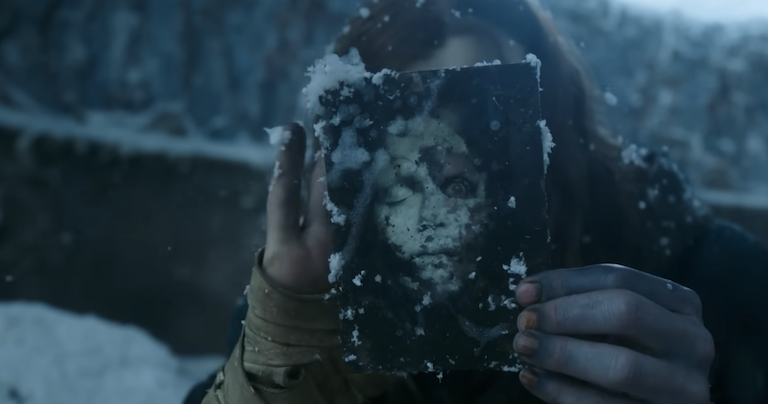
But in del Toro’s tale, the creature (no real monster here) takes on an even more saintly aura. He’d never throw a little girl into a lake, because his inborn innocence would somehow prevent him from doing so. While Shelley’s depiction of the monster stressed his spiritual dichotomy—his perfect teeth and glossy hair paired with yellow skin and abhorrent appearance—del Toro turns the creature into something like a god. He looks a little different, sure. But he’s built like Michelangelo’s David in all its marbled, muscular glory. It’s incredibly gentle when given the chance. And, oh by the way, he’s apparently immortal.
And according to Elizabeth—a love interest for both Victor and his creation—the creature was created untainted by Original Sin—that is, the predilection for disobedience that was triggered by Adam and Eve in the Garden of Eden. (Another nice gesture to Paradise Lost.) If everyone would’ve just left Frankenstein alone, he’d be the kindest, most gentle guy you’d ever meet.
Here, I think, del Toro lets his love of the outsider (and his own agnostic suspicion of Christianity) get the better of the story. There’s no monster in the creature, and that undercuts the story’s dissonance and, thus, robs it of some of its power.
Consider our own status as creations: We are beloved products of a perfect God, graced with free will that we misused (and misuse). We know that we, as creations, can never surpass the Creator. Victor Frankenstein felt that he could correct God’s mistakes—and that made him the real monster.
And yet, Victor’s own creation … somehow was better than his creator? Not just physically, but spiritually, too?
I’m not sure if that flies. When we play a game of telephone, we know the message grows ever-more garbled. We know that when we seek to manually copy a manuscript, errors are bound to find their way in. How could it not be the same when a person tries to copy another person? How can a creator as imperfect and as morally compromised as Victor Frankenstein give life to a being without sin and with spiritual wisdom?
Guillermo del Toro is a talented director, and Frankenstein may indeed be one of his finest creations (albeit, if you read my Plugged In review, full of plenty of problems). But it only gets the theology half right. We’re all lost without a Savior. Without Christ, we’re all monsters.











 Ad-Free & Subscriber Log-In