


What follows is the first in a series of reflections on one of the most challenging passages in the Gospels:
Jesus said, “I came to bring fire to the earth, and how I wish it were already kindled! I have a baptism with which to be baptized, and what stress I am under until it is completed! Do you think that I have come to bring peace to the earth? No, I tell you, but rather division! From now on five in one household will be divided, three against two and two against three; they will be divided:
father against son
and son against father,mother against daughter
and daughter against mother,mother-in-law against her daughter-in-law
and daughter-in-law against mother-in-law.”He also said to the crowds, “When you see a cloud rising in the west, you immediately say, `It is going to rain’; and so it happens. And when you see the south wind blowing, you say, `There will be scorching heat’; and it happens. You hypocrites! You know how to interpret the appearance of earth and sky, but why do you not know how to interpret the present time?”
(Luke 12.49-56, NRSV)
“I came to bring fire to the earth, and how I wish it were already kindled!…Do you think that I have come to bring peace to the earth? No, I tell you, but rather division! From now on five in one household will be divided, three against two and two against three; they will be divided…”
So, there it is. The end to so much nonsense over the millennia:
Jesus meek and mild.
Jesus never judged anyone.
Jesus doesn’t care what you believe.
The God of the Old Testament is all about judgment, the God of the New Testament is all about love.
Oh, and speaking of love, that’s all you need. Thank you, St. John Lennon.
The only way that some interpreters of the Gospels have been able to get around passages like this one is to suggest that the church put these words in the mouth of Jesus.
But then you are forced to cut out his talk about teachers of the law being white-washed tombs. You are forced to slide over the cleansing of the Temple. You are forced to cut the passage in which Jesus grieved the fact that the rich young ruler turned away — but he didn’t chase him down. And, pretty soon, you realize that talking about Jesus by cutting all the judgment out of his teaching is like talking about Wyatt Earp without dealing with the fact that he was a gunfighter.
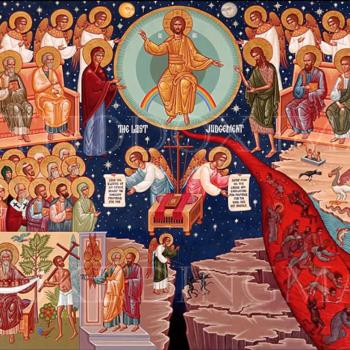
So that approach doesn’t really work. But, then, what do we do with Judging Jesus?
First of all, we need to shed the moral and spiritual dishonesty of the sixties, the theme of which was this: Judgment is always just for the hell of it. Something meant to drive people into a guilty stupor and coerce a religious decision from them. Spoiler alert: It’s not.
Judgment in the Old Testament and in the New is about consequences. It’s about the intrinsic connection between bad choices and bad results. And anyone who is remotely honest with themselves is aware that when we do what we know is wrong — or if we act in ways that are incongruent with the truth — there are consequences. Maybe not right away. Maybe not overnight. But, sooner, or later there are consequences.
This is why Jesus refers to the practical knowledge that his listeners act upon when they scan the horizon. They know when rain and scorching heat are coming. The causes aren’t obscure. But when it comes to spiritual discernment, they pretend that they don’t know what is coming.
But we do, don’t we. As quaint as it may seem, over two centuries ago Ralph Waldo Emerson observed something we know to be true, even though we act as if we don’t:
Sow a Thought and you Reap an Action; Sow an Act and you Reap a Habit; Sow a Habit and you Reap a Character; Sow a Character and you Reap a Destiny.
It is not only silly, it is morally dangerous to suggest that reality is otherwise. And it is damnably dangerous to suggest that God can’t possibly be just or good, unless he just sets that all that Judging Jesus to the side.
The truth is, that without consequences, moral obligations mean nothing. Without consequences, there is no justice. Choosing the good is meaningless. And without consequences, reality itself is lawless and chaotic.
To suggest that God or Jesus should not be concerned with judgment, then, is grossly misleading. No God worth believing in pats us on the back when we are cruel, vicious, dissembling, or violent and says, “There, there, that’s ok.”
If you don’t believe that, ask someone whose child was killed by a drunk driver. Ask a victim of rape. Ask a person whose adulthood has been scarred by an abusive parent or a sexual predator. Ask someone who lives in a war zone.
Judgment is not just for the hell of it. Judgment is not about making us feel bad or about avoiding punishment by a capricious God. Judgment is about finding a place to stand in a world that is just, in a world where ignoring justice has consequences.
Ironically, judgment as a consequence of our alienation from God and one another, is also the predicate of what we most need from God and from one another. What the popular spirituality of the sixties refused to acknowledge is that if there is no such thing as sin, then there is no reason for forgiveness, mercy, and restoration.
God didn’t bring us to that point in order to rescue us. But the message that God is with us assumes that we needed him. Without that assumption, there is no reason for Jesus to enter into our lives or bring us out into the light. No point in talking about forgiveness — needed or given. No need to talk about salvation. After all, if we are not under judgment, then what does Christ save us from?
As I’ve said elsewhere before: The Gospel is good news in a broken world. It is not fake news that the world isn’t broken. And to argue we are not under judgment is to traffic in fake news, and the popularity of that falsehood goes a long way to explain why we can have so much and continue to be so unhappy.
Acknowledging the legitimacy of Jesus’ judgment, then, is not about making us feel bad. It is the first step to freedom.












 Ad-Free & Subscriber Log-In