


What follows is the third and final in a series of reflections on one of the most challenging passages in the Gospels:
Jesus said, “I came to bring fire to the earth, and how I wish it were already kindled! I have a baptism with which to be baptized, and what stress I am under until it is completed! Do you think that I have come to bring peace to the earth? No, I tell you, but rather division! From now on five in one household will be divided, three against two and two against three; they will be divided:
father against son
and son against father,
mother against daughter
and daughter against mother,
mother-in-law against her daughter-in-law
and daughter-in-law against mother-in-law.”
He also said to the crowds, “When you see a cloud rising in the west, you immediately say, `It is going to rain’; and so it happens. And when you see the south wind blowing, you say, `There will be scorching heat’; and it happens. You hypocrites! You know how to interpret the appearance of earth and sky, but why do you not know how to interpret the present time?”
(Luke 12.49-56, NRSV)
The last reflection brings me to yet another point about this passage. Jesus offers a window into the will of God, the purpose of our lives, and the spiritual freedom to receive all that God has to offer.
When he first spoke the wordswe find in Luke 12 there was enormous urgency to choose. Ancient Israel had longed for deliverance and in his coming, that deliverance was finally available. That offer was given in the shadow of Roman oppression. In the shadow of growing conflict, and the looming destruction of all that Israel represented. Jesus was aware of this, and he offered freedom in the midst of chaos.
The popular interpretation of his words in Luke’s Gospel suggests that he was badgering people. Seeking to catch them off guard. And rushing to judge them.
But what Jesus was offering was “the pearl of great price”; treasure that would rot or rust; freedom, whatever the circumstances they might face. And the fact that this gift was finally available, carried with it its own urgency.
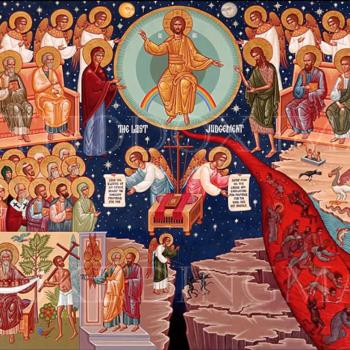
Like any of us who are parents, he wasn’t urging them to look out for judgment because he was trying to frighten or coerce anyone. Like a parent who is alarmed that his child might be enslaved to drugs or an obsession with soul destroying pursuits, Jesus warned the children of Israel that there may not have much time to receive the gift of freedom.
Finally, let me close with a personal observation:
As I sat with this passage again this week, it occurred to me that the most difficult thing about the teaching of Jesus is taking it seriously, which is why both then and now there is a place for the kind of urgency he announces.
When this passage appeared in the lectionary last week, there are preachers grappling with what one of them called this “crazy text”, and I think that a lot of people share his impression. We don’t believe we might be judged. We don’t believe we should be judged, and truth be told, we don’t really believe that anything is that urgent.
We are comfortable. Our homes are airconditioned. There will be food for lunch. So, when a judging Jesus climbs into our comfortable lives, into our airconditioned spaces, and in between donuts and coffee, our first reaction isn’t hostility. It’s apathy.
We are – collectively – more like the rich young ruler Jesus invited to follow him than we would like to think. And we love what we have so much, that we just can’t be troubled to follow him.
But what Jesus knew was that the urgency to choose doesn’t necessarily lie in losing everything. In fact, having everything we need is the crisis. Because once we realize that our possessions won’t save us and that – and we have been offered life – then the crisis is here, and we have to choose.
If you have made that choice, if you are on that journey, I hope that you will continue to seek the fullness of all that God can offer you. If you haven’t made that choice, don’t let it pass you by. How we decide to live our lives is the moment of judgment.








 Ad-Free & Subscriber Log-In