There are three major religions in China-Daoism, Buddhism, and Confucianism-but religion in China predates these traditions and continues to exist outside their boundaries. Archaeological and textual evidence attests to the existence of a sophisticated and literate religious tradition that predates the "three religions," during, and possibly also prior to, the Shang dynasty (1766-1045 B.C.E). In addition to this religion of the ancient nobility, there were likely also religious beliefs and rituals associated with rural and peasant populations, and there is evidence of pre-literate human communities with their own religious practices dating back as far as the Stone Age. As many as fifty ethnic minorities exist in China as well, some of great antiquity, each with their own unique religions. The term "Chinese religion" thus refers to a diverse and complex collection of many traditions. When Qin Shihuangdi unified the Chinese empire in 221 B.C.E., he standardized many elements of human culture-for example the size of bricks, the axle lengths of carts, administrative districts, and the written language. In doing so, he established a pattern of unity within diversity that would become characteristic of Chinese civilization, and is evident in its religion. Elements from earlier religions were preserved and integrated into the "three religions" when these were established, and the three co-exist with one another. With the exception of clergy, most people take elements from each of the three without affiliating exclusively with any one of them. At the same time, popular or folk religion in China continues to exist and exert an influence apart from the formal traditions. Despite the absence of formal structures or doctrinal unity, Chinese popular or folk religion has persisted through the ages and is a vital aspect of religion in China.
Chinese Religion
Chinese Religion Quick Facts
| Formed | 4000 BCE |
| Origin | China |
| Followers | 400,000,000 |
| Deity | Multiple deities |
| Sacred Texts | Includes I Ching, Confucian Canon |
| Headquarters | None |
Chinese Religion
Chinese Religion Overview
Chinese Religion Origins
Chinese Religion Origins -- Chinese Religion Beginnings
In the 1st and 2nd millennia B.C.E., hierarchical political organizations were mirrored by divine hierarchies of clan ancestors who were believed to be able to predict and control events on earth. Natural forces such as the sun, moon, earth, rivers, and mountains were also worshipped.
Chinese Religion Origins -- Chinese Religion Influences
Although there has been recent research concerning possible influences from central Asia, most evidence indicates that Chinese religion began and evolved internally, with no outside influences prior to the introduction of Buddhism early in the 1st millennium C.E.
Chinese Religion Origins -- Chinese Religion Founders
Founders in early Chinese religion were not those who established religious organizations, but cultural heroes who were credited with the invention of essential human forms such as writing, fire, and agriculture.
Chinese Religion Origins -- Chinese Religion Scriptures
The earliest form of sacred text in China was the oracle bones. Questions addressed to the divine ancestors or to natural forces were inscribed on bones or shells. These were then heated, and the resulting cracks interpreted as responses. All early texts -- narrative histories, poetry, and records of ritual and significant events -- were also revered, as writing itself was believed to be imbued with sacred power.
Chinese Religion Origins -- Chinese Religion Historical Perspectives
Western scholarship on Chinese religions began with Jesuit missionaries in the 16th century, who found the Confucian beliefs of court officials compatible in many ways with their own. Both were disdainful of Chinese popular religions, deemed superstitious and degenerate. Since the mid-20th century this attitude has shifted, and objective scholarship on Daoism and folk religion has increased.
Chinese Religion History
Chinese Religion History -- Chinese Religion Early Developments
In the latter part of the first millennium B.C.E., religion grew more independent of the ruling clans. Great thinkers debated the qualities that best characterized an ideal ruler; they also posited ways, or paths, an individual might follow, and considered moral questions.
Chinese Religion History -- Chinese Religion Schisms, Sects
In the early centuries of the first millennium C.E., influenced by the introduction of Buddhism from India, China's "three religions" -- Daoism, Confucianism, and Buddhism -- took shape as separate traditions.
Chinese Religion History -- Chinese Religion Exploration, Conquest, Empire (incl. violence, persecution)
The dominance of particular traditions shifted according to dynasty and region throughout the Common Era. At times Daoism and Buddhism were allied with the government. At other times, particularly on the local level, they nurtured resistance movements.
Chinese Religion History -- Chinese Religion Missions, Spread, Changes, Regional adaptations
Each of the "three religions" evolved, co-existing and shaping one another, throughout the Common Era. A vibrant folk tradition also persisted, weaving in and out of the matrix of the "three religions." Confucian thought centered on education, civil service, and morality, while Daoism and Buddhism grew as religious establishments.
Chinese Religion History -- Chinese Religion Modern Age
The modern age brought marked shifts in the religious climate of China. Two thousand years of dynastic rule gave way to nationalist, and then communist governments. Under the latter, especially in the 1950s and 60s, religious organizations were persecuted and many temples and works of art were destroyed.
Chinese Religion Beliefs
Chinese Religion Beliefs -- Chinese Religion Sacred Narratives
Within early written literature, remnants of the themes and motifs of an ancient mythology can be discerned. These themes include emergence from primordial chaos, the creation of elements of human culture, and recovery from massive natural disasters.
Chinese Religion Beliefs -- Chinese Religion Ultimate Reality and Divine Beings
The divine beings of non-sectarian Chinese religion are the spirits of nature that inhabit mountains, rivers, sun, moon, and the like. Cities and local communities also have earth or city gods that embody their unique locality. Deceased ancestors can also become divinities. Ultimate reality is composed of the interrelated triad of Earth, Humanity, and Heaven.
Chinese Religion Beliefs -- Chinese Religion Human Nature and the Purpose of Existence
Early Chinese thinkers disagreed as to whether human nature was innately good or evil. In either case, one's purpose was to orient oneself harmoniously within human society, and also in respect to the heavenly hierarchy.
Chinese Religion Beliefs -- Chinese Religion Suffering and the Problem of Evil
The earliest texts indicated a preoccupation with moral questions, and in ancient stories of historical figures and events evil individuals who were originally successful often eventually suffered a bad end. Early songs sometimes reflected the social and political inequities characteristic of the lives of ordinary people.
Chinese Religion Beliefs -- Chinese Religion Afterlife and Salvation
Early Chinese nobility envisioned an afterlife much like the lives they lived on earth, and had elaborate tombs built into which were placed all the necessities of life. Later, Buddhist influence led to the development of notions of reward and punishment in the afterlife.
Chinese Religion Ritual, Worship, Devotion, Symbolism
Chinese Religion Ritual, Worship, Devotion, Symbolism -- Chinese Religion Sacred Time
The earliest ideas of sacred time in China gave primacy to the past, whether to mythic great dynasties or to utopian ideas of an ancient, primitive egalitarian society. The cycles of nature have also long been regarded as sacred.
Chinese Religion Ritual, Worship, Devotion, Symbolism -- Chinese Religion Sacred Space
Mythic sacred spaces include the realms of the immortals, such as Penglai or Kunlun; the heavenly realms where deceased ancestors reside; and the Buddhist heavens. Also central to Chinese religion is the theme of ordinary space as sacred.
Chinese Religion Ritual, Worship, Devotion, Symbolism -- Chinese Religion Rites and Ceremonies
Many early religious rites were connected with the ruling clans. Later, Buddhist and Daoist rituals became important to many, and folk or popular religions developed their own rites. Festivals and ceremonies from a variety of sources are included on the Chinese ritual calendar.
Chinese Religion Ritual, Worship, Devotion, Symbolism -- Chinese Religion Worship and Devotion in Daily Life
The typical Chinese individual is not affiliated with any one religion, but is strongly influenced by the matrix encompassing Buddhism, Daoism, Confucianism, and folk and popular traditions. Devotional activities range widely -- from self-cultivation exercises like meditation or qigong, to worship of deities or ancestors, to conscious efforts to serve as a valued member of human society.
Chinese Religion Ritual, Worship, Devotion, Symbolism -- Chinese Religion Symbolism
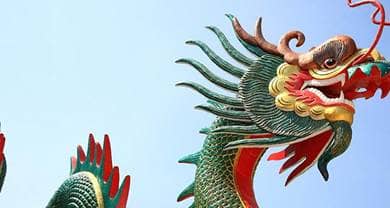
Symbolism in China is extraordinarily complex and diverse. Among the most popular symbols are the dragon, symbolizing imperial authority and China itself; the twelve animals of the Chinese zodiac; and the Chinese characters representing health, wealth, happiness, and longevity.
Chinese Religion Ethics, Morality, Community
Chinese Religion Ethics, Morality, Community -- Chinese Regligion Leadership/Clergy
Apart from Buddhist and Daoist clergy, examples of Chinese religious specialists include mediums, diviners, feng shui practitioners, healers, and astrologers. These may operate independently or as part of religious organizations.
Chinese Religion Ethics, Morality, Community -- Chinese Religion Community Organization and Structure
In many ways, local communities are the heart of Chinese civilization. Religious groups sometimes provide leadership, meeting places, and social services to their communities; at other times clans or secular organizations have taken on this role.
Chinese Religion Ethics, Morality, Community -- Chinese Religion Principles of Moral Thought and Action
In China, these include respect for elders and leaders, an obligation to promote harmony within one's family and community. Buddhist precepts such as prohibitions against killing, lying, stealing, and sexual misconduct are also honored.
Chinese Religion Ethics, Morality, Community -- Chinese Religion Vision for Society
The Chinese vision is of a harmonious society in which every member has a place and a purpose. Individual self-improvement is undertaken not only for one's own benefit, but also for the benefit of society.
Chinese Religion Ethics, Morality, Community -- Chinese Religion Gender and Sexuality
Traditional Chinese biases have been exemplified by practices such as foot-binding and female infanticide, and by the custom among the nobility of having multiple wives and concubines. Lives as Buddhist or Daoist nuns provided greater opportunities for education, leadership roles, and independence. In today's China, great strides have been made toward gender equality.