Patheos Watermark

Shinto

Shinto Quick Facts

Formed500 BCE
OriginJapan
Followers3,000,000
DeityPolytheistic
Sacred TextsThe Kojiki, The Nihongi
HeadquartersNone

Shinto

Shinto Overview

Shinto ("the way of the Kami") is the name of the formal state religion of Japan that was first used in the 6th century CE, although the roots of the religion go back to at least the 6th century BCE. Shinto has no founder, no official sacred texts, and no formalized system of doctrine. Shinto has been formative in developing uniquely Japanese attitudes and sensitivities, creating a distinct Japanese consciousness. Belief in kami - sacred or divine beings, although also understood to be spiritual essences - is one of the foundations of Shinto. Shinto understands that the kami not only exist as spiritual beings, but also in nature; they are within mountains, trees, rivers, and even geographical regions. In this sense, the kami are not like the all-powerful divine beings found in Western religion, but the abstract creative forces in nature. Related to the kami is the understanding that the Shinto followers are supposed to live in harmony and peaceful coexistence with both nature and other human beings. This has enabled Shinto to exist in harmony with other religious traditions. As the foundation for Japanese culture, Shinto has also played a significant role in the political realm. For centuries, Shinto religious festivals and ceremonies have become indistinguishable from the affairs of the government.


Shinto is sometimes called Japan's "indigenous" religion, but it may have originated in an animistic tradition that may be older than the Japanese islands themselves. Its beginnings are difficult to trace, as its original forms have been obscured by later forms that were shaped by political forces.

Shinto was probably influenced by all of the cultures from which people came to populate the islands we now call Japan millennia ago. These include the east Asian continent, the islands of the Pacific, and areas in what is now Russia. Later, Chinese culture and Buddhism in particular had considerable influence on Shinto.

Shinto has no founder in the sense that Buddhism or Christianity has a founder, nor is there an individual or group of individuals who were responsible for developing Shinto as a religion. The institution now called Shinto was initially created by the Yamato clan in their bid to assume rulership of the Japanese islands.

While regarded as histories, the Nihonshoki (Chronicle of Japan) and Kojiki (Record of Ancient Matters) are texts that include records of ancient mythology and deal with religious matters. A number of esoteric texts detailing ritual and religious matters of the shrines, and discussing the relationship between Shinto and Buddhism, are also among the sacred texts of Shinto.

Recent scholarship has focused on unpacking the effects on Shinto brought about by various modern movements in Japan -- from the "National Learning" movement that began in the 17th century, to the restoration of imperial rule in 1868, to the "State Shinto" that dominated in Japan until the end of World War II.

In the 8th century C.E., the Nihonshoki (Chronicle of Japan) and the Kojiki (Record of Ancient Matters) were written to legitimate the rule of the Yamato clan as descendants of the gods. Using elements of an earlier mythology, the Yamato rulers created a unified Japan, sanctified by their claims to divinity and supported by a system of shrines.

Buddhism was introduced to Japan from Korea, and later, China, in the 6th century C.E. Along with Buddhism, Japan adopted many elements of Chinese culture, including its written language. The name "Shinto" is derived from the Chinese (shen dao, or way of the gods), and its emergence as a formal tradition was a native response to Buddhist influence.

By the end of the 11th century, there were only twenty-two "official" Shinto shrines, and even at these, Buddhist deities regarded as the same as specific Shinto kami were worshipped. The imperial line continued but had little power. Toward the end of the 12th century, the first of the shogun governments was established.

Buddhism and Shinto developed side-by-side for many centuries. While Shinto was, in a sense, a state religion, there were many occasions in which Buddhism also received state support. Systems of equivalency between Buddhas and kami were developed, and worship of both was normally conducted in the same temple complexes.

During the Edo period (1600-1868), efforts were made to redefine Shinto as a tradition separate from Buddhism, and a "National Learning" movement emerged. In 1868, the Meiji emperor was restored to power and Buddhism and Shinto were forcibly separated. An aggressive, militaristic attitude was supported by "state Shinto," buttressed by the ancient notion of the emperor as a direct descendent of the deity of the sun, Amaterasu.

The deities (kami) Izanagi and Izanami gave birth to all things, including the Japanese islands, and also to three major Japanese gods. One of these is Amaterasu, the sun goddess. The emperors of Japan, and all of the Japanese people, are believed to be descendents of these kami.

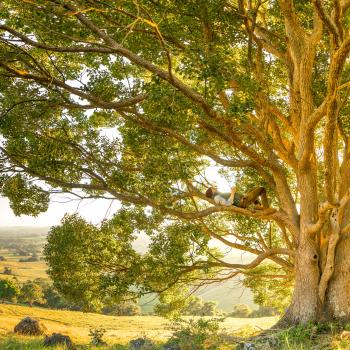
Ultimate reality in Shinto includes the chaos from which the kami emerged, but the focus of the ultimate in relationship to humanity is earth. Certain kami gave birth to the earthly realm and everything in it. Kami can occupy natural objects such as mountains, rivers, or trees. They can also occupy sacred areas and, more rarely, human beings.

Humans are part of the natural realm, which is sacred. Pollution does occur through normal acts such as contact with things that threaten life, for example: death, blood, or disease. This is unavoidable and constitutes no "sin." Pollution is washed away regularly through acts of purification. Thus one's purpose is to maintain the pure and natural state of existence.

In Shinto, the ideas closest to the western notion of evil are pollution and impurity, and these are addressed through rituals of purification. Suffering is not regarded as a form of punishment for human behavior, but, rather, as a natural element of human experience. Shinto deities are equally capable of being gentle and loving, or awesome and terrifying.

There is an old saying in Japan: "born Shinto, die Buddhist." Before Buddhism, it was believed that all who died went to a vast hellish underworld from which there is no escape. Buddhism introduced the idea of rewards and punishments in the afterlife, and death and salvation in the afterlife came to be regarded as Buddhist matters.

Sacred time in Shinto is focused on the human life cycle, particularly on milestones such as birth, coming of age, and marriage. The New Year, harvest, and other significant moments in a yearly cycle are also celebrated, sometimes in conjunction with Buddhism. When one enters the confines of a shrine with a reverent attitude, one can also experience sacred time.

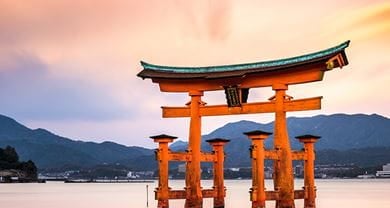
Any space where a kami has manifested is sacred space. This includes natural objects such as trees or mountains, and the precincts and altars of Shinto shrines. In Japan today it is not uncommon to see a small shrine, marked by a specially designed rope called a shimenawa, in the middle of a downtown shopping district, or a shrine indicated by a torii gate atop a high-rise building.

Ritual is central to the practice of Shinto. Every step of a ritual within a shrine follows a carefully prescribed pattern, with segments including purification, prayer, offering, and entertainment for the kami. Matsuri, or festivals, are yearly celebrations that encompass an entire community and may last for several days.

In earlier generations, it was common to have a kamidana within the home and workplace. These would be purified daily, and daily offerings were placed on them for the kami. Talismans from local shrines might also be placed in the kamidana. Today individuals will visit a local shrine to pray whenever they have a need or desire to do so.

There are many Shinto symbols. Among these are the torii gate that is found at the entrance to a Shinto shrine, the sword and the mirror (both related to the myth of Amaterasu), and a pair of foxes seen at the entrance to shrines for the deity Inari. Symbols placed on Shinto altars are usually covered or hidden.

Shinto priests are ranked both within a shrine and nationally. They are typically male, although there are a few female priests. Today, many Shinto priests attend a Shinto university and then train at one of the larger shrines. Some rituals also involve miko, or shrine maidens; these are typically young women who serve until they marry.

A typical shrine will exist for the worship of one or more specific kami. Shrines are supported and maintained by community groups, and often serve as centers for community life. The larger shrines are members of national shrine associations, and certain shrines such as Ise, the main shrine of Amaterasu, have significance for the Japanese nation as a whole.

Shinto moral principles are strongly influenced by Confucianism. It is believed that humans have an innate moral sense, and can be motivated by shame to avoid doing wrong. Acts of wrong-doing are cleansed through acts of purification. Sincerity, which is the harmony of thought and action, is a prized human characteristic.

The Shinto vision for society has varied in different eras, but at its core is the idea of harmony --harmony between humans and kami, harmony within social groupings, and harmony between humans and nature.

Ethics in Shinto are cultural and situational; there are no Shinto commandments or precepts forbidding certain actions. Male homosexuality has sometimes been socially acceptable, and at other times it has been frowned upon. Marital infidelity by men has often been overlooked, but women are almost always expected to be faithful. Until the last century, men were allowed to divorce their wives, but the reverse was not the case.

Recommended Shinto Products

Shop More


Most Popular on Facebook