Society of Friends (Quaker)
Society of Friends (Quaker) Quick Facts
| Formed | 1654 CE |
| Origin | England |
| Followers | 300,000 |
| Deity | God (Trinity) |
| Sacred Texts | Bible |
| Headquarters | None (Friends general Conference, Philadelphia, PA USA) |

Society of Friends (Quaker)
Society of Friends (Quaker) Overview
The Religious Society of Friends, commonly known as the Quakers, is a Protestant Christian tradition originating in mid-17th century England. Founded (traditionally) by George Fox, it adhered to religious teaching and practice that focused on living in accordance with the "Inward Light" (the inward apprehension of God, who is within everyone). Fox claimed that true believers could engage the risen Lord directly through the Holy Spirit without ministers, priests, or the sacraments. All are capable of experiencing the promise of Christ, enabling all to live in Christ's love. This belief influenced the position of the equality of women, a unique characteristic within Christianity in its time. Quaker meetings are often filled with silence because they are committed to waiting for God's presence in faith and patience. This religious movement was not received well in England and they in turn were persecuted for not going to services of the Church of England, refusing to tithe, and for going to Quaker services. While being persecuted in England, many Quakers were converting many people in America, especially in Massachusetts and Rhode Island. In fact, Pennsylvania was set up as a Quaker colony in which the state was supposed to be governed by Friends' principles, including religious toleration and pacifism. Historically, the Society of Friends has endorsed strong moral codes including the refusal to participate in war, the refusal to own slaves, and the elimination of many worldly structures. Socially, they were committed to various causes including women's suffrage, the abolition of slavery, and prison reform. Today there are many branches of Quakerism, some that hold more traditional Christian doctrines and others that are more liberal in their interpretations of these beliefs.
Laura Mancuso explains what it means to be a Quaker in today's world.
The Religious Society of Friends, known as Quakers, originated in the cauldron of the 17th-century English Civil War, one of many new religious groups to appear at that time.
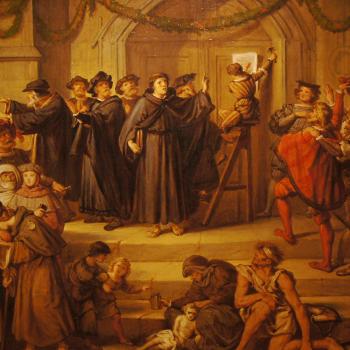
The Reformation begun by Calvin and Luther sought to rid the Church of objects and rituals that had been added since apostolic times. The Quakers completed the process, removing anything perceived as interfering with a direct experience of God.
The Society of Friends began in the vision and ministry of George Fox (1624-1691), the originator of the uniquely Quaker concept of the Inner Light. His Journal and other writings still influence the movement today.
The Friends' scripture is the Bible, but the Bible is not the source of all faith and practice. The Holy Spirit speaks to anyone who follows the Inner Light, and the Spirit has higher authority than the written word.
The profound impact of Quaker thought and action on American history and polity has attracted a great deal of scholarly attention, as have the diplomatic and practical benefits of Quaker approaches to peacemaking.
English Quakers were severely persecuted for refusing to attend the state church, take oaths in court, or fight in wars, insisting on freedom of speech, assembly, and worship, and condemning slavery and the treatment of prisoners and the mentally ill.
In the late 18th century, American Quakers began enforcing strict discipline on members, losing followers and converts. During the revivalism of the early 19th century, Quakers seeking fresh expression of their faith split into three groups: Hicksites, Wilburites, and Gurneyites.
A historic peace church, the Society of Friends has made a significant contribution to American history and society by consistently advocating for peace, public education, temperance, democracy, women's rights, and the abolition of slavery.
Early Friends were persecuted in the American colonies, but William Penn (1644-1718) made Pennsylvania a refuge for fellow Quakers. He allowed complete religious toleration, separating government from religion. This was a landmark on the way to Constitutional guarantees of religious freedom.
During WWI, the American Friends Service Committee (AFSC) and its British counterpart provided ways for conscientious objectors to contribute to relief and reconstruction efforts. Still highly esteemed and active, the groups were jointly awarded the Nobel Peace Prize in 1947.
The Quakers belong to the Reformation tradition, which seeks to renew the Christian apostolic faith as it was practiced in the first century after Christ.
Friends place profound faith in the Inner Light that dwells within every soul, speaking to those who listen, helping them to distinguish good and evil, and connecting all people.
Friends don't teach that human nature is inherently sinful. On the contrary, the heart of Quakerism is the belief in an Inner Light, a part of God's spirit that dwells in every human soul.
Friends have provided a consistent voice of protest against injustice and seek a high standard of life for the individual and society, a kind of perfection whose realization is made possible by the Divine spark within all people.
In Quaker thought, salvation is connected to the Inner Light. It is a direct experience of God within, allowing the Quaker to live out God's salvation, which was manifest in the life of Jesus Christ.
Quakers meet weekly for worship in either "programmed" or liturgical services, or "unprogrammed" services. Both types of service emphasize silence, called "expectant waiting," in order to allow the Spirit to reveal guiding truth to members.
Friends meet in unconsecrated buildings called meetinghouses that stress simplicity. The meetinghouses have no altars or special seating for ministers or other officials, nor do they have stained glass or elaborate furnishings.
There are no specific sacraments or rituals in the Quaker tradition. A believer joins the faith through a process known as "convincement," which follows from a conscious decision to listen to and follow the Inner Light.
Early Friends showed their commitment to sincerity through their dress and speech. Present-day Friends continue to practice simplicity and sincerity in speech and appearance, and in their consumer choices as well.
Early Quakers cultivated symbolic gestures such as the use of "thee" and "thou," and the wearing of simple woolen clothing. These gestures were gradually abandoned, while the ideals of sincerity and simplicity continue to guide Friends' attitudes and behavior.
Meetings may or may not choose officials, elders, or ministers. If clergy are chosen, it is because of their abilities in spiritual leadership. However, they are the equals of other members. Quakers discourage the development of clerical hierarchies.
Friends use the meeting system developed by George Fox. The basic group is the monthly meeting, which meets weekly for worship and monthly for business. Group decisions are made through a sense of unity, called the "sense of the meeting."
The practice of inner listening and obedience to God will lead to a life that reflects the character of Jesus, which includes honesty, simplicity, sincerity, integrity, and the power to encourage good and confront injustice.
The Quaker social ethic is firmly rooted in the belief that the Inner Light is in all people. Because every person possesses a part of God, Quakers have consistently stood for nonviolence and the equality of all people.
Friends encouraged women to participate in ministry as early as the 17th century. There is no current agreement on the question of homosexuality, but statements affirming the acceptance of all regardless of sexual orientation were published as early as 1963.