Chattaways on film

Chattaway is not exactly a very common name, so it’s always fun to see it flit across a movie or TV screen every now and then.

At school, I occasionally heard from sports buffs about a Chris Chataway who broke the 5,000 metre record back in 1954 — but my family was always notoriously bad at gym class, and anyway, he spells his name with only one “t”, so I always figured he didn’t count.

I happen to be a movie soundtrack buff, so it wasn’t long before I noticed the name Jay Chattaway listed as the composer for movies like Silver Bullet (1985) and Red Scorpion (1989); later, he became one of the regular composers for the various Star Trek shows, and if you Google my name, you will probably find a bunch of Star Trek sites. (It’s even worse if you run a search for my wife’s new married name — not that she, a librarian, does anything as public or Google-able, like writing, as I do — but anyway, Googling “Deanna Chattaway” will tend to produce a lot of pages featuring the words “Deanna Troi” and “Jay Chattaway”.) I believe my father actually got in touch with Jay some years ago, and there was some discussion of ways our family trees might connect, but it was all just speculation, as I recall.

Years ago, my sister Monica moved to Ontario and worked as an extra in a handful of programs, the only two of which I remember are the TV-movie The Women of Windsor (1992) and the big-screen movie Guilty as Sin (1993), in which she was one of the courtroom reporters — between her height and her long hair, I spotted her immediately just while watching the trailer! More recently, she was involved in the local indie music scene, and this led to a bit part in Blaine Thurier (of the New Pornographers)’s Male Fantasy (2004) as a musician who quits a band. So, now she has an IMDB page too.

I don’t have an IMDB page of my own yet, but I may get one some day, as I was interviewed for a documentary called The Big V last summer and I hear it’s pretty much finished; now it’s just a question of whether its producers will take it to festivals or go straight to TV, etc.

In the meantime, I have discovered that my parents were not the first people to invent the name “Peter Chattaway”. Apparently that was also the name of a character in an episode of an Australian TV show called The Contrabandits, which aired in November 1968, two years before I was born. (The chief inspector throughout this series was played by Denis Quilley, who I know as the prophet Samuel in King David and Simon Peter in A.D. Anno Domini, both of which were produced in 1985). The episode synopsis:

For many years Chattaway has evaded Customs duty on thousands of radio parts through a swindle involving a number of interlocking firms. The discovery of drugs brought in on a luxury yacht indicates that Chattaway is mixed up in drug running, and the Customs Special Branch uncover a trail which leads to transistor radio parts in cases which should contain machinery.

So I’m a drug smuggler! Won’t my parents be proud. :)

Since I’m half-Mennonite (my mother was a Sawatzky, her mother was a Derksen, etc.) and I was raised in a Menno milieu, it’s also fun to come across Mennonite names on the big screen, but it doesn’t happen very often — in fact, the only example I can think of is the “Ben Hildebrand” who gets killed by dinosaurs right near the beginning of Jurassic Park III. If you know of any others, by all means, let me know!

Must films always tell stories?

Jeff Overstreet has just posted an item on a couple of quotes he’s come across that remind him of the films he appreciates that prioritize images and sounds over “narrative”.

His post, in turn, reminds me of one of my own pet peeves. I can be a very linear, very narrative-driven thinker — and I think it has a tendency to show up in my reviews, where I sometimes slip into synopsis mode — but I have long argued that films don’t necessarily need to have stories, and some of the films I appreciate the most are the ones where something other than “story” is our primary concern.

For example, one of the reasons I thought Disney’s Fantasia 2000 was a bit of a disappointment, compared to its predecessor, was that Every Single Fricken Cartoon in that film told a story — and what’s worse, a fair number of the stories were identical and redundant (the Beethoven, Gershwin, and Respighi segments all concern parents who lose their children and/or try to protect them, and this is fairly similar to the Daisy-loses-Donald storyline of the Elgar segment). Contrast this to the original Fantasia, where entire sequences are devoted to the sheer joy of dance or, in the case of the Bach sequence, pure abstraction. (The so-called “abstract” segment in Fantasia 2000 told a story too, sigh.)

Similarly, I fell in love with Koyaanisqatsi many years ago — and it now occupies a permanent spot on my all-time Top 10 (actually more of a Top 11) — because it consisted of nothing more than documentary footage and music. Admittedly, director Godfrey Reggio would insist that even films like his require some degree of dramaturgical development — but the point remains, his film encourages us to look and see in new ways, rather than simply spin a yarn.

Other films from my Top 10 that might fit into this category include Lawrence of Arabia, which has a brilliant script by Robert Bolt but is best remembered for the brilliant way it captures the look, the mood, the feel of being in the desert (when I saw the “director’s cut” at the Park Theatre back in 1989, there was always a massive line-up for drinks at intermission, people had become so thirsty), and The Purple Rose of Cairo, which again has a brilliant script, this time by Woody Allen, but ends with a scene in which Mia Farrow just watches, and watches, and watches as a Fred Astaire & Ginger Rogers dance unfolds on the screen before her.

Oh, and let us not forget the rather stark differences between Stanley Kubrick’s 2001 and Peter Hyams’s sequel 2010, which I get into here.

Millions of Hippie Preachers

Two of my more recent film columns are now online.

My review of Danny Boyle’s Millions for BC Christian News is here — alas, I didn’t have time or space to compare and contrast this film with Saint Ralph, but then, why take time out from discussing a vastly superior film in order to dwell on an inferior one?

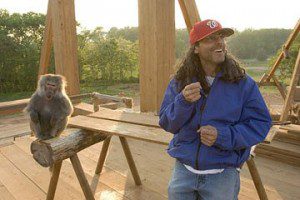
And my column on Frisbee: The Life and Death of a Hippie Preacher for ChristianWeek is here, and also here. I quote only one sentence from my interview with director David Di Sabatino in this article, but a fuller Q&A; will eventually appear on the Christianity Today website, closer to the film’s premiere at the Newport Beach Film Festival, which runs April 21-30.

Episode III-D? 3-DPO? R3-D2?

The news from George Lucas at ShoWest gets weirder. Quoth The Hollywood Reporter:

George Lucas is such a fan of the latest 3-D technology that he is planning to remaster all of the “Star Wars” films for rerelease in 3-D.

Appearing as part of a sextet of high-profile directors promoting 3-D and digital cinema at film industry convention ShoWest on Thursday, Lucas said he hadn’t yet committed to a precise schedule but hoped to have the first film ready for the 30th anniversary of the original “Star Wars” movie in 2007 and that he would then rerelease one “Star Wars” film per year in 3-D.

Well, why not. Given that Lucas has sacrificed decent characterization for special effects in pretty much every single film (it wasn’t quite so noticeable in the original trilogy, thanks partly to Irvin Kershner’s direction of Empire), he might as well keep pushing these films in the direction of pure, aimless spectacle. It’s about time something in these movies had depth.

Okay, I admit it, I’m going for the cheap punchlines here. But seriously, every time Lucas turns his eye to one of these films again, he makes things worse, and he always, always focuses on the wrong things.

Back in 1997, I hated the way he pandered to his fans by sticking a gratuitous shot of Boba Fett into the original Star Wars — he even stops and looks at the camera. And then, when the film came out on DVD last year, Lucas stuck in an annoying sound effect in the scene where the stormtrooper in the background accidentally bangs his head on the blast door; what used to be an almost imperceptible “blooper” that was fun to point out to your friends has now become a stupid, obvious gag (on par with, say, adding an “oo-la-la” sound effect to the shot of Han Solo accidentally grabbing Princess Leia’s boob in Return of the Jedi).

Expect more of the same if and when Lucas ever gets around to fulfilling this newest plan of his. Who knows, he might even decide never to release the films in 2-D again. Sigh.

See Grace Fly — on TV

Just received word that See Grace Fly, an independent, Vancouver-made film that has some interesting spiritual elements, will be showing on Movie Central this coming Tuesday and beyond. The movie was inspired partly by the experiences of star Gina Chiarelli’s father and schizophrenic aunt; I interviewed Chiarelli about it here. There are links to a handful of reviews here, my favorite of which is probably the one by Ron Reed — who, not incidentally, runs the theatre which put on the play for which Chiarelli won her Jessie Award.

This time, Lucas really really means it!

Reuters reports that George Lucas is calling the upcoming Star Wars: Episode III – Revenge of the Sith “a real tearjerker” and “more emotional” than “the first one” (I assume he means Episode I, not Episode IV — although it wouldn’t make much difference).

He also compares Episode III to the chart-topping blockbuster of all time, Titanic, which I guess is his way of taking back everything he once said about how Episode III would make the least money because it will be “too dark”. Since Episode II turned out to be the least lucrative film of them all (in unadjusted dollars, it ranks marginally ahead of Episodes V and VI, a.k.a. Empire and Jedi, but in adjusted dollars, it’s way down at #80 while the other four films are all in the Top 20), I guess he’s really hoping he won’t go out with a whimper this time. Best to plant the idea that his film is just like that really, really successful film over there.

So, with all that in mind, I guess he means Episode III will be “more emotional” the way that he once said Episode II would be “more romantic”? Alas, the romance was one of the most poorly, clunkily handled things in that movie, and I fear nothing will have improved since then.

But of course, fear leads to anger, and anger leads to hate … so I’ll stop while I’m ahead.

Forget the movie, I want the animatics!

Just finished watching the extras on the Incredibles DVD with the missus. Wow. I always thought of storyboards as these hasty little sketches that weren’t really all that interesting in their own right. But for this cartoon, they created some darn fine animatics that are just about as exciting as anything in the finished film. In fact, because these animatics combine 2D drawings with 3D backgrounds and objects so expertly, they are a lot more interesting than the animatics for, say, the Lord of the Rings films, which tended to have rather boring and blocky 3D figures running around their 3D environments. (I had a similarly positive reaction to the considerably more stylized mix of 2D and 3D in the Hong Kong cartoon McDull, Prince de la Bun.) The fact that the Incredibles animatics are all black-and-white also lends them an extra aura of cool. I think I’d like to see the entire movie that way, at least just once.

Saint Ralph — first impressions

I just skimmed through my friend and colleague Steve Greydanus’s review of Millions, the delightful new fable by Danny Boyle. (How can you tell it’s by Danny Boyle? Because, like Shallow Grave and Trainspotting and A Life Less Ordinary and perhaps some of his other films as well, a fair chunk of the story involves a bag stuffed full of money.) In his final paragraph, he states:

Millions is a rare and special family film: a moral parable rather than a morality tale; a film that combines high ideals and hard realities; a story of hope and faith in something more than Santa Claus. Which is not to say that Santa Claus, or rather St. Nicholas, doesn’t show up. But when he pops on a bishop’s mitre rather than the familiar red Santa hat, it’s clear we’re not in Hollywood movieland here.

Amen to all of that. And now I wonder what he would make of Saint Ralph, a Canadian film about a 14-year-old boy who attends a Catholic school (the film has a title card for each month of the school year, and each title card names a patron saint who has a feast that month), and who thinks he can heal his mother by running the Boston Marathon, and in which “God” speaks to the boy wearing a Santa suit, but without the beard.

Why does Ralph Walker (Adam Butcher) believe he can wake his mother (Shauna MacDonald) from her coma? Because the nurse (Jennifer Tilly) tells him the doctors said “it would take a miracle” for her to wake up, and because Fr. Hibbert (Campbell Scott), the priest who oversees the running exercises at school, tells him it would be a “miracle” if any of the boys in his care were to win the Boston Marathon. If Ralph were to win the race and heal his mother, it might also earn him some sort of redemption at school, where he is constantly being reprimanded by the principal (Gordon Pinsent), an irrationally harsh and dogmatic authority figure who keeps looking for ways to expel the boy, supposedly for his own good.

Written and directed by Michael McGowan, who is otherwise unknown to me, Saint Ralph comes from what we might call the Catholics-need-to-lighten-up school of film-making. At various points, characters quibble over the differences between venal sins and mortal sins, etc.; there is much mirth at the expense of Catholic approaches to sexuality, including their rules against “self-abuse” and teenagers touching each other through their clothing; and the “good” priest is the one who tells his students about Nietzsche while the “bad” priest is the principal who opposes this.

To be fair, though, Fr. Hibbert does declare at the end of the film that he hadn’t really believed in much of anything before, but now he does, and perhaps we can read into this the idea that his earlier teaching methods reflected his lack of belief; I especially like the way Fr. Hibbert’s punchline makes a point of extolling Christ over Nietzsche. Scott plays the scene beautifully, and it’s a shame Pinsent has to play such a one-dimensional ogre opposite him; the fact that Pinsent’s character has a change of heart in the film’s very last moments is not a sign of dimension, but more a sign that nothing and nobody is invulnerable to the film’s feel-good vibe.

At any rate, whatever its merits may be, I still can’t help lumping this film in with others in which questions of childhood and faith are more gimmicky than inspired. I can’t think of anybody I knew back when I was 14 who would have thought winning the Boston Marathon was a “miracle” on par with healing the sick, much less anyone who would have actually become a contender there after only a few months of training. And the fact that the child actors are all somewhere between average and mediocre just makes the story that much harder to swallow.

Watching Saint Ralph, I kept thinking back to Millions, which succeeds where Saint Ralph fails precisely because it sees the world through the eyes of a child (and in a way that is absolutely, convincingly childlike), and also because it just flat-out goes for the magic and gives the saints their own objective reality, whereas Saint Ralph hedges its bets and tries to hint at magic while staying within the tidy boundaries of that which can be rationally explained. (After bumping his head, Ralph may think he sees God in a Santa suit, but that doesn’t mean he’s actually there, does it?)

Saint Ralph played at the Toronto film festival last September, but I am told it won’t open in regular theatres here until April 8 — by which time I will probably have forgotten all about it. Meanwhile, Millions, which is already open in the States, will be opening here next Wednesday — and I’m rather looking forward to seeing it again.

Narnia — not merely Christian, you know

Michael Coren had a piece in the National Post a couple days ago about C.S. Lewis, motivated in part by the upcoming film adaptation of The Lion, the Witch and the Wardrobe. He describes the story as “a delicious mingling of childhood fantasy, Christian metaphor and sublime story telling,” and goes on to say: “As pure literary fantasy, the books are an unrivalled success. Yet they also succeed as Christian metaphor. Neither clumsy nor didactic, Lewis colours secular magic with Godly reality.”

Well, now. This is certainly true (although I think Tolkien might have argued that the books were a little, if not clumsy, then perhaps a bit slapdash). But the idea that these books are “Christian metaphor” has been so repeated, and repeated, and repeated by Christian apologists — Coren himself uses the phrase twice in just a few paragraphs — that I think articles like this just contribute to one of the great blind spots in Narnia appreciation. Namely, I think it needs to be acknowledged that the Narnia books are a wonderful introduction to pagan mythology.

Seriously, the two biggest influences on my own childhood love of myths, especially the Greek and Roman kind, were the Beethoven sequence in Disney’s Fantasia and the fantastical creatures that populated Lewis’s Narnia books. These myths were not mere “fantasy”, but part of a great cultural heritage that Lewis believed was far more in touch with the Truth than the secular ideologies of our day. Indeed, if I understand him correctly, Lewis probably would have balked at the idea that these robust myths could be summed up as mere “children’s fantasy,” and he probably would have balked at the idea that the magic portrayed in these books was “secular”. Secularism, understood as a product of the Enlightenment, was as resolutely opposed to the pagan religions of the past as to the Christian religion of the present — and if Lewis brought “Godly reality” into the “secular” world, it was through a magical, pagan back door. To quote what Lewis wrote in ‘Is Theism Important?’, from God in the Dock:

When grave persons express their fear that England is relapsing into Paganism, I am tempted to reply, ‘Would that she were.’ For I do not think it at all likely that we shall ever see Parliament opened by the slaughtering of a garlanded white bull in the House of Lords or Cabinet Ministers leaving sandwiches in Hyde Park as an offering for the Dryads. If such a state of affairs came about, then the Christian apologist would have something to work on. For a Pagan, as history shows, is a man eminently convertible to Christianity. He is essentially the pre-Christian, or sub-Christian, religious man. The post-Christian man of our day differs from him as much as a divorcée differs from a virgin. The Christian and the Pagan have much more in common with one another than either has with the writers of the New Statesman; and those writers would of course agree with me.

These sorts of distinctions and definitions become especially pressing when certain Christian writers start attacking, say, the Harry Potter books for their pagan elements while turning a blind eye to those exact same elements in Lewis’s books.

I myself am a Christian and I cherish the fact that Lewis was capable of expressing his beliefs through all sorts of literature, including children’s fantasy. But I think we owe it to Lewis and his beliefs to be more forthright about this aspect of Lewis’s writings. When I see The Lion, the Witch and the Wardrobe, I will not only be asking if they got the story’s Christian underpinnings right, but if they got Lewis’s love of pagan mythology right.

“Where are the women?”

Barbara Kay has just written an interesting column in response to Maureen Dowd‘s call for more female op/ed writers.

Dowd notes that “Men enjoy verbal dueling,” while she, “As a woman,” wants “to be liked — not attacked.” Whether she means to or not, Dowd implicitly acknowledges that the problem may not be editorial hiring policies so much as the fact that there are just far, far more men willing to debate the contents of columns such as hers than there are women; she writes:

Men I know and men who read The Times write me constantly, asking me to read the opinion pieces they’ve written. Sometimes they’ll e-mail or fax me their thoughts to read right before I have lunch with them. Women hardly ever send their own rants.

Most tellingly, she adds that “Male bloggers predominate,” and the blogosphere is one realm in which hiring practises simply do not come into play — as Kevin Drum puts it:

Although its geeky Usenet roots were (and are) testosterone laden affairs, there are still no formal barriers to entry here, no old boys club in the usual meaning of the word. Yet if you take a look at the Blogosphere Ecosystem, which for all its faults is probably the closest thing we have to a consensus measure of popularity for political blogs, you will find exactly three women in the top 30: Michelle Malkin, La Shawn Barber, and Michele Catalano. (There are a few group blogs in the top 30, but those are very heavily male dominated too.)

That’s a grand total of 10% of the most popular political blogs. And to gaze even more deeply into our collective navel, that 10% is 100% conservative. . . .

As it happens, Kay is a conservative herself, and she takes special exception to Dowd’s conclusion that “there are plenty of brilliant women out there who are great at math and science. We just need to find and nurture them.” Kay responds:

No, Maureen, you’ve got it backwards. If a woman needs finding and nurturing, she’s wrong for the job. We don’t want shrinking violets on our op-ed pages. We want strong proactive women writers with definite opinions, who scorn affirmative action and like to duke it out in public.

Obviously, as a man who has just entered the blogosphere, I am part of the problem here. But I don’t see how I could be part of the solution if I wanted to. Like the posters for The Godfather Part III say, “Real power cannot be given. It must be taken,” and if women want to join the verbal fray, they will. Or to use another analogy, it doesn’t matter how often you extend the invitation — if a girl doesn’t want to go out with you, she won’t go out with you.

And now, of course, comes the part where I wonder about the implications of this for film blogs, film critics, and so on.

I don’t think that film discussions must always be about mounting arguments, but I do think that that is a big part of what we do — in my case, at least, arguments have been very helpful in clarifying why I think the way I do about a film, or what I think a film is trying to say. And women have certainly played a big part in how I have come to understand certain films. (Although, now that I think about it, the discussions in question have often concerned science fiction, which, for all I know, may just appeal to women with a stronger appetite for abstract reasoning.) But I can also see that there must be room for “finding and nurturing” in film appreciation, too.

It’s kind of like faith. Theological discussions, debates, and arguments can be fun. But you can’t always be arguing the faith; you have to just sort of bask in it from time to time, through prayer and meditation and so on, and you have to make space in which people feel safe basking. And I say this as one who is still learning how to do both of those things.