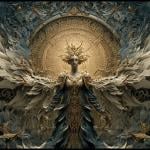
The Triumphal Entry

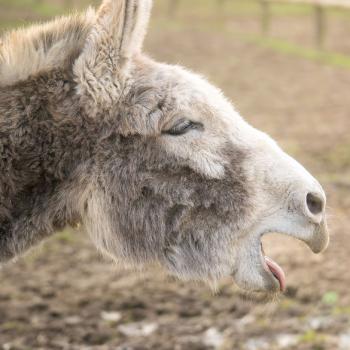
This morning, in preparing for Palm Sunday, I was reading the account of the Triumphal Entry in the Gospel of Luke. What especially touched me on this reading was the fact that as the Lord was approaching Jerusalem on the donkey, while His disciples shouted out “Blessed be the King who comes in the name of the Lord!” (loudly enough that the Pharisees in the crowd were demanding that they stop), the Lord was not smiling and waving, or even sitting calmly on the donkey. He was weeping.

“Now as He drew near, He saw the city and wept over it, saying, “If you had known, even you, especially in this your day, the things that make for your peace! But now they are hidden from your eyes.” (Luke 19:41, 42)

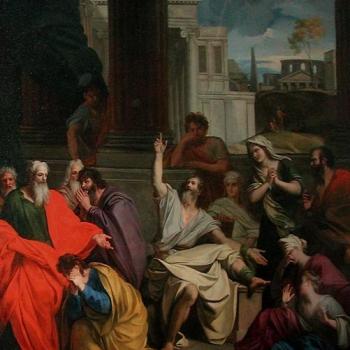
There’s something profoundly moving in that image of such deep grief and pity in the middle of such joy. I want someone to paint a picture of the triumphal entry this way: with the crowds shouting and rejoicing, and Jesus weeping.

Salvation and Jesus: A Challenge

I want this blog post to be a challenge. In the New Church, we embrace the teaching that God does not condemn anyone for ignorance of Him; that people who do not know Him as the Lord Jesus Christ, who are ignorant of His Word, can be saved, because if they have lived as well as they can in love to the neighbor and love to God, they will embrace Him as God after death, since “those who do the truth come to the light” (John 3:21).

These are beautiful teachings, illustrating God’s mercy.  And yet. I think we overemphasize these teachings. I think these teachings are about the Lord’s mercy for those who are in ignorance – but they are not about people who have the Word and are in some sense “within the Church,” or “within Christianity,” or “within the Christian world.” Now, there are a lot of other passages and teachings to take into account. I wrote a longer blog post including some of these, but decided not to publish it. For now, I simply want to present these passages, without caveats (although with emphasis added by me).

In the following work, by the name Lord is meant the Savior of the world, Jesus Christ, and Him only; and He is called “the Lord” without the addition of other names. Throughout the universal heaven He it is who is acknowledged and adored as Lord, because He has all sovereign power in the heavens and on earth. He also commanded His disciples so to call Him, saying, “Ye call Me Lord, and ye say well, for I am” (John 13:13). And after His resurrection His disciples called Him “the Lord.” (Arcana Coelestia 14)

[Read more...]

Waiting on the Lord

Yesterday, I preached in Dawson Creek and Grande Prairie on waiting for the Lord, based on the story of Saul’s unlawful sacrifice (1 Samuel 13:1-15). The thing that struck me about the story is the fact that Saul did wait for the Lord, for seven whole days, while his army scattered; it was only after Samuel failed to show up that Saul offered the sacrifice. I can relate to that feeling – I’ve already waited and waited for the Lord, and He seems to be failing; I’m going to do things my way before things completely fall to pieces.  Anyway, here’s the sermon; the readings were 1 Samuel 13:1-15; Luke 12:35-48; Divine Providence 73:6, 7.

“Our soul waits for Jehovah; He is our help and our shield.” (Psalm 33:20)

Wait on the Lord. Throughout the Word, this message is given over and over again. In Psalm 27 we read, “Wait for Jehovah; hold firm, and He shall encourage your heart; and wait for Jehovah” (Psalm 27:14). In the book of Isaiah, we read, “The youths shall faint and tire, and the young men stumbling shall stumble; but they that wait upon Jehovah shall renew their power” (Isaiah 40:30, 31). In these passages, we see a promise – that those who wait for the Lord shall be given strength and encouragement. The Lord will give hope to those who wait faithfully for him.

[Read more...]

How I View Swedenborg’s Writings

New Church Perspective has finished publishing my two-part essay on how I read the WritingsPart I, Part II.

The Little Way

There’s something about St. Thérèse. Until a year or two ago I’d never heard of Thérèse of Lisieux.  I was introduced to her by Tomas Halik in his book Patience with God. There he wrote about her “dark night of the soul” leading up to her death, where she seemed to have lost her faith almost completely. But he also wrote about the things that had later led to the Catholic church canonizing her as a saint, especially her devotion to what she called “the little way.” Since then, I’ve heard her name come up in several different contexts: a few blogs I read have mentioned her in passing, two different friends on separate occasions have told me that she’s an inspiration; and most recently, Richard Beck has been blogging about “the little way” on his Experimental Theology blog. I still haven’t read the book she is remembered for, her autobiography The Story of a Soul (L’histoire d’une âme), but I want to take a closer look at what “the little way” is all about.

As Beck describes it, Thérèse had a desire to do great things, to be a martyr, to find a great and high vocation. And yet, she did not see that as a possibility for her life, and she desperately sought to know what God was calling her to do. The answer she received was that He was calling her to do something on a much smaller level, but just as great in importance: to become love in the simple, small, everyday things of her life. Beck describes it this way:

[Read more...]

The Seventh Blind Man of Indostan

Recently I ran across a reference to the poem “The Blind Men and the Elephant” by John Godfrey Saxe (although for the life of me I can’t remember where), and it reminded me of the little-known final stanza of the poem.  It’s little known because it’s never been published; I discovered it written in invisible ink on the back of Saxe’s original manuscript, hidden away in the depths of a dark, deserted Indostani library and protected by a wall, a man with a  spear, a snake, a tree, and (for some reason) a guy wielding a rope and a fan.  Or at least, I think it was.  Like I said, it was dark.  Anyway, here ’tis, published for the first time:

The seventh man of Indostan
Just listened to them brawl,
And sighed, “These fools cannot agree,
Their minds are far too small.
From their dispute it’s plain that there’s
No elephant at all!”