- Roksana Bahramitash speaks on a panel about Muslim women and artwork at the University of Southern Mississippi.
- A lively discussion about Muslim marriage and divorce oversights in Kerala, India.
- MR Zine interviews Nawal El Saadawi.
- More on Esha Momeni’s detainment from AFP, the BBC, the LA Times, and from the president of California State University (where Momeni is a graduate student).
- A girl in South Africa dreams of pink headscarves and breast cancer awareness.
- The News gets its news wrong. I think this is what they meant to say.
- The Telegraph reports on a national conference of Muslim women in India.
- Islamic courts have been given permission to deal with divorces in the U.K.
- Hawaria Fattah is Europe’s first female imam.
- A 17-year-old Palestinian girl was wounded when Israeli troops opened fire on her school. May Allah give her strength.
- Women in Uganda have pledged to support Muslim leaders to ensure that Muslim women’s rights aren’t violated.
- Al-Khemiyya reviews Crooked Rib’s art exhibit in Melbourne, Australia.
- Baroness Warsi believes that government groups for Muslim women are “patronizing.”
- The BBC covers the Third International Congress on Islamic Feminism.
- A woman in Somalia has been executed for adultery by stoning. May Allah grant her peace. More from Al Arabiya and WLUML.
- In Niger, a woman who was sold into sexual slavery has won a landmark case against her government, which a regional West African court found had failed to protect her. Barikallah! More from The Guardian.
- A cleric in Indonesia has caused outrage by taking a 12-year-old girl as a second wife, which violates several Indonesian laws; more from Al Arabiya. Another cleric in Indonesia backs him up.
- Egyptian police have arrested a couple accused of “wife-swapping.” More from Al Arabiya, Global Voices Online, The Guardian, and Asharq Alawsat.
- Malaysia’s Prime Minister says that Shirin Ebadi should be allowed to speak at the Malaysian university that she was just dis-invited to.
- The BBC examines how imams fail women when it comes to sex abuse.
- Al Azhar issues a fatwa declaring that women can use force against their husbands if their husbands use violence on them.
- Sexual harassment from her supervisor forces a successful businesswoman to resign from her job.
- A divorced woman pleads to stay in Saudi Arabia to see her children. May Allah grant her justice.
- On Moroccan director Habiba Belkacem. Via Global Online Voices.
- In Pakistan, a newlywed 17-year-old girl meets an unspeakably horrific death at the hands of her husband’s family. May Allah bring her peace and justice. More from Yahoo! News and the BBC.
- Other bloggers react to Egypt’s first jailing for sexual assault.
- Cycads writes a brief history of Malaysian womanhood.
- The Feminist School reports that Nahid Keshavarz is summoned to Iran’s Revolutionary Court (again).
- A 14-year-old girl’s marriage to a 70-year-old man has been annulled by a Saudi Arabian court following a complaint by the girl.
- Islam in Europe examines the practice of some Muslim immigrants returning to countries of origin for fertility treatments, Sweden’s democratic party supporting a headscarf ban, and an imam in the Netherlands gives advice about polygyny that contradicts Dutch law.
- IslamOnline interviews Okolo Rashid, the woman behind the International Museum of Muslim Cultures in Jackson, Mississippi.
- Arab women’s magazine Al Hasnaa features an interview (in Arabic only, sorry) with MidEast Youth Editor Esra’a.
- A man gives his [essentialist] judgment on women’s desire and attraction.
- Hesham Hessaballah writes about the Muslim mother who moved Colin Powell.
- Menassat covers Dima al-Joundi’s documentary about domestic workers in Lebanon.
- The home of an Iranian women’s rights activist Parastoo Alahyaari has been searched and property detained, reports Payvand News.
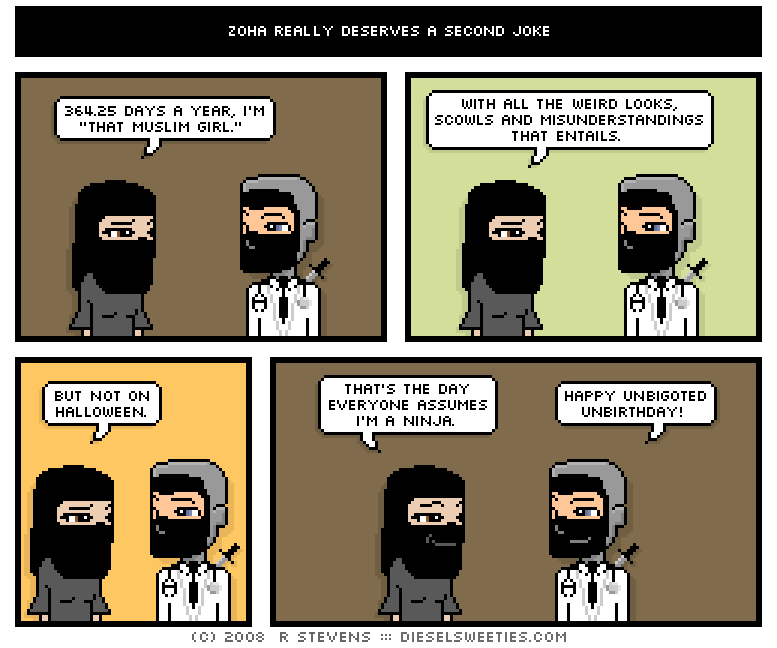
A Halloween-themed comic by R. Stevens. Via Islamify.
- The Dawn reports that, in Baluchistan, 38 women have been murdered in the past three months under the pretext of honor. May Allah give them all justice. Via Progressive Muslima News.
- Nigar Ataulla writes about how dialogue within the Muslim community can improve things for women.
- Sand gets in my eyes ponders on education and Saudi girls.
- A’isha M. R. Hils writes about the difference between what the Qur’an says about female infanticide and what the reality is.
- Islamic feminist and novelist Cihan Aktas discusses her novels and the headscarf. Via ifeminists.com.
- Shahrazad reports on new regulations for marrying Iranian women.
- Egypt’s first marriage conducted by a female registrar took place this week.
- Of the 44 candidates running in the Riyadh Chamber of Commerce and Industry elections, three are women.
- A groundbreaking ceremony was held for The Riyadh Women’s University this week. This university plans to be the largest university for women in the world. More from Al Arabiya, Reuters, and Arab News.
- A Pakistani woman is accused of murdering her husband.
- IslamOnline reports on classes that teach women’s empowerment through the Qur’an. More from the Christian Science Monitor. Via Progressive Muslima News.
- Middle East Online examines the majority held by women in Tunisian universities.
- The Feminist School gives a rundown on Iran’s intensification of political pressure on women’s activists.
- Contraception use increases in northern Nigeria.
- The Telegraph reports that two Muslim women accuse their employers of discrimination.
- Cycads gives her definition of Islamic feminism.
- CNN profiles female Muslim Nigerian novelists and Sand gets in my eyes applies it to Saudi Arabia.
- A Norwegian police superintendent thinks that headscarves will be a “usual” part of police uniforms a few years from now. Good news for Muslim policewomen who want to wear it.
- A woman who escaped from prison in Saudi Arabia has been recaptured.
- Afghan women are pissed that President Karzai is considering talks with the Taleban, and worry that all they’ve gained since the 2001 overthrow of the Taleban will be lost.
- The British gallery that is showcasing Sarah Maple’s artwork has been attacked, and she has received death threats. Via DeenPort.
- Indonesian lawmakers have passed the anti-pornography bill. More from the BBC and IslamOnline.
- The News covers a demonstration for the release of Dr. Aafia Siddiqui, as well as countless unnamed family members, in Pakistan.
- Today’s Zaman profiles Turkish pioneer Fatma Aliya Hanim.
- Dalia Mogahed will speak at the University of St. Thomas in Minnesota next week.
- Yvonne Ridley has lots to say about the arrest of Dr. Aafia Siddiqui.
- The lawyer for Noha Roshdi, the first Egyptian woman to put her sexual harasser behind bars, has abandoned her after finding out that she carries an Israeli passport.
- The Associated Press covers the increased numbers of Muslim women on U.S. ballots.
- In India, the Iqra Foundation will organize a conference for Muslim women at the beginning of November.
- MidEast Youth covers a technology program for women in Iraq.
- The woman in Algeria who was accused of damaging a Qur’an and sentenced to 10 years’ imprisonment has now been acquitted.
- Khola Hasan gives her thoughts on Dr. Amina Wadud’s leading prayer.
- A Jordanian woman was stabbed to death by her brother. May Allah give her peace and justice. Via ifeminists.
- The Islamic Center of Pittsburgh in Oakland will hold its first women’s conference.




I love the cartoon. A niqabi friend of mine said the same thing!
Concerning the article about Amina Wadud leading prayers. It always irritates me when Muslims comment that “there are more pressing issues in Islam that need addressing…such as FMG, honor killings, oppression of women, marriage and divorce rights etc”…and yet if those are considered the “big” issues and they havent even come close to being sorted out yet…why not start with the “small” stuff? At least it would be a positive step for a change.
It seems the only “real” argument Muslims have against women leading prayers is….OMG! what if she gets her period in the middle of prayer…I would guess the same thing that happens if a male prayer leader happens to pass gas or something…step aside and let someone else take over…now that wasnt hard was it?
@coolred38
“It seems the only “real” argument Muslims have against women leading prayers is….OMG! what if she gets her period in the middle of prayer”
That one made me laugh out loud…LOL.
Oh…though I have to add I think a part of the problem people have is that it’s immodest for a woman to pray in front of a man. I’m still not sure why. I mean, when I’m bending over so are the men. So they’re not going to see my be-hind if they are also praying. Additionally, usually during prayer women’s bodies are more covered such that their shape is not as visible as is the man’s. We really don’t give men much to see when we’re praying.
Eek..sorry for all the comments….I should edit my comments better…
I meant to say..
“Oh…though I have to add I think a part of the problem people have is that PEOPLE THINK it’s immodest for a woman to pray in front of a man.”
Salaam Alaikum,
Actually, I think coolred38′s comment concerning the female- led jummah misrepresented the actual discourse which took place at the time of Wadud’s first jummah prayer.
Both sides of the debate (which included men and women) had very nuanced and detailed theories regarding female imamship and the evidences related to it in the Qur’an, Sunnah and the seerah and it’s a shame to what was a very enlightening discussion being mislabelled here as ‘those mean old men being silly”.
Whether you agree with female-led jummah or not, I think it’s important to respect the arguments presented by both sides, both of whom, I believe acted with sincerity and with what they believed to be allowed within Islam.
In regards to the Sadaawi interview,
A feminist who is not for the right for women to choose to wear a piece of scarf? Further, she’s patronizing to those who decide to wear it because of course women must all agree on the same choice for themselves as her or they’re “lying or ignorant”. Yikes!
You have cool stuff I found it so intrested just going through it all ! the cartoon ( I know it is not called cartoon just can remember the name for it ) was hilarious hahhha
@ Safiya and coolred: Thanks both for your perspectives. Here’s something I don’t understand: if Muslims who don’t believe a woman should lead mixed gender prayer disagree with Dr. Wadud or other women leading prayer, why don’t they just not participate? I didn’t understand the point of all the picketing going on outside. I think that the refusal to participate was clear enough.
@ safiya outlines:
I actually read coolred38′s comment as saying that the issue of a woman-led prayer is something to bring up, as opposed to others who say that we should not be engaging in it because there are other things to worry about. I didn’t really get the whole “mean old men” vibe from it.
And you are right – both sides should respect each other though. But I agree with Fatemeh. Why all the fuss? Why not just let those who agree with female-led prayer pray and those who don’t can pray elsewhere. To me it is this protest and anger that seems futile and worth criticizing. If one doesn’t agree, say your piece and then leave it be. Let people pray in peace.
On imams and sexual abuse:
I think it’s quite sad to hear that Muslims feel letdown by their own Imams.
However, I do believe part of that is because some Imams probably don’t know to deal with situations like sexual abuse and domestic violence. At the same, it’s wrong to tell them keep quiet about it. I have to wonder, is it a situation where people don’t want to risk airing “dirty laundry?”
Islamic feminism:
I liked that post. I think people don’t understand that feminism can come in different forms. Also, people seem to have this misconception that feminism is merely a Western ideal and invention, when in reality it’s really not.
Although I have great respect for Amina Wadud; she’s the kind of woman the Muslim community is need of. I’m not convinced by her argument either. Why? Evidence wise, unfortunately, there isn’t sufficient evidence to support female led prayer. The evidence comes later by scholars like Al-Tabari and Ibn-Arabi and even the hadith about Umm Waraqa is understood she was leading females in her house. This is supported by the evidence that Aisha did the same, and there is no evidence to show that she led a mixed prayer. In fact, if there was to be any woman who should have led both men and women, it would have been her. She after all led battles and many men relied on her narrations. But that’s the evidence before us, and critics of Wadud argue that there is no evidence that suggests otherwise, and so we must not support her actions. I’m not convinced with this line of thinking either; just because there is no explicit evidence to support female-led prayer, we shouldn’t completely rule it out. It seems too hasty and lacks insight. The fact that the Hanbali school allows mixed prayer of tarawih– as long as the woman is not at the front, leaves room for the possibility. Not sure where the evidence for that is though. Never encountered it.
At the end of the day, i’d agree with Fatemeh. If you don’t agree with it, then don’t participate. Wadud isn’t ignorant of the scholarship(unlike Manji); she’s a scholar who has made a decision based on the evidence available that it is permissible. We can’t simply discredit someone of her knowledge just like that! It should be instigating debate.
The reality is, there have been some pretty stupid decisions made by male religious leaders, ESPECIALLY regarding women. The recent decision by a Saudi cleric who announced women should wear one-eye veils or the full niqaab comes to mind. There isn’t explicit evidence to support the wearing of the niqaab in the first place. Yet, it’s considered a viable option. Not much hoohaa about that. Funny that.
Safiya
Actually my comments were made really based on the comments that people left after that particular article…most seemed to think the period was THE basis for disallowing wome to lead prayers. I was commenting more on my opinion that those commenting were ignoring the articles points (whether they believed them or not) and were just breaking it down to …has period…doesnt have period.
Pesonally I dont care who leads the prayer as long as they meet the criteria laid out by Prophet Mohammed….must be knowledgable about the Quran with much piety and respect thrown in by the followers…never heard where he said that person had to be male.
Short story…a few years back my son was chosen to lead the Ramadan night prayers…he was soooo excited and nervous and practiced all day. I was happy for him and nervous as well but quietly I was thinking WTF! because he was 14 at the time…those he was going to lead were mostly well into their 40′s 50′s and 60′s…who decided a 14 year old boy was fit to lead prayers? Turns out the basic reason was because he had memorized the Quran (he is a good boy as well of course)…that was basically the only criteria they were looking for. I dare say if there had been a more experienced and pious sister around…she would have fit the bill just as well then right?
You know, I think the bottom like with female led prayer is choice. In Judaism, there are reform/conservative synagogues with female rabbis, but there are also Orthodox ones that do not permit them. In Christianity, the Catholic/Orthodox churches don’t have female priests, but most mainline protestant churches (Episcopalians, Lutherans, etc.) have female priests/ministers. At least if you’re in a country with a fair amount of diversity, such as the USA, it’s not hard to find a female minister or rabbi with equal standing to a man in the same institution. Not so with Islam. It just seems sad that there is so little space in Islam for those who do wish to be in integrated mosques with female led prayer. Even if you oppose female led prayer, why not let those who disagree with you find their own space to practice the way they want to? What’s the fuss?
** “line”, not “like” in the first sentence. Sorry about that.
Salaam Alaikum,
Just to clarify, My comment was not intended to condone any type of “tabloid” activity, which I think is damaging and demeans us as a community.
However, I do think reasoned dialogue is incredibly beneficial and informative for the community as a whole. Disagreements can occur without causing rancour. A recent example was the disagreement between ISNA and several leading U.S scholars (notably Sh Hamza Yusuf) regarding Ramadan moon sighting. This may not seem a juicy topic but it concerns similar issues of the validity and permissibility of certain obligatory acts. Despite this disagreement, both parties are still able to work together.
Sahar’s comment raises the issue of scholarly credibility, which is a key one. For many people outside Saudi the mere words “Saudi cleric” is a major avoidance factor in itself, hence I think people have long stopped paying attention to them.
The article about the newly married wife that was mauled to death by dogs and than killed because of suspicion of cheating…all I can say to that is…I hope somebody is paying attention to the truly fu***d up world it has become….cause the end of the world has got to be coming soon when people have regressed and turned back into animals.
Stories like that that make you wonder why vigilantes arent given the heroes welcome they deserve…sigh. and yes…its not very Muslim like…but there it is.
@AG
Because there can only be “difference of opinion” on legitimate issues/interpretations. IF aminah had studied with all the great current day scholars from Mauritania all the way to Indonesia, i would guess that a lot more people would be willing to “live and let live”.
With regard to the news article on the stoning of the Somalian woman, an article I saw today says while she was originally reported as being 23 years old, her father has brought to the attention of Amnesty International the fact that she was only 13. If that article was correct, then I find it all the more tragic than such an act could have been committed against a child. =/
It’s true. We wrote a press release at WLUML and SKSW Campaign (www.stop-stoning.org) about the Somali case, and then only found out later that she was 13, and most likely raped. Tragic.
@Philip:
But then who decides what’s a legitimate issue/interpretation?
If there is one thing we can see from this issue and its discussion it’s that so much is subjective.
And the criteria you have for Wadud (why aren’t you referring to her by her last name – first name use implies a level of disrespect) I am curious if you have the same for male scholars.
It seems that the sexism in our community, in general, is so strong that women are held to a standard that men are never asked to meet. This appears to be a way to silence women and “keep them in their place.” The second a woman questions the status quo she is said to “have an agenda” – as if the male scholars never did.
You know, if men don’t even want women to pray BEHIND THEM, in the same room, then I really don’t think that they would want one to be leading the prayer. *sigh*