Book Review – Sufi Narratives of Intimacy: Ibn Arabi, Gender, and Sexuality

This review was originally published at Muslim Views.

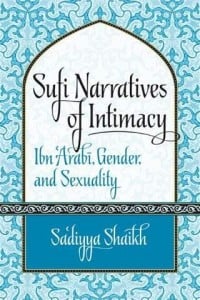
Research in the areas of Islamic and Gender Studies often overlap when it comes to the question of women in the Islamic spiritual tradition. What does Sufism offer to men and women seeking out paths of equality and egalitarianism? How does maleness or femaleness influence spirituality, and is the notion of the un-gendered soul a tenable one in the context of a hyper-gendered legal tradition? Is it possible to go beyond socially instituted gender norms, to more fundamental questions about what it means to be a human being, and use these notions to then create new gender discourses? These are some of the questions Dr Sa’diyya Shaikh, a Senior Lecturer at the University of Cape Town’s Religious Studies department, grapples with in her latest publication, Sufi Narratives of Intimacy: Ibn Arabi, Gender and Sexuality. She handles the complex spheres of gender and Sufism with the intellectual finesse and critical maturity required for such an endeavour, displaying an in-depth working knowledge of the tradition.

Shaikh provides a unique and ground-breaking reading of the works of thirteenth century Andalusian Arab Muslim scholar, Sufi saint and philosopher Muḥyiddin Muḥammad ibn ‘Alī ibn Muḥammad ibn ‘Arabi (d.1240). Shaikh reads his work through a feminist lens by which she focuses on the question of gendered roles and functionalities in the Islamic tradition – going beyond the legal trappings into more ontological questions that she feels must be answered in order to reshape and redefine contemporary understandings of Islam and gender justice. [Read more...]

Ramadan: The Mother and Activist

Ramadan for me personally has always been a month of compassion, congregation and contemplation. However, last year in Ramadan, my entire days and nights revolved around caring for my then-one-month-old twins.

Halaqa

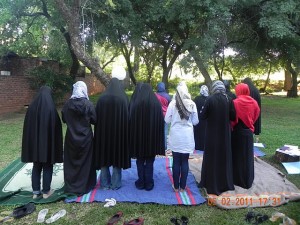
Our women’s halaqa praying together.

Time passed by like a whirlwind; I have vague memories of feeding, burping, changing, and rocking babies to sleep – all the while trying to maintain some semblance of spirituality. Just one Ramadan before that, I had all the time in the world to pray, attend congregational prayers and prepare scrumptious meals for Iftar gatherings. The Ramadan the twins were born, I went to the mosque once. This year, the girls turned one, and it is a constant juggling act – trying to fit in prayers, meals, quality time with God and visits to the mosque (which are a must for me – there is nothing that lifts my spirits more than praying in unison with my brothers and sisters at the masjid).

I chose not to fast last year due to breastfeeding and post-birth demands on my body – which was in itself an experience. I had never gone through an entire Ramadan without fasting, and I realized how the act itself lends to the atmosphere of the month – I felt excluded from the spiritual and festive moods of Iftar, Suhoor and taraweeh because I was not fasting. This year, I am still nursing but have been able to fast – it hasn’t been easy, with two other beings dependant on my body for part of their nutrition – but I’ve found that drinking copious amounts of liquids from Iftar until Suhoor, and eating the right foods, helps! So far, we’ve had at least one baby awake at each Suhoor.

Johannesburg's new Turkish mosque

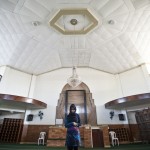
Johannesburg’s new Turkish mosque: a face of a changing Muslim community. Photo credit: Nazim Jawoodeen.

It’s quite unpredictable, not knowing if they’re going to sleep through or not, trying to eat before the time is up and then getting the baby back to sleep without missing fajr! Having said that, the month is so brimming with mercy that these trials seem small in comparison to the blessings that abound: the atmosphere of generosity and celebration, the sharing of food and the fervour at the mosques, the heightened sense of God-consciousness that fasting provides, and the discipline to do extra prayers.

Ramadan in South Africa, and in Johannesburg particularly, is different from both other Muslim-minority countries and Muslim-majority countries. It is generally taken more seriously and not as festive as I’ve experienced in other countries, and also is more of a family affair than a community one, because traditionally, only men went to the mosques for Iftar, returning home for dinner with the rest of the family then going back to the mosque for Taraweeh. Another common practice is for groups of men who have memorized the Qur’an to gather at an individual’s home for night prayers, rather than at the mosque. This has changed somewhat over the last decade with the influx of immigrants and refugees, and the establishment of non-Indian mosques, as well as growing awareness amongst women about their rights to sacred space. [Read more...]

In the Name of Honour: The Free Aafia Siddiqui Campaign in South Africa

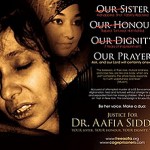
Earlier this year, South African Muslim media was abuzz with the story of Dr. Aafia Siddiqui, an American-educated Pakistani cognitive neuroscientist who was convicted and sentenced to 86 years in prison for assault with intent to murder her U.S. interrogators in Afghanistan. The media campaign served to raise awareness about Siddiqui’s alleged abuse at the hands of the U.S justice system, and to assert her complete innocence. Her story is a difficult one, spanning the vastness of two continents and the complexity of terrorism politics in both of these. This post is not meant to cover the Siddiqui case, or to make any judgement claims as to her innocence or guilt. I would like to add that I sincerely advocate for justice for Siddiqui, who has no doubt suffered tremendously – whatever her political inclinations.

The focus of this post is the treatment of Siddiqui’s case in recent South African Muslim media. I am often accused in my community of unduly and unnecessarily vilifying the Muslim media, so I must add a disclaimer – that pointing out discrepancies in the media’s treatment of Muslim women or issues pertaining to gender is not an attack on all the work of an organization, but meant to create dialogue on how Muslim women can be better represented. The groups I speak of articulate a certain kind of gendered ideology, and it is their right to propagate this discourse. I do, however feel that, living in the multicultural and vibrant democracy of South Africa, alternate expressions of Islam and Muslim women need to be put forth. [Read more...]

Book Review: Desperate in Dubai

Desperate in Dubai, a cheeky exposé novel based on the original blog written by Ameera al-Hakawati (a pseudonym), revolves around the lives of four women who live, love, and labour in the sparkling Gulf city of Dubai.

Cover of Desperate in Dubai.

I recently had the chance to catch up with al-Hakawati in Dubai, to chat about her book, her faith, and the politics of anonymous writing as a Muslim woman.

British-born Al-Hakawati says she knew she had to write a book about Dubai the moment she arrived in what she describes as the “craziness and diversity” of the city. She initially chose to write anonymously due to the salacious nature of the book, particularly as she would be writing about Arab and Muslim women in an Arab country. Later on, her anonymity developed into more than a tactic to avoid censorship, and became what she calls a “liberating tool,” allowing her to write at leisure about taboo subjects concerning Muslim women, such as sexuality and extra-marital relationships. She was able to explore the lives of Muslim women, without worrying about what people thought about her as a Muslimah. She has faced some hiccups along the way, with her blog being banned and her books being temporarily taken off the shelves in Dubai.

Al-Hakawati felt it important to delve into aspects of women’s lives that are normally brushed under the carpet – issues like falling in love, dating, secret marriages, getting pregnant, experimenting with drugs, alcohol and men; things which do happen in reality but which Muslims like to believe do not. She writes, not to condone these actions, but to highlight the challenges facing Muslim women in the real world. She did receive a lot of criticism on the blog for writing about Muslims doing “sinful things,” but felt the issues too important to be deterred.

I read the book on the flight home from Dubai, and although it was light reading and at times simplistic or exaggerated, I did enjoy that it cast light upon aspects of Muslim women’s lives that are normally viewed through Orientalist lenses. Fashion, hijab, relationships, sex, and marriage are intertwined and feature throughout the book, and are written in as a normal part of the women’s lives. As a Muslim and a woman herself, al-Hakawati’s voice certainly lends authenticity to the narrative, which revolves around four main female characters, three of whom are Muslim.

Of the three Muslim characters in the book, one is Arab-Emirati, another of Moroccan descent, and the third a British-born Indian. Al-Hakawati chose these identities as a representation of the diversity of Muslim women, whom she feels are often lumped into the same category despite varying cultural, linguistic and national differences. The fourth character is a Lebanese Christian. [Read more...]

South African Muslimahs Speak about Headscarves at Airports

Over the Christmas and New Year season, Quraysha Ismail Sooliman, South African Muslimah scholar and lecturer in Political Studies at the University of Pretoria, was on her way out of the country with her family. At Oliver Tambo International Airport in Johannesburg, she and her daughters were stopped at passport control, and one of her daughters was asked to remove her headscarf in order to be properly identified. The same happened upon their return, when her second daughter was asked the same, both times in an abrupt and condescending tone.

Shakira Sooliman. Image via Mail & Guardian.

Sooliman, who happens to be an outspoken gender-activist, decided to write to South African Home Affairs, stating,

“We are South African citizens and highly offended by this attitude. If rights are being violated due to ignorance by home affairs officials then such behaviour needs to be corrected. We do not wear face veils so the demand to have the head covering removed violates constitutional rights.”

She further stated, “I am raising this issue because I do not want to see an escalation of ‘Islamophobia around hijab’ in our beautiful country.”

The reason I discuss this story here is two-fold. Firstly, the issue appeared in the media (both print and radio), with other Muslim women coming forward to report being handled in the same way. Secondly, the way in which Muslim women themselves took this story up, using the mainstream South African media to voice their concerns, is representative of their emerging voice in broader society.

One of the first to report on this story was the Mail & Guardian. Fatima Asmal-Motala, freelance journalist and Muslimah activist, who herself experienced discrimination for wearing a headscarf when applying for a passport, reported for the paper.  Her story included a detailed interview with Sooliman, as well another woman who was asked to remove her headscarf, and a response from a Home Affairs representative. Her story allowed the women to speak for themselves, explaining why the incidents upset them to the extent it did – particularly in the very tolerant South African context, where all forms of religion and dress are usually respected. The headline however, “Headscarves Raise Hackles” left much to be desired, giving the impression the women were kicking up a fuss for petty reasons.

Sooliman and Asmal-Motala were also interviewed on the national radio station SAfm, where they posed important questions directly to Home Affairs, and other Muslim women were given the chance to call in to report similar experiences. Their interview brought to the mainstream society’s attention the independent voices of Muslim women, in protesting about matters they believe to be an infringement of their religious rights.

Other media outlets like Sunday Times and IOL also reported on the story, making sure to quote Sooliman, who always maintained that “We do not want special favours but want to be treated with dignity and respect,” and asked the pressing questions, “Is there religious freedom in South Africa or is it also going to be eroded? Is there legislation that states that Muslim women cannot submit photographs for passports or ID documents with a headscarf?” [Read more...]

The Fight over South Africa’s Muslim Marriage Bill Rages on

Recently, the South African Justice Ministry opened the latest draft of the Muslim Marriages Bill (MMB) up for public comment and called for submissions on the bill’s contents.

Along with this came the media furor over the Muslim community’s reaction to the idea of the government recognizing Muslim marriages as Muslim marriages and providing legislation for Muslims according to both constitutional gender equality and the dynamism of fiqh. The point of this post is not to assess the Shar’iah compliance of the bill, but to highlight the voices in the media that have spoken out against blatant dismissal of the bill and called for critical engagement, especially since most of the issues deal with gender equality and women’s rights within marriages.

Why, you may be wondering, would some Muslims be averse to a bill which would, if passed, help against the abuse and violation of women’s rights in marriages, with measures such the setting of a minimum marriage age to the requirement of the court’s permission to enter into a polygamous union?

The answer is that some Muslim organizations have been using emotional incitement tactics to stir up the ignorant amongst the Muslim community with campaigns such as “MMB is anti-Shariah” or “Don’t support the Kufr MMB.”

[Read more...]